
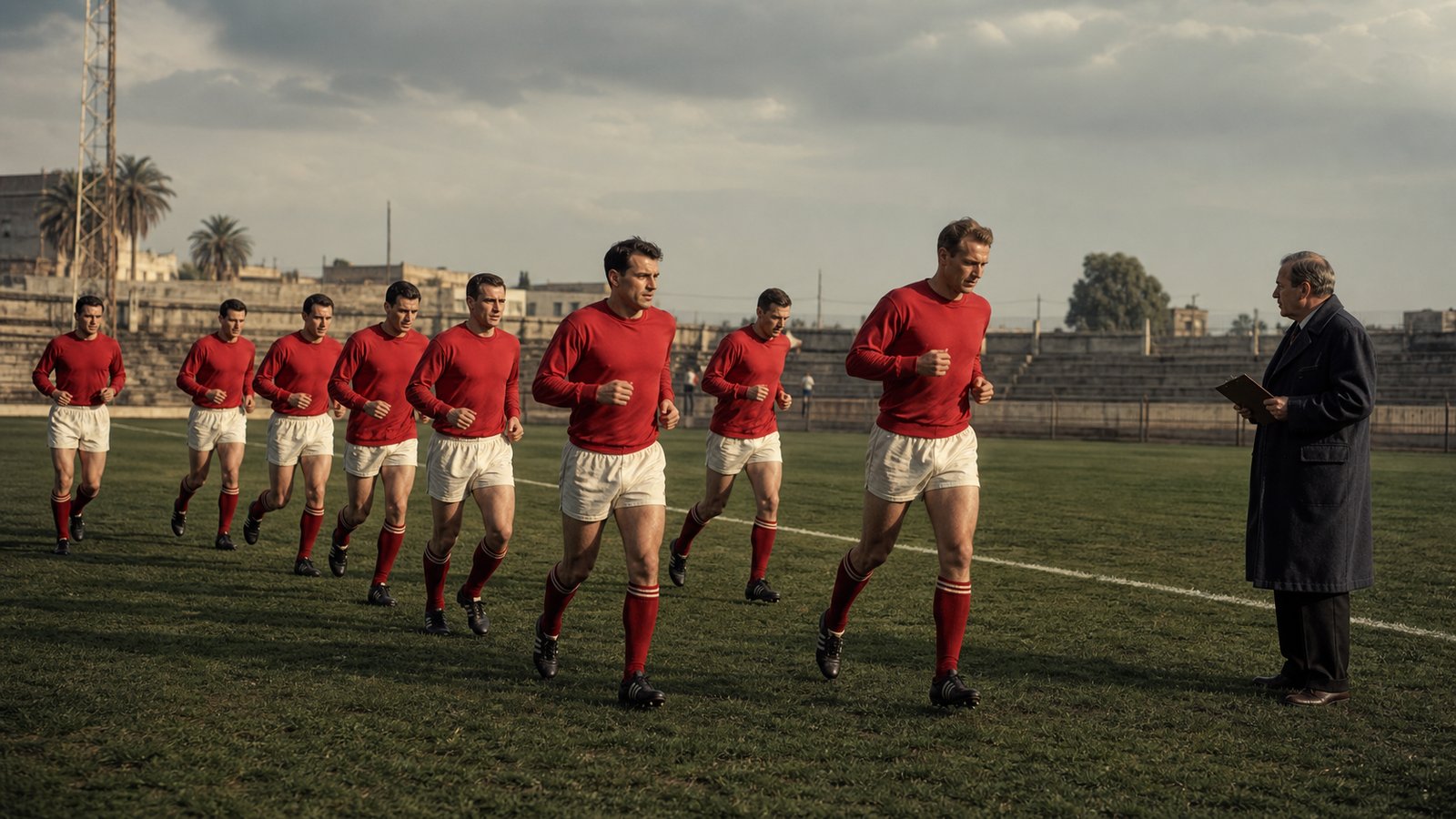
Wales arrived in Tel Aviv in January 1958 without a football.
The kit had crossed the Mediterranean, but the balls had not. Jimmy Murphy could only send his players running around the training pitch before a World Cup play-off that had not existed when the original qualifying groups were drawn. Each man was eventually given a crate of Jaffa oranges by the hosts. At a British embassy reception, bunches of leeks hung as a reminder of home. The preparation mixed courtesy, comedy and an enormous opportunity.
Wales had already failed to win their European group. Israel had reached the end of another qualifying route without playing a match. A chain of withdrawals pushed FIFA toward an improvised solution, and even then Wales were not the first team selected.
The forgotten balls are the perfect object for this journey. Almost nothing about it followed the expected itinerary.
Wales Had Already Finished Second
Murphy possessed a gifted generation. John Charles could dominate as a centre-forward or centre-half. Ivor Allchurch supplied craft from inside forward, while Cliff Jones brought speed from the wing. Wales began Group 4 by beating Czechoslovakia 1–0 in Cardiff on 1 May 1957, a result that made Sweden seem reachable.
The road then narrowed quickly. Wales led East Germany before a crowd reported by the BBC account as 110,000, but lost 2–1 in Leipzig. Illness and injuries left only ten players available for the next match in Prague. Ray Daniel had to be summoned from holiday. He arrived without his own boots, played in a new pair that raised blisters, and scored an own goal in a 2–0 defeat by Czechoslovakia.
The contrast around that Prague trip was sharp. The players earned their living as professionals, yet the national side still travelled with the habits of a modest association. Football historian Phil Stead described an away party carrying almost as many councillors as players. When bodies became unavailable, the response was late rather than prepared. Daniel’s borrowed opportunity therefore began with a journey from holiday and a hurried purchase, not a planned reserve stepping into familiar equipment.
A 4–1 victory over East Germany in the last scheduled match repaired the goal difference, not the table. Czechoslovakia finished with six points; Wales had four. Under the qualifying format, second place meant elimination.
The squad dispersed believing its chance had gone. Elsewhere, however, another section of the competition was becoming impossible to complete.
Four Withdrawals Left Israel Without a Match
Israel’s route sat inside the combined African and Asian zone. Turkey withdrew at the first stage because it objected to being placed there rather than in Europe. Israel advanced without kicking a ball and was paired with Indonesia.
Indonesia wanted the tie played on neutral ground rather than in Israel. When that request was not accepted, it withdrew. On the other side of the bracket, Egypt declined to meet Sudan amid the political hostility that followed the Suez Crisis. Sudan then refused to face Israel. The sequence left Israel as the zone’s winner by default.
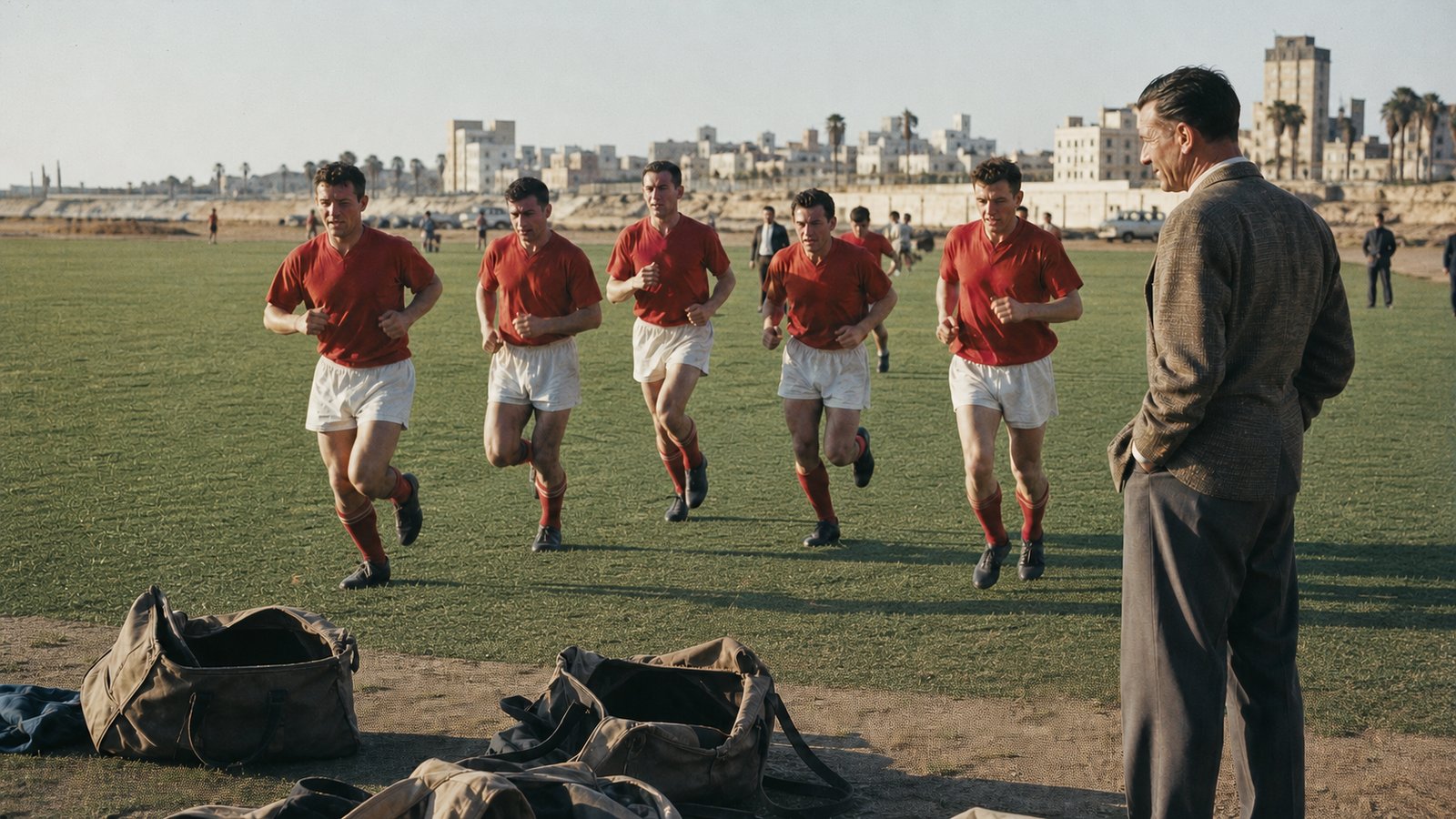
FIFA faced a problem larger than an empty fixture list. Its rule was that no country apart from the host and reigning champion should reach the finals without playing. Sweden already had the host’s place and West Germany held the champion’s exemption. Israel therefore needed an opponent, even though every scheduled rival had disappeared.
The answer was to reopen the European competition. Nine group runners-up became eligible for a special home-and-away play-off. Wales, recently eliminated on the field, was suddenly back inside the draw.
The Draw Reached Wales on Its Second Try
Belgium came out first. The Belgian association declined the invitation. A second selection produced Wales, and Murphy’s side accepted. The result was a contest assembled from withdrawals in two regions, a FIFA requirement and two turns of a draw.
That history can make the football itself sound incidental. It was not. Wales still had to travel to Ramat Gan on 15 January and beat a team that had waited through the whole qualifying cycle. The missing balls restricted Murphy’s session to fitness work, but the welcome was warm. Cliff Jones later remembered the crates of oranges given to the players. The embassy dressed itself with leeks for its visitors.
Once the match began, the oddity of the invitation gave way to a controlled away performance. Allchurch scored, Dave Bowen added another, and Wales left with a 2–0 lead. They had converted an administrative reprieve into a practical advantage: Israel now needed at least two goals in Cardiff merely to level the aggregate score.

The return leg took place three weeks later. About 38,000 people packed Ninian Park on 5 February. Israel’s players explored Cardiff, including a cinema visit on Queen Street, while Wales prepared to protect the opening result without surrendering the initiative.
Cardiff Put Murphy Somewhere Else
Allchurch scored for the second time in the tie. Jones supplied the other goal, and another 2–0 victory completed a 4–0 aggregate passage to Sweden. Wales had played the two matches FIFA required and won both without conceding.
The date gave the result a second, far more serious consequence. Murphy was not only the Wales manager. He was Matt Busby’s assistant at Manchester United and a central coach of the young side remembered as the Busby Babes. His duty at Ninian Park kept him away from United’s European Cup trip to Red Star Belgrade.
The next day, 6 February, United’s aircraft crashed while attempting to take off from Munich after refuelling. Twenty-three people died. Murphy learned that the club he served had been torn apart just after completing the Welsh qualification he had pursued.
He now carried two jobs that would have overwhelmed most coaches separately. At United, with Busby gravely injured, Murphy helped hold together a club in mourning and guided a makeshift side to the FA Cup final. At the same time, he had four months to prepare Wales for its first World Cup.
The play-off did not simply put a country in a tournament. It placed Murphy in Cardiff on one night and away from a doomed journey on the next. The same fixture that opened Wales’s summer altered the course of his life.
Sweden Began With Three Draws
Wales reached the finals as an accidental invitee but did not perform like an accidental participant. Their group contained Hungary, host nation Sweden and Mexico. They drew 1–1 with Hungary after John Charles answered an early goal by József Bozsik. Allchurch put Wales ahead against Mexico before a late equaliser made it 1–1. A goalless match with Sweden completed three draws.
The format demanded another play-off, this time against Hungary for a quarter-final place. Lajos Tichy scored first, but Allchurch levelled and Terry Medwin made it 2–1. A side that had needed an extra route merely to qualify now survived an extra match inside the finals.
Brazil waited in the last eight. Charles was unavailable after being hurt against Hungary, removing Wales’s most imposing player. For 65 minutes the match remained scoreless. Then 17-year-old Pelé controlled the ball with his back to goal, lifted it into his path and scored the only goal. He would collect five more in the semi-final and final as Brazil won the cup.
Wales left after a 1–0 defeat, having made the eventual champions work longer for a goal than any other opponent at the tournament. The country would wait 64 years to appear at another World Cup finals.
The qualification is sometimes compressed into good fortune, as if a draw alone carried Wales to Sweden. The records show a longer journey. Wales first lost its ordinary chance. Turkey, Indonesia, Egypt and Sudan removed themselves from another route for different political reasons. Belgium declined the first European invitation. Only then did Wales receive two matches, both of which it won 2–0.
At the beginning stood an empty training field and luggage missing its most obvious item. At the end stood a World Cup quarter-finalist. Between them were four withdrawals, a second draw, two Allchurch goals and Murphy’s decision to be exactly where Wales needed him on 5 February 1958.
Sources
Football Association of Wales; BBC Sport Wales; Rec.Sport.Soccer Statistics Foundation.