
For a country that became a model of football organization, West Germany entered the national professional league era surprisingly late. England had a national league in the nineteenth century. Italy and Spain built powerful national competitions long before television turned club football into a global product. West Germany, by contrast, spent the postwar years with regional Oberliga structures feeding championship rounds. The system produced great clubs, fierce local rivalries, and the 1954 World Cup miracle, but it also left the domestic game fragmented. The Bundesliga, launched in 1963, was not just a new fixture list. It was the moment German football accepted that modern elite competition needed national concentration, professional standards, and a league table that could be understood every week from Hamburg to Munich.
Regional Pride Was Not Enough Anymore
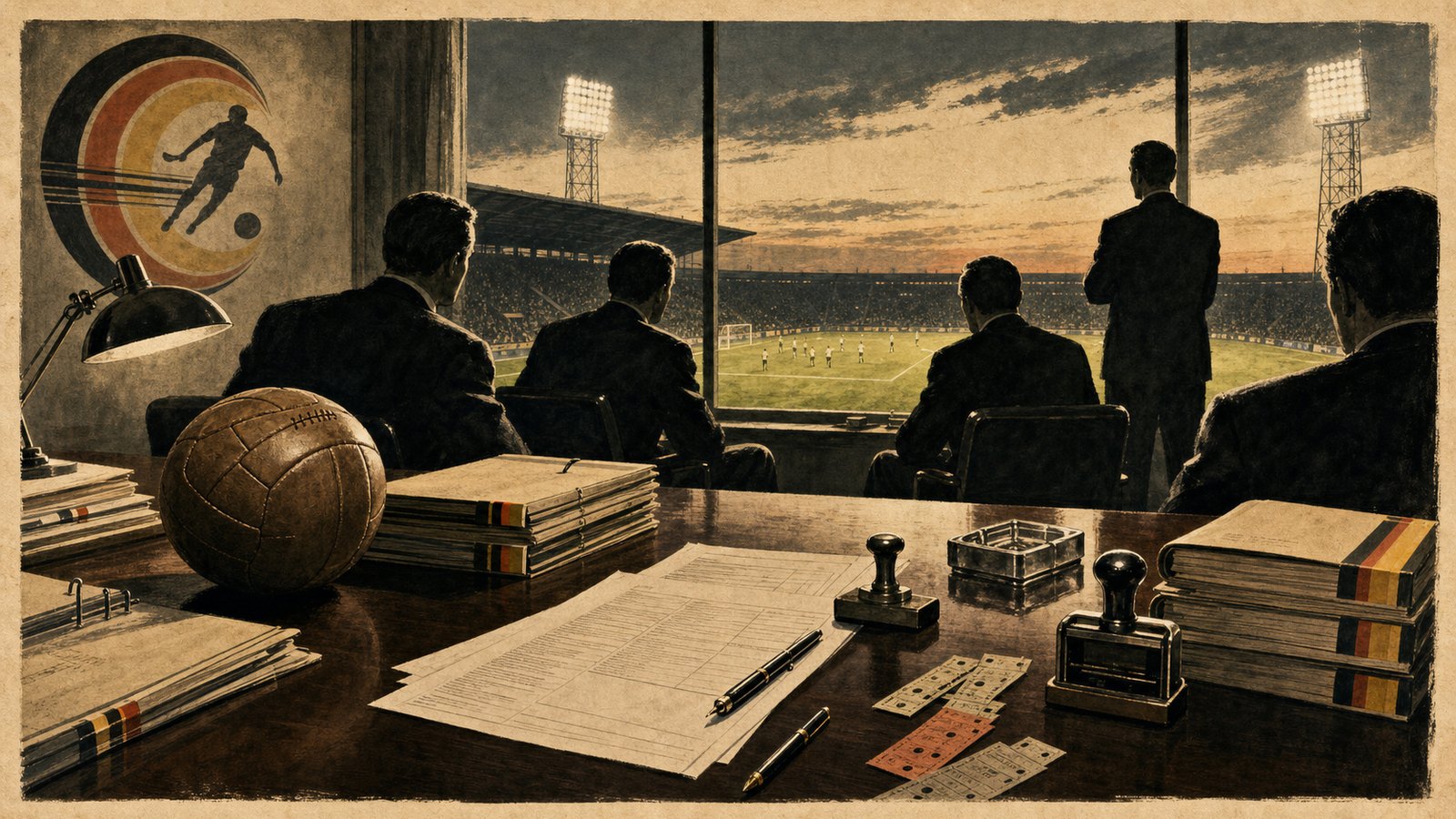
The older Oberliga map made emotional sense. Clubs represented regions with distinct football cultures, and postwar reconstruction gave local identity real force. But the format also meant that the best teams did not face each other through a full national season. A club could dominate locally, then discover in the championship round that another region had been operating at a different speed. For supporters, that created drama. For administrators, it created a problem: German football wanted international credibility and consistent elite development, but its domestic calendar still looked partial.
The pressure increased after West Germany’s 1962 World Cup disappointment in Chile. The national team had won in 1954, yet the sport’s administrators could see that rivals were becoming more professional and more systematic. Training, scouting, player compensation, and tactical standards could not be left entirely to regional inertia. A national league offered regular high-level matches, more predictable revenue, and a cleaner pathway for identifying the best players.
The decision was not simply sporting. It involved licensing, geography, stadium capacity, financial guarantees, and political compromise inside the German Football Association. Not every famous club could be included. The first Bundesliga season had sixteen clubs, and selection itself became part of the league’s founding mythology.
Professionalism Had to Be Controlled
German football’s relationship with professionalism was cautious. The word carried anxieties about money, club solvency, and the loss of amateur ideals. The Bundesliga did not instantly become the free-spending marketplace later associated with European elite football. It created a controlled professional structure. Clubs needed licenses. Player pay and club finances were monitored. The message was clear: professionalism was necessary, but chaos was not.
That caution shaped the league’s character. German football developed a reputation for strong attendance, member influence, financial restraint, and stadium culture. Those traits did not all appear fully formed in 1963, but the Bundesliga’s birth gave them a national stage. The league could market competition while still presenting itself as an organized public institution rather than a private circus.
The tension never disappeared. Ambitious clubs wanted more revenue and better players. Smaller clubs feared being left behind. Supporters wanted local authenticity but also wanted their teams to compete with Italy, Spain, and England. The Bundesliga became the arena where those contradictions could be managed openly.
A National Table Changed the Meaning of Success
A single league table sounds mundane because modern fans take it for granted. In 1963, it changed how German clubs understood ambition. There was no longer a regional cushion. Week after week, results could be compared directly. Travel demands grew. Squad depth mattered differently. A cold away match in the north and a pressure game in the Ruhr now belonged to the same title race. Consistency became a national measurement rather than a local boast.
The first champions, 1. FC Koln, embodied the new order. They were already a serious club, but the title gave the league an immediate example of what a national champion looked like: organized, visible, and measurable across a whole season. Borussia Dortmund, Hamburger SV, Eintracht Frankfurt, Werder Bremen, Schalke, and others helped turn the competition into a recognizable map of postwar German football power.
The league also changed relegation’s emotional weight. Dropping out was no longer a regional setback; it meant losing a place in the national shop window. Promotion became a route into modernity, not just into a harder division. That fear and aspiration gave the Bundesliga a pressure rhythm that regional football could not duplicate.
The National Team Benefited From Weekly Concentration
The Bundesliga’s effect on the West German national team was not mechanical, but it mattered. A national league made it easier to compare players under similar competitive conditions. Coaches and selectors could watch high-pressure matches more regularly. Players faced stronger opponents more often. Tactical and physical standards became less uneven. By the time West Germany won the 1972 European Championship and the 1974 World Cup, the league had given the national team a deeper, more coherent domestic base.
That does not mean the Bundesliga alone created Franz Beckenbauer, Gerd Muller, or the Bayern Munich generation. Exceptional players still came from clubs, coaches, neighborhoods, and personal genius. But the national league amplified them. It placed elite players in weekly contests that sharpened habits and produced a more visible hierarchy. It also allowed successful club models to influence the national conversation faster.
The European Cup results of Bayern and Borussia Monchengladbach in the 1970s made the point internationally. German clubs were no longer regional champions stepping briefly onto a bigger stage. They were products of a national system that could sustain excellence.
Late Arrival Became an Advantage
The Bundesliga’s lateness is often treated as backwardness, but it also allowed German football to design with caution. The league arrived after other countries had already exposed some risks of professionalism: reckless spending, uneven competition, and administrative drift. West Germany’s answer was not perfect, yet it linked elite ambition to licensing and institutional oversight. That combination became one reason German football could later claim a different identity inside the European market.
The league still evolved into a commercial product. Television money, sponsorship, stadium redevelopment, and global stars all changed it. But the founding structure left a memory of football as a system, not just a spectacle. The 1963 launch created the platform on which Bayern could become a superclub, on which promoted outsiders could dream, and on which supporters could argue fiercely about money without pretending money was new.
The Bundesliga did not invent German football culture. It organized it into a machine powerful enough to travel.
Its late arrival also explains why the league could feel both traditional and modern at once. The terraces, regional accents, and supporter identities were already there, but the weekly national schedule gave them a sharper competitive language. A Saturday result in Bremen could matter immediately to a title race in Cologne or Munich. That shared rhythm helped turn scattered football loyalties into one recognizable national conversation.
The lesson of 1963 is that a league format is never just administration. It decides who meets whom, how often pressure arrives, where money flows, and which clubs become visible to children choosing a team. Germany’s professional revolution came late, but once it came, it gave the country a durable football grammar. The clubs that adapted fastest learned to treat scouting, training, ticketing, and supporter expectation as connected parts of the same national machine. That is why the Bundesliga’s founding still feels like a governance story as much as a sporting one, and a decisive one.
Sources
- German Football Association historical material on the Bundesliga launch
- Bundesliga official history
- Ulrich Hesse, Tor! The Story of German Football
- David Goldblatt, The Ball Is Round
- Contemporary reporting on the 1963-64 Bundesliga season