
Benfica’s second European Cup did not look like a tidy handover from one empire to another. It looked like a match being pulled out of the old order by speed, nerve, and a manager who understood that Real Madrid’s history could not defend the whole pitch at once.
The score in Amsterdam in 1962 still sounds almost unreal: Benfica 5, Real Madrid 3. Ferenc Puskás scored a first-half hat trick, the sort of performance that should have made the night belong to the Spanish dynasty. Alfredo Di Stéfano was still on the field. The white shirts still carried the memory of five straight European Cups. Yet by full time the trophy stayed with Lisbon, and the final had become something larger than another famous shootout. It showed how a club from Portugal could survive the aura of Madrid, absorb a tactical shock, and answer with a younger, faster, more direct European machine.
The dynasty Benfica had to beat twice
Benfica did not arrive in 1962 as a random challenger. The club had already won the 1961 European Cup, beating Barcelona 3-2 in Bern and ending Real Madrid’s run of five consecutive titles. That mattered because the 1962 final was not just Benfica chasing a first miracle. It was Benfica trying to prove that the previous year had not been a one-off interruption.
Madrid still represented the tournament’s original grammar. Between 1956 and 1960, Real had made the European Cup feel like its private property. The names were not only names; they were a psychological field position. Di Stéfano meant control between lines. Puskás meant a left foot that could turn half chances into punishment. Francisco Gento meant a winger who could stretch a match until it tore. Opponents did not merely play Madrid. They played the accumulated memory of what Madrid usually did to nights like this.
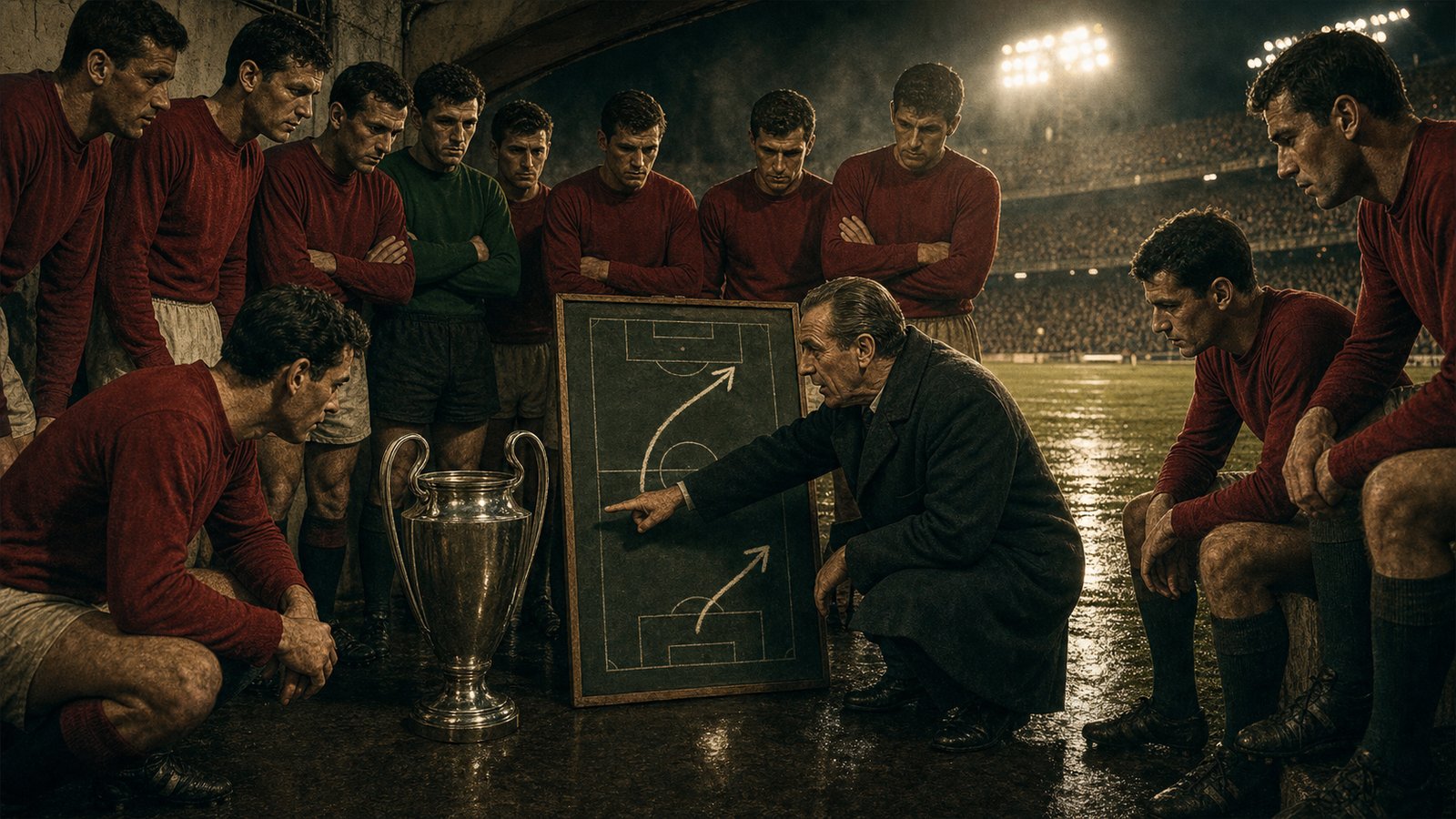
Benfica’s task was therefore double. They had to win the tactical contest in front of them, but also refuse the old European hierarchy that said the Spanish giant would eventually make the evening obey. That refusal began before the final, in the way Béla Guttmann had rebuilt Benfica’s confidence and movement after arriving in Lisbon in 1959. The team was not designed to admire Madrid’s aura. It was designed to run through the moments when aura created hesitation.
Guttmann’s Benfica was a transition side before the word became fashionable
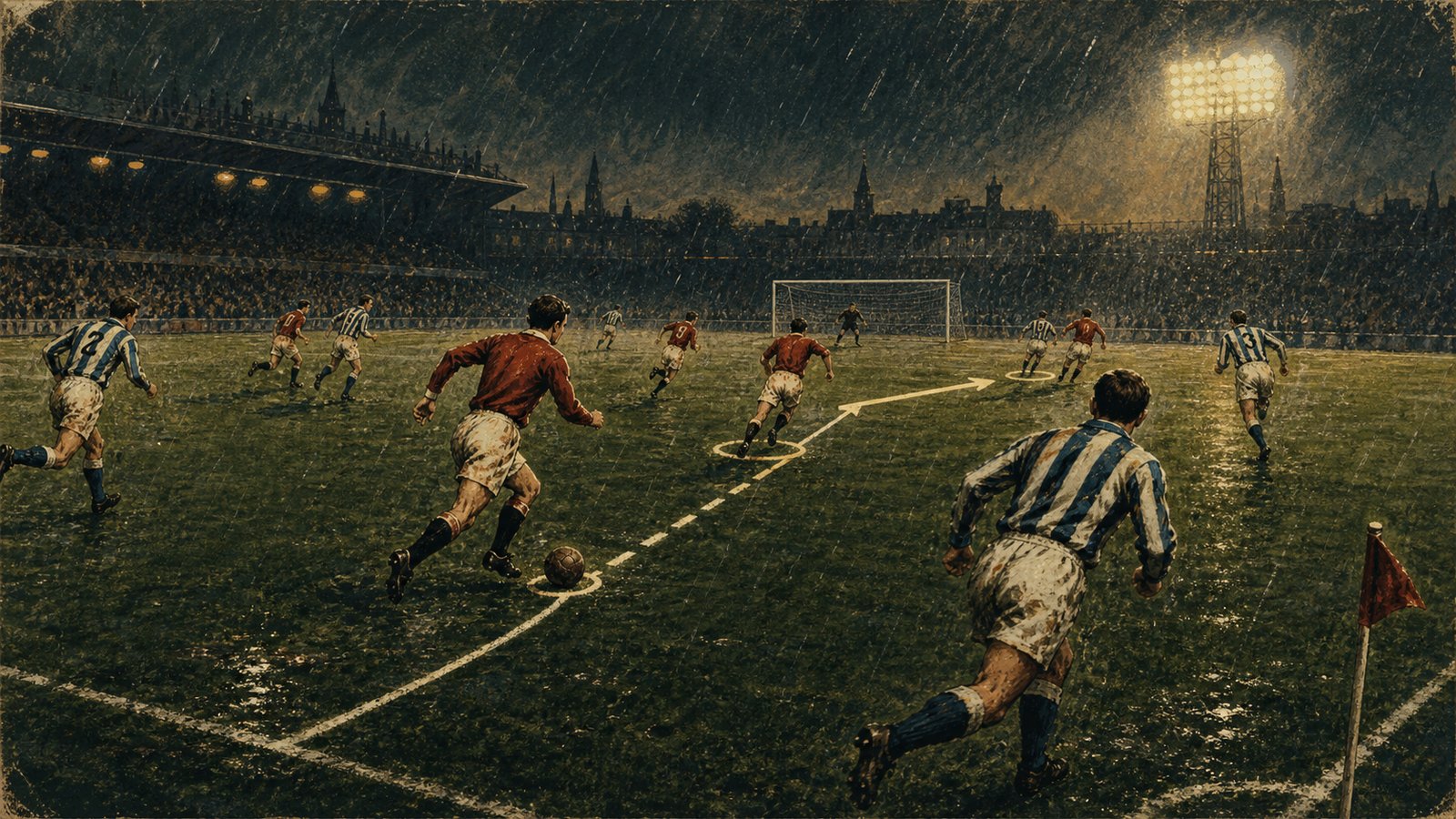
Guttmann is often remembered through the curse story that followed his exit, but the football was more interesting than the legend. His Benfica were not a static collection of stars arranged around a single genius. They were a side that could defend with numbers, move the ball quickly into space, and turn recovery into attack before an opponent had fully reset. In modern language, they were dangerous in transition. In early 1960s language, they were simply too quick and too brave to treat possession as a ceremony.
The structure gave room to experience and explosion at the same time. Mário Coluna, the captain, offered the authority and passing range that stopped the game becoming pure chaos. José Águas gave the attack a penalty-box reference. António Simões provided youth and width. Eusébio, still at the start of his European legend, gave the side a different kind of threat: not just finishing, but acceleration, violence of shot, and the feeling that a defender’s half-yard mistake could become a goal before the crowd had processed it.
This blend is why the 1962 final should not be reduced to romance. Benfica were emotional, yes, and they were carried by Portuguese football’s rising belief. But they were also ruthlessly practical. If Madrid wanted the game to become a monument to its old champions, Benfica kept dragging it back into running, pressure, second balls, and the spaces behind defenders whose names were bigger than their legs now allowed.
Puskás made the old order look alive
For a while, Amsterdam seemed ready to crown Madrid’s past again. Puskás scored three times before half time. The first half had the cruel shape of a lesson: every loose moment near Benfica’s box seemed to find the Hungarian, and every finish seemed to remind the Portuguese side that European finals did not wait for nerves to settle. A hat trick in a final is usually enough to define the night. Against most opponents it would have been.
That is the trap in remembering the match as a simple Benfica masterpiece. It was not simple. Benfica were hit hard, and early enough that the final could have become a familiar Real Madrid story. When Puskás struck, Madrid were not only scoring goals; they were testing whether the younger champions would panic and abandon the mechanisms that had carried them there.
The key is that Benfica did not respond by becoming reckless. They did not turn the match into desperate long shots from every angle. They kept finding ways to attack the game’s weak points: faster support around the ball, better use of runners, and the courage to keep playing forward even after Madrid’s most decorated players had landed their punches. The comeback was dramatic because the scoreline was wild, but it was possible because Benfica’s system did not disappear under pressure.
Eusébio turned the final into a future-tense match
Eusébio’s two goals in the second half changed the emotional temperature of the final. They also changed its historical meaning. He was not yet the fully mythic figure that later World Cup audiences would see in 1966, but Amsterdam made it clear that European football had a new attacking reference point. His penalties and shooting were not delicate gestures. They were statements of force, clean technique, and self-belief delivered on the biggest club stage available.
What made Eusébio so dangerous for Madrid was not only the goals. It was the way his presence altered Benfica’s possible answers. If Madrid pushed, Benfica could threaten space. If Madrid retreated, Benfica had shooting power and runners to attack the box. If defenders hesitated, Eusébio had the first step and the strike to punish the gap. The final became a future-tense match because the most frightening player after half time was not one of Madrid’s imperial symbols. He was the young forward in red, carrying a different European map with him.
The win was also a Portuguese football argument
Benfica’s 1962 victory mattered beyond one club’s trophy cabinet. Portuguese football had produced great players before, but back-to-back European Cups gave the domestic game a different continental legitimacy. Lisbon was no longer a stop on the way to the real powers. For two seasons, the champion of Europe lived there.
The achievement also complicates the easy story that the European Cup’s early years were only about Real Madrid until the rest of the continent caught up later. Benfica were part of that catching-up process while Madrid’s giants were still standing in front of them. The final did not wait for Di Stéfano and Puskás to disappear. It forced their era to share the frame with Coluna, Águas, Simões, and Eusébio.
There was a social charge to that, too. Benfica’s rise gave Portuguese supporters a club that could look directly at the most glamorous names in Europe and not blink. In the stadium, that may have felt like noise, flags, and disbelief. In football terms, it was a shift in expectation. The European Cup was no longer only a contest of established imperial centers. It could be won by a side whose edge came from recruitment, coaching, momentum, and a willingness to play the final at a pace the old champion did not control.
The strange afterlife of a perfect peak
The bitter part is how quickly the perfect peak became a rupture. Guttmann left Benfica after the 1962 triumph, reportedly after a disagreement over a pay rise or bonus. The famous curse story, in which he supposedly said Benfica would not win another European trophy for a hundred years, has grown so large that it sometimes swallows the football. Benfica did lose later European finals, and the legend became irresistible because football loves a neat haunting.
But treating the story only as a curse misses the real warning. Great football machines are fragile because they depend on alignment: manager, board, dressing room, recruitment, timing, and belief. Benfica had that alignment for a brief, brilliant window. Once it broke, the club still had talent and tradition, but the exact chemistry that beat Madrid in Amsterdam could not simply be ordered back into existence.
That is why the 1962 final remains so powerful. It was not merely the night Benfica defeated Real Madrid 5-3. It was the night a team built around speed, transition, and fearless attacking refused to let Madrid’s dynasty write the last sentence. Puskás scored three, and still the future arrived in red. Guttmann’s side did not just win a final. It showed that European power could move, and that once it moved, even the most decorated old empire had to chase.
Sources
- UEFA, 1962 European Cup final archive
- UEFA, Benfica club competition history
- Encyclopaedia Britannica, Eusébio biography
- FIFA Museum, Eusébio and Portuguese football history
- RSSSF, European Cup 1961-62 results