
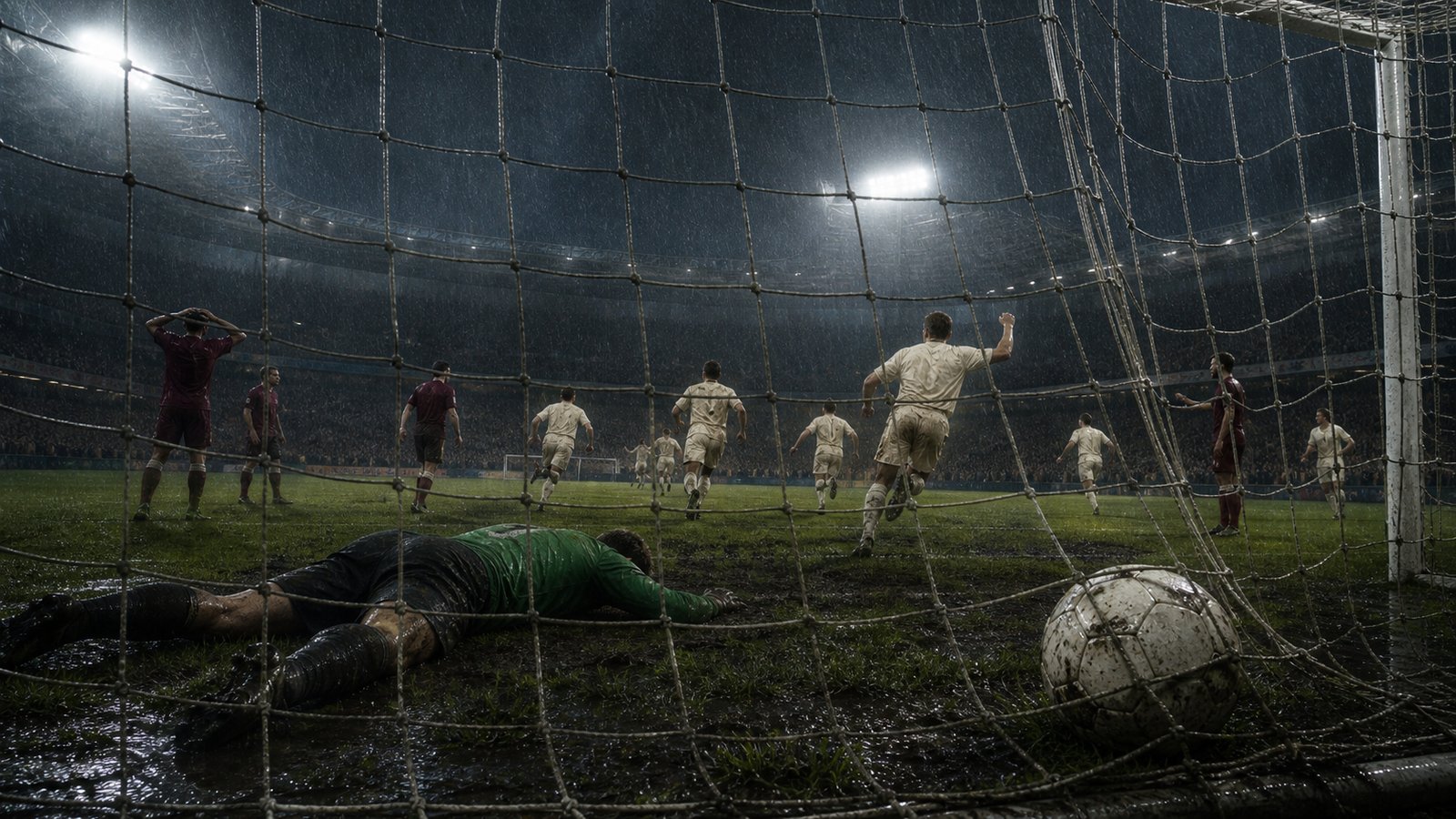
At 9:55 on a Sunday night at Wembley, Oliver Bierhoff swung his left foot at a loose ball and changed the emotional grammar of extra time. Germany and the Czech Republic had been level in the Euro 1996 final. Under the new rule, however, there would be no restart after his shot squirmed beyond Petr Kouba. No reply, no remaining minutes, no second act: the referee pointed towards the centre only long enough to confirm that the match was over.
Football wanted extra time to be more attacking. Its answer was brutally simple: the first team to score would win immediately. The label “golden goal” sounded celebratory, but its deepest effect was psychological. A single mistake no longer cost merely a goal; it removed the future from the match.
FIFA Changed the Name, Then the Stakes
Sudden-death football was not invented in the 1990s. Knockout matches had long produced local experiments, replays and improvised methods of separation. What changed was the governing bodies’ decision to formalise the idea for modern elite competition. FIFA introduced the concept into its rulemaking in 1993 under the less marketable phrase “sudden death.” The friendlier name came later. “Golden goal” promised a positive climax rather than an execution.
The intention seemed logical. Conventional extra time often deteriorated as fatigue rose and both teams calculated that penalties were safer than committing players forward. If the next goal ended the contest, administrators hoped, teams would chase it. The scorer had not simply broken a tie; he had closed the event.
That distinction mattered because football normally protects the possibility of response. A team conceding in the 91st minute of a 120-minute match can adjust its shape, take risks and send defenders forward. Golden-goal football erased that basic bargain. The attacking incentive existed, but so did a new defensive terror: lose possession in the wrong channel and the competition could end before anyone reached the centre circle.
Bierhoff Gave the Rule Its Perfect Advertisement
The Euro 1996 final supplied the demonstration the rule’s advocates could hardly have scripted better. Patrik Berger put the Czech Republic ahead from the penalty spot in the 59th minute. Germany coach Berti Vogts then sent on Bierhoff, who equalised with a header in the 73rd. Five minutes into extra time, the substitute received Jürgen Klinsmann’s pass with his back to goal, turned and struck through a defender. Kouba got hands to the shot but could only deflect it inside his post.
German players sprinted away as champions while the Czech goalkeeper remained on the turf. The match had lasted only five extra-time minutes. UEFA’s history describes Bierhoff as the golden-goal hero of a tournament in which football had “come home.”
Yet Wembley also revealed the rule’s strange compression. Bierhoff’s shot was both a goal and a final whistle. A normal late winner produces a frantic interval in which one side protects and the other gambles. Here, celebration arrived without the defensive siege that usually validates it. The spectacle gained an unforgettable instant but lost the answer that might have followed.
Blanc Made a World Cup Match Vanish
Two years later, the World Cup gave the experiment another landmark. France met Paraguay in Lens in the round of 16. Paraguay goalkeeper José Luis Chilavert and a deep, disciplined defence kept the hosts scoreless for almost two hours. Aimé Jacquet used all three permitted substitutes, including David Trezeguet and Robert Pirès, while the possibility of penalties drew closer.
In the 114th minute, Youri Djorkaeff helped a ball into the area, Trezeguet cushioned it, and defender Laurent Blanc finished past Chilavert. It was the first golden goal in World Cup history. France’s players poured across the pitch; Paraguay’s resistance, built over 113 goalless minutes, ceased to matter in the instant the ball crossed the line. The hosts advanced 1–0 and eventually won the tournament.
Lens showed the rule at its most theatrical. A tense match really could vanish. It also complicated the claim that sudden death would guarantee attacking extra time. Paraguay had every reason to protect the draw because one French breakthrough meant immediate elimination. France had every reason to be careful because one counterattack would end a home World Cup campaign. The decisive move was thrilling, but much of the preceding caution was not an accident. It was a rational response to the rule.
The Attacking Cure Changed the Price of Risk
The golden goal treated caution as a problem of insufficient reward: make a goal more valuable and teams will seek it. Coaches experienced a different equation. The reward rose, but so did the punishment for losing control. Under ordinary extra time, conceding leaves minutes in which to recover. Under sudden death, the probability of recovery becomes zero. That can make the conservative choice more attractive, not less.
Every clearance could be the last action. Every set piece carried the possibility that one mistimed jump would end a season. A crowd reacted to each attack as a potential trapdoor. The rule intensified isolated moments while making teams more conscious of protecting space behind the ball.
There were glorious exceptions. Trezeguet’s left-footed volley against Italy in the Euro 2000 final remains one of the competition’s most vivid endings. Italy had led until Sylvain Wiltord equalised in stoppage time; in the 103rd minute, Robert Pirès reached the byline and pulled the ball back for Trezeguet. The finish was clean, immediate and final. At the 2002 World Cup, Senegal’s Henri Camara ended Sweden’s tournament with another golden goal, turning a tight round-of-16 match into a national landmark.
Those memories proved that the mechanism could produce ecstasy. They did not prove it consistently produced adventurous football. A rule can create spectacular endings while encouraging the behaviour it was designed to remove. Administrators had altered the value of scoring without fully accounting for the value teams place on staying alive.
The Silver Goal Could Not Rescue the Experiment
UEFA eventually tried a compromise. Under the “silver goal,” a team leading at the end of the first 15-minute period of extra time would win; a goal did not stop play immediately, so the opponent retained at least the rest of that half to respond. The format appeared at Euro 2004. Greece eliminated the Czech Republic in the semi-final when Traianos Dellas scored in first-half stoppage time, leaving no second period to play.
The compromise exposed how awkward the project had become. Ordinary extra time, golden goals and silver goals each gave a different answer to the same question: when was a lead decisive?
In February 2004, the International Football Association Board decided that both golden and silver goals would disappear after that summer’s competitions. Major knockout football returned to two complete 15-minute periods, followed by penalties if the score remained level. The golden goal’s elite life had been brief: long enough to decide European Championship and World Cup matches, but not long enough to become football’s natural language.
What Football Recovered Was the Right to Reply
The experiment is often remembered through its winners: Bierhoff wheeling away at Wembley, Blanc ending the resistance in Lens, Trezeguet’s volley flashing into the Rotterdam net. Those images deserve their place. Sudden death could turn one finish into an entire story.
Its removal restored something less spectacular but more fundamental. Football recovered a guaranteed span of time in which consequences could unfold. A goal in extra time could force a tactical transformation rather than terminate the contest. The leading side still had to defend its advantage. The trailing side still had permission to answer.
The golden goal tried to manufacture courage by making attack instantly conclusive. Instead, it demonstrated that risk is shaped as much by the cost of failure as by the reward for success. Its great moments were real, but so was the fear surrounding them. One touch could make a champion, and for a few strange years it could also make the rest of the match disappear.
Sources
UEFA European Championship archive; FIFA World Cup archive; International Football Association Board records; Los Angeles Times contemporary report.