
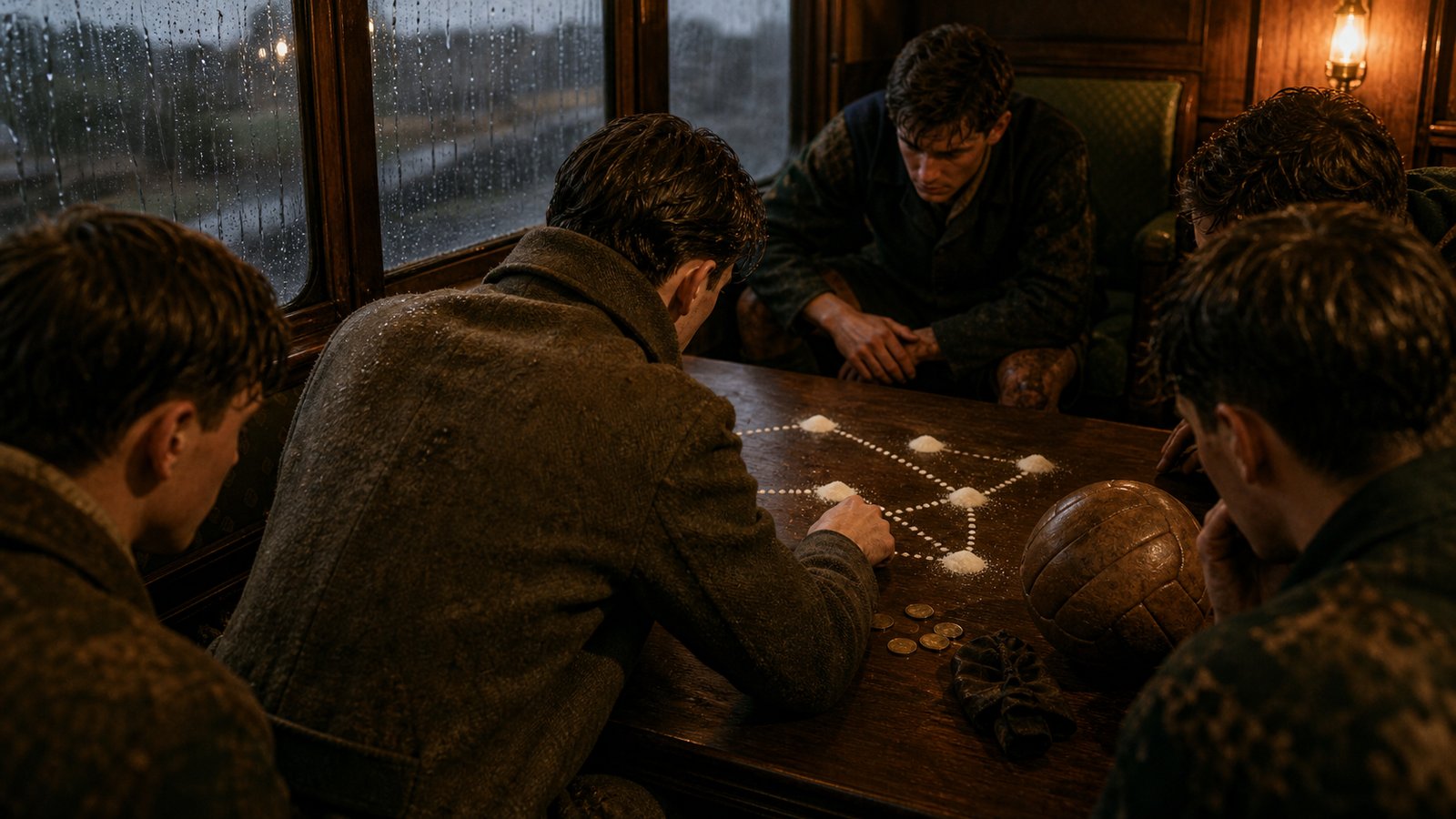
On the journey home from Bradford in February 1936, Arthur Rowe turned a railway compartment into a tactics room. Tottenham had won 5–2, and the players were enjoying a two-shilling victory bonus. Rowe spread sugar across a table and reconstructed the late goal that had delighted him: roughly seven passes, beginning near Tottenham’s own penalty area, before the ball reached the other end.
His question was more important than the result. What if such a move could be rehearsed rather than left to chance? Thirteen years passed before Rowe returned to Tottenham as manager. Within two seasons, the club climbed from England’s second tier to its first league championship. The name attached to the football was “push-and-run,” but its real subject was the next pass: deliver the ball quickly, keep moving, and make a teammate’s return angle appear before the defender could reset.
Sugar on a Table Preserved a Seven-Pass Goal
Rowe had been born in Tottenham in 1906 and made 201 appearances for Spurs between 1929 and 1939. The Bradford match belonged to his playing career, when the club was enduring another uneven Second Division season. According to the later account preserved by Spurs Odyssey, the decisive passage began inside Tottenham’s penalty area and contained about seven passes. Rowe used the sugar to show where each movement had gone.
The detail matters because it reveals how he saw football. A long passing move was not merely a beautiful accident. It was a repeatable relationship between the player on the ball and the teammate who immediately offered another angle. Rowe later compared the principle to childhood games against a kerb or wall: play the ball, change position, and receive it back without allowing the exchange to become still.
Tottenham’s 5–2 win at Bradford Park Avenue came on 22 February 1936. Fred Sargent scored twice, while Johnny Morrison, George Hunt and Willie Evans supplied the other goals. Nothing in that afternoon announced a future English champion. Spurs eventually finished fifth in the Second Division. Yet Rowe carried the geometry of the final move long after the score had disappeared from the weekly news.
Budapest Added Speed to a Tottenham Habit
After retiring as a player in 1939, Rowe travelled to Budapest through his friendship with Hungarian sports journalist László “Lotzi” Feleki. He worked with high-school and college students, with Feleki translating. Hungarian coaches watched the sessions, and the future great Ferenc Puskás was among the players said to have observed him. The outbreak of the Second World War brought Rowe back to England.
He also resisted the fantasy that tactics could be imposed without regard for the players. His later description of street football included an important condition: ideas had to fit the squad’s abilities and limitations. Push-and-run therefore required judgment as much as speed. A hurried pass to a marked teammate was not progress. The useful action was the quick pass followed by intelligent movement into free ground.
One New Player Joined an Existing Core
Tottenham appointed Rowe near the end of the 1948/49 season after another fifth-place finish in Division Two. He inherited Ted Ditchburn in goal, captain Ronnie Burgess, Bill Nicholson in midfield and gifted attackers Eddie Baily, Les Bennett, Len Duquemin, Les Medley and Sonny Walters. Rowe decided that the group needed only one major addition. He persuaded Alf Ramsey to join from Southampton.
The arrangement worked because the responsibilities connected. Ramsey supplied momentum from the back. Nicholson operated ahead of him. Burgess and Baily moved the ball through midfield, while the forwards exchanged positions and offered immediate returns. Baily later insisted that Rowe did not choreograph every pattern. The players already enjoyed quick passing, understood one another, and repeated changing-room phrases such as “Make it simple, make it quick.”
Rowe’s coaching gave that instinct a collective rule. Tottenham opened the 1949/50 campaign with one early home defeat to Blackburn, then went 22 league matches unbeaten from September into January. They stayed at the top for nine months, scored 81 goals and conceded 35. Both figures were the best in the division. Their nearest rival finished nine points behind.
Promotion Created a Public Appetite
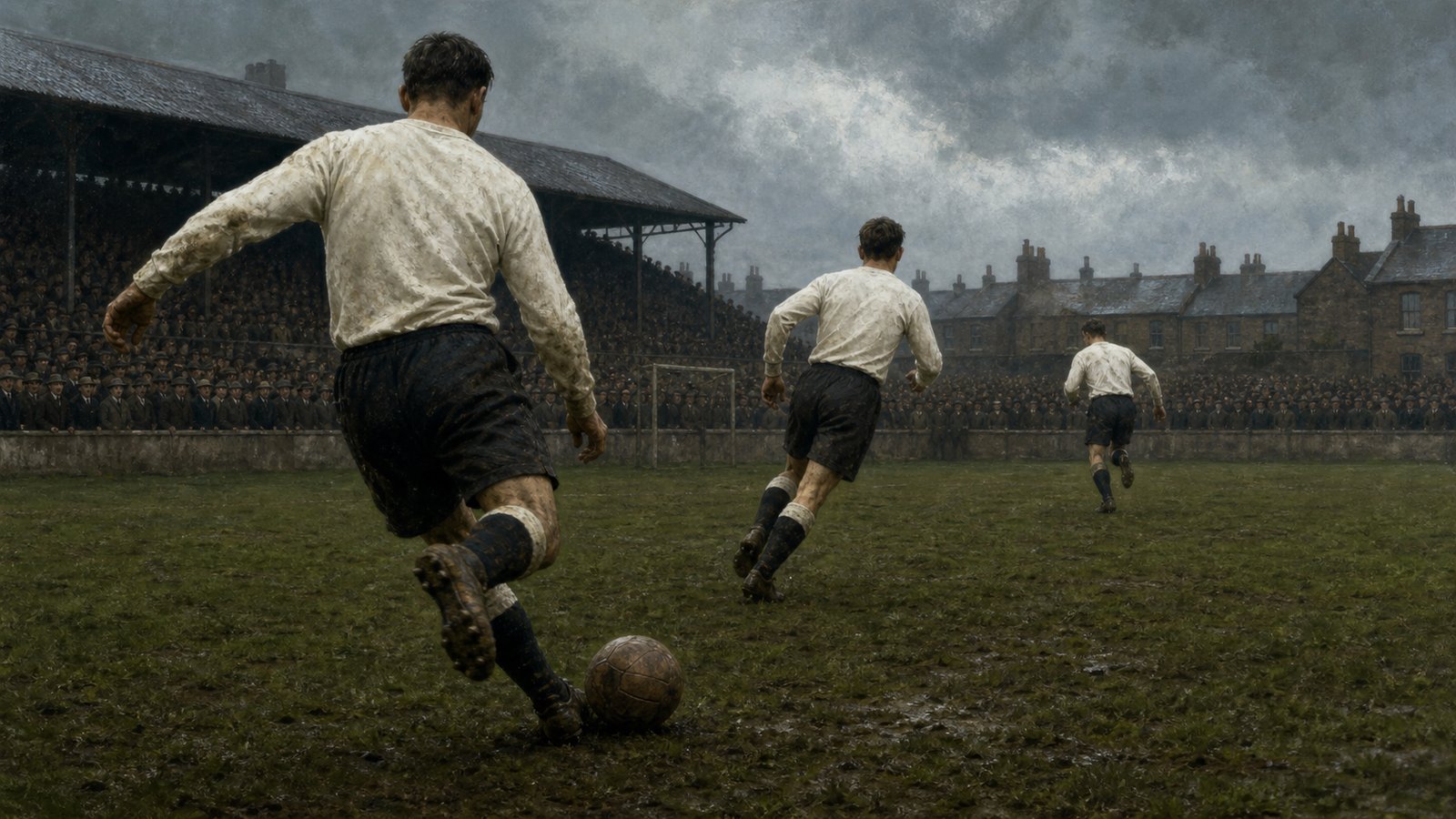
The results attracted an audience before Tottenham had returned to the top flight. White Hart Lane averaged 54,405 spectators during the Second Division title season, the highest figure in the Football League. More than a million people visited the ground across the campaign. Promotion was secured with a 2–0 win at Queens Park Rangers on 1 April 1950, with Baily and Medley scoring.
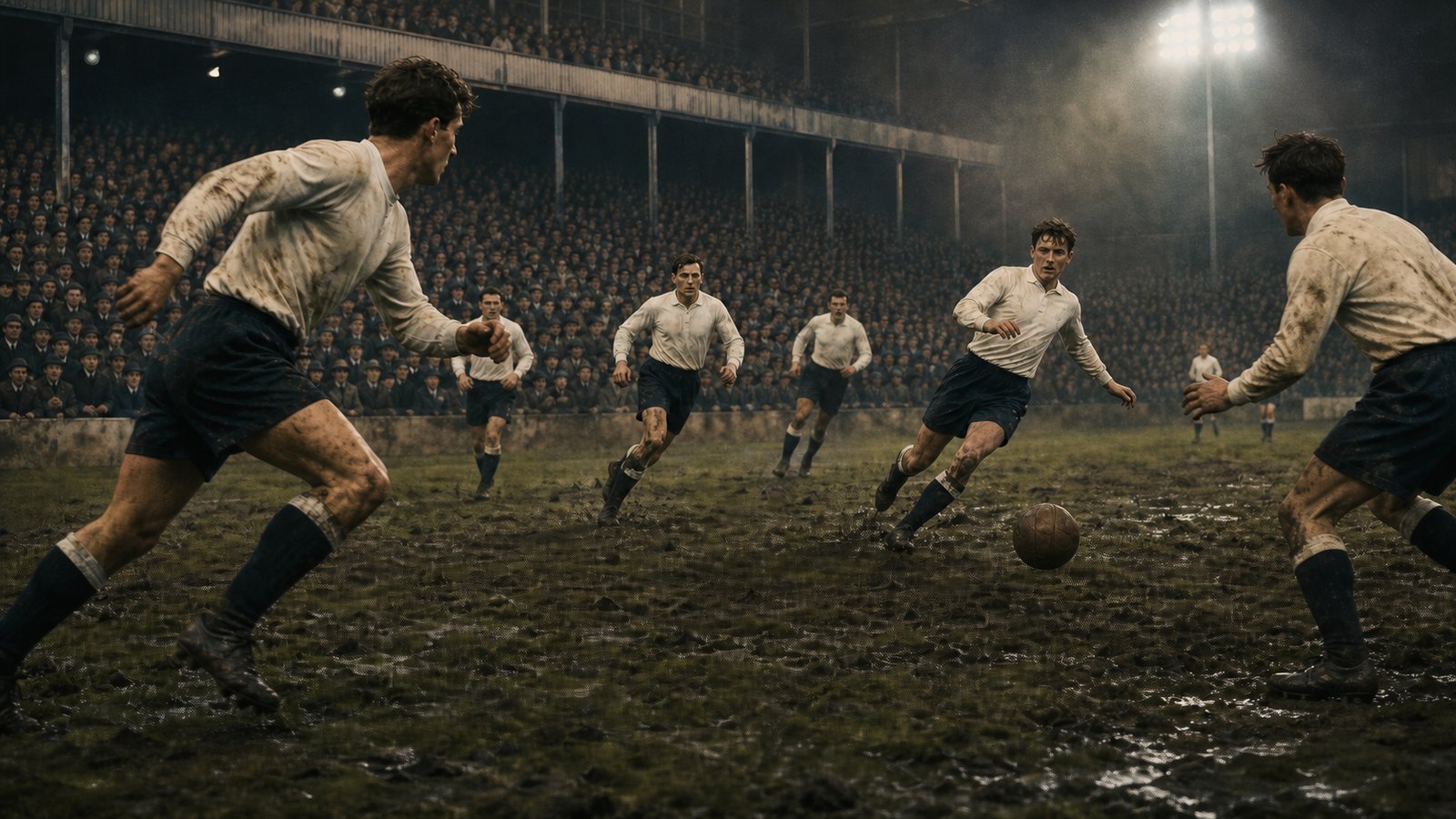
Tottenham’s first months back in Division One were less commanding. By the end of September 1950, the promoted side sat 13th. A 3–2 victory at Aston Villa began the acceleration: eight consecutive wins carried Spurs to second place by mid-November. The sequence culminated in a 7–0 demolition of Newcastle United before more than 70,000 spectators at White Hart Lane.
The surface made the exhibition more revealing. Heavy boots, a heavy ball and a damaged pitch could punish any passing side. Tottenham’s players learned to strike through the ball cleanly so that it travelled over mud rather than dying in it. Against Newcastle, Baily, Medley and Duquemin combined before Bennett headed the opener after five minutes. The remaining goals came in waves, each attack beginning before the previous movement had fully left the defence’s mind.
Mud Forced the Idea to Prove Its Practical Side
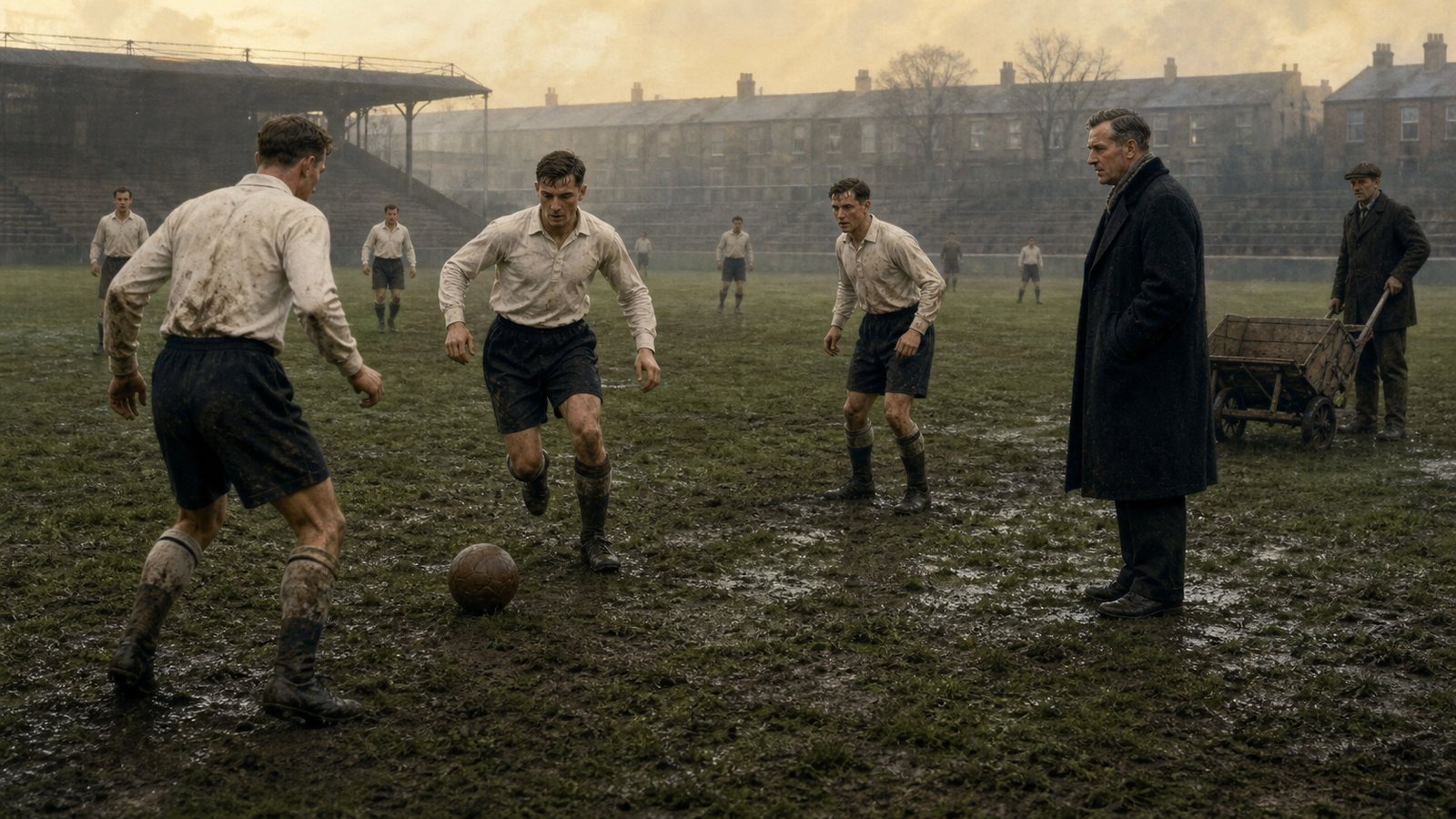
Winter threatened that rhythm. On sodden grounds the ball held in the surface, return passes arrived late, and players had to run backwards to retrieve exchanges designed to move forward. During one training session, however, Rowe noticed the ball travelling cleanly across a muddy practice pitch. No sand had been spread that morning. He ordered the ground staff to stop applying it, removing one source of drag from Tottenham’s home conditions.
The adjustment belongs beside the elegant passing because it shows Rowe’s method at work. He was not protecting an abstract style from reality. He was changing the environment so that the squad’s strongest actions could survive it. Tottenham won eight of 12 league matches after the early January FA Cup exit and lost only twice in the league from mid-January to the season’s end.
On 28 April 1951, a goal by Duquemin delivered a 1–0 win over Sheffield Wednesday at White Hart Lane and confirmed Tottenham’s first Division One championship. The trophy came one season after the Second Division title and after a 15-year absence from the top tier. Rowe’s side had completed an ascent that looked sudden on the table but had been rehearsed through thousands of small exchanges.
The Method Continued Through Two Different Heirs
Two members of the championship squad carried parts of Rowe’s thinking into defining managerial careers. Bill Nicholson later led Tottenham to the league and FA Cup Double in 1960/61. Alf Ramsey became England’s World Cup-winning manager in 1966. Neither copied the 1951 side as a museum piece. Their teams differed in shape and emphasis, but both had learned inside a group where movement after the pass was treated as a responsibility.
Rowe’s visit to Hungary also makes the story more circular than a simple English invention. He observed and taught in Budapest before the war; Hungarian coaches and players watched him; then Hungary’s national side stunned England 6–3 at Wembley in 1953 and 7–1 in Budapest in 1954 with fast combinations and unfamiliar movement. Football knowledge had travelled in both directions rather than belonging to one country.
The championship was the visible reward. The deeper achievement was that Tottenham’s football could be recognised before the table was read. A player released the ball and immediately went somewhere useful. Another already knew why. What began with sugar scattered across a train table ended with White Hart Lane expecting the next pass to arrive.
Sources
Tottenham Hotspur, Arthur Rowe, “Push and Run” Football and the Influence of Hungarian Football; Tottenham Hotspur, Arthur Rowe on the 1950/51 Division One Title in His Own Words; Spurs Odyssey, The History of Push and Run; Spurs Odyssey, The Story of 1950/51.