
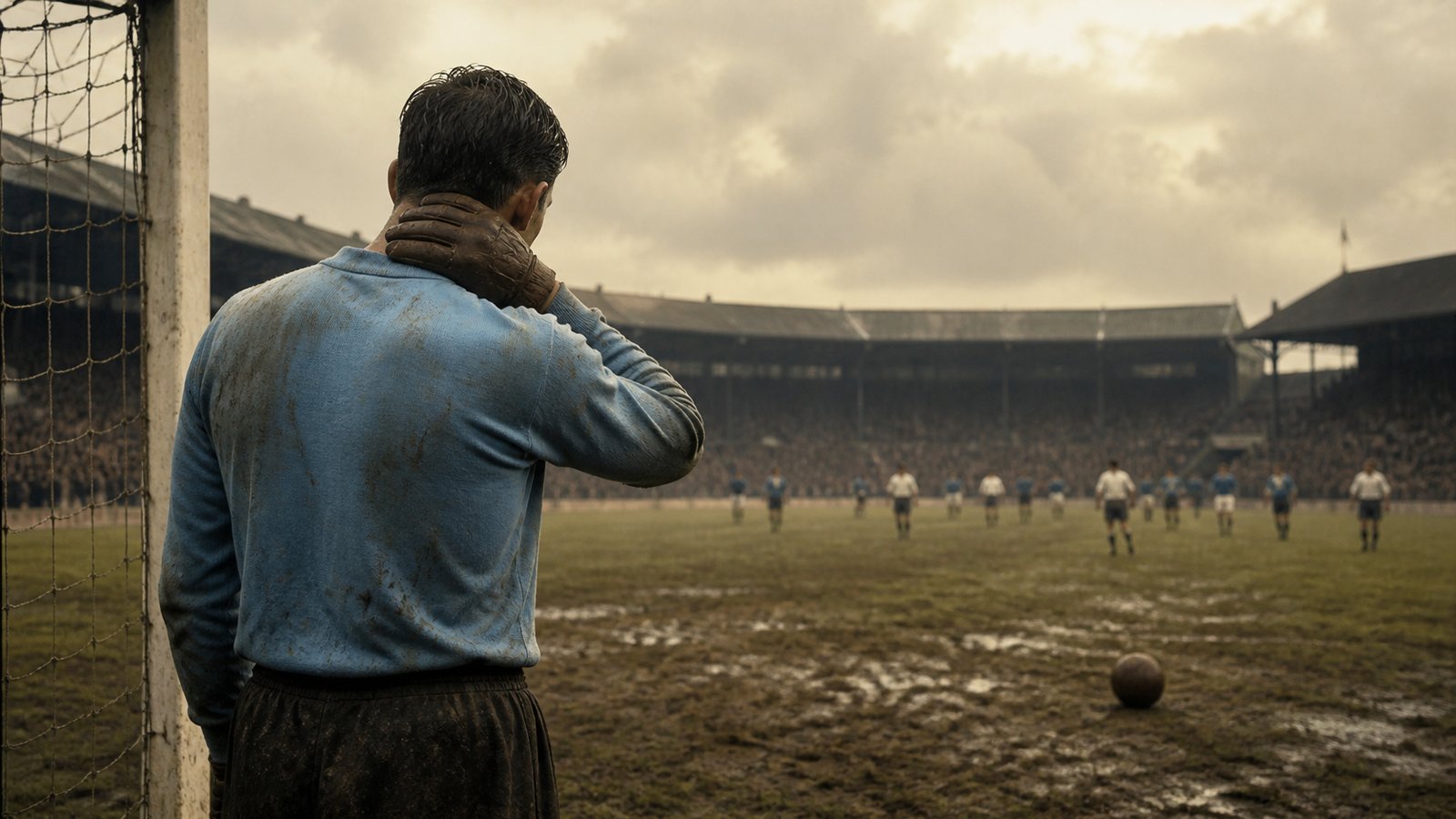
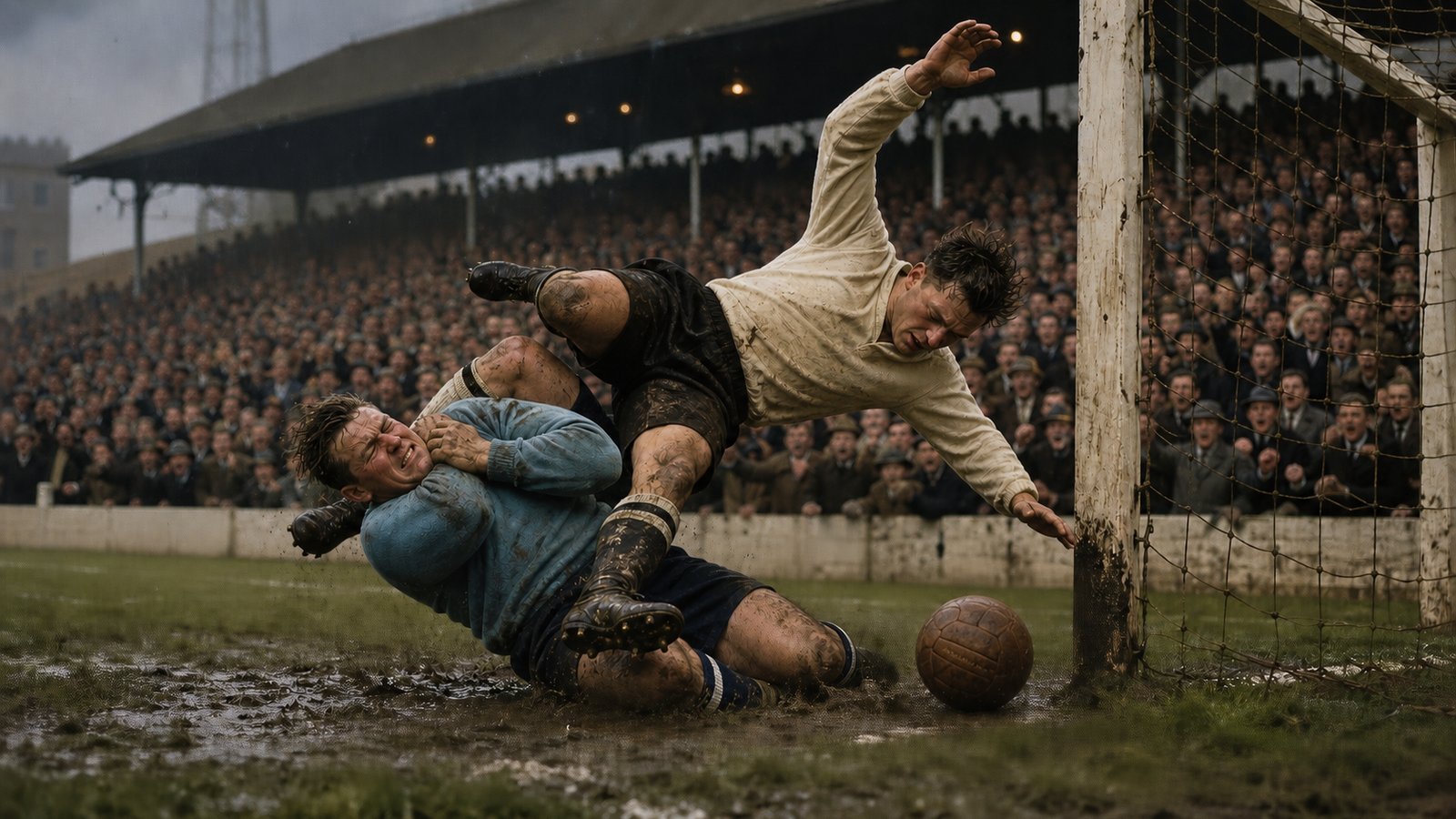
Seventeen minutes remained in the 1956 FA Cup final when Birmingham City forward Peter Murphy chased a short cross into Manchester City’s penalty area. Bert Trautmann came off his line to intercept it. Murphy’s thigh struck the goalkeeper’s neck, and the collision knocked Trautmann unconscious. When he came round, he could not recognise the people around him.
There were no goalkeeper substitutions waiting to rescue Manchester City. Trautmann stayed. He later recalled collapsing two or three more times, supporting his neck with his right hand and turning his whole body whenever he needed to look across the box. City won 3–1. Only days later did an X-ray explain the pain: five vertebrae had been dislocated.
The broken neck made the final famous, but the match carried another extraordinary reversal. Seven years earlier, Trautmann’s arrival at Manchester City had brought mass protest against a former German soldier. By Wembley, he was Footballer of the Year. The collision did not create his acceptance from nothing. It condensed a much longer change into seventeen almost unbearable minutes.
The collision left City’s goalkeeper looking through fog
Trautmann was an aggressive goalkeeper who preferred to meet danger rather than wait on his line. He described the final’s decisive collision as the unavoidable meeting of two players moving at speed. Murphy attacked the cross. Trautmann attacked the same space. The striker’s thigh caught him in the neck.
After regaining consciousness, Trautmann’s sight was foggy. It eventually cleared enough for him to continue, but the rest of his body kept reporting that something was seriously wrong. His neck could not turn normally. He used one hand as a brace and rotated from the waist to follow play. According to his later account, he fell several more times during the closing quarter-hour.
Manchester City still needed him. A 2019 Guardian history credits Trautmann with two crucial saves after the injury. Birmingham could not force a way back, and City completed a 3–1 victory. The score makes the ending look controlled. Trautmann’s movements reveal how narrow that control had become: every glance and landing now had to be negotiated around an injury nobody on the field understood.
The medal ceremony preserved the warning in plain sight
After the whistle, Trautmann climbed toward the royal box to collect his winner’s medal. He was still holding his neck. The Duke of Edinburgh asked whether he was in pain, and Trautmann compared the sensation to severe toothache. The exchange put the injury in public view without revealing its scale.
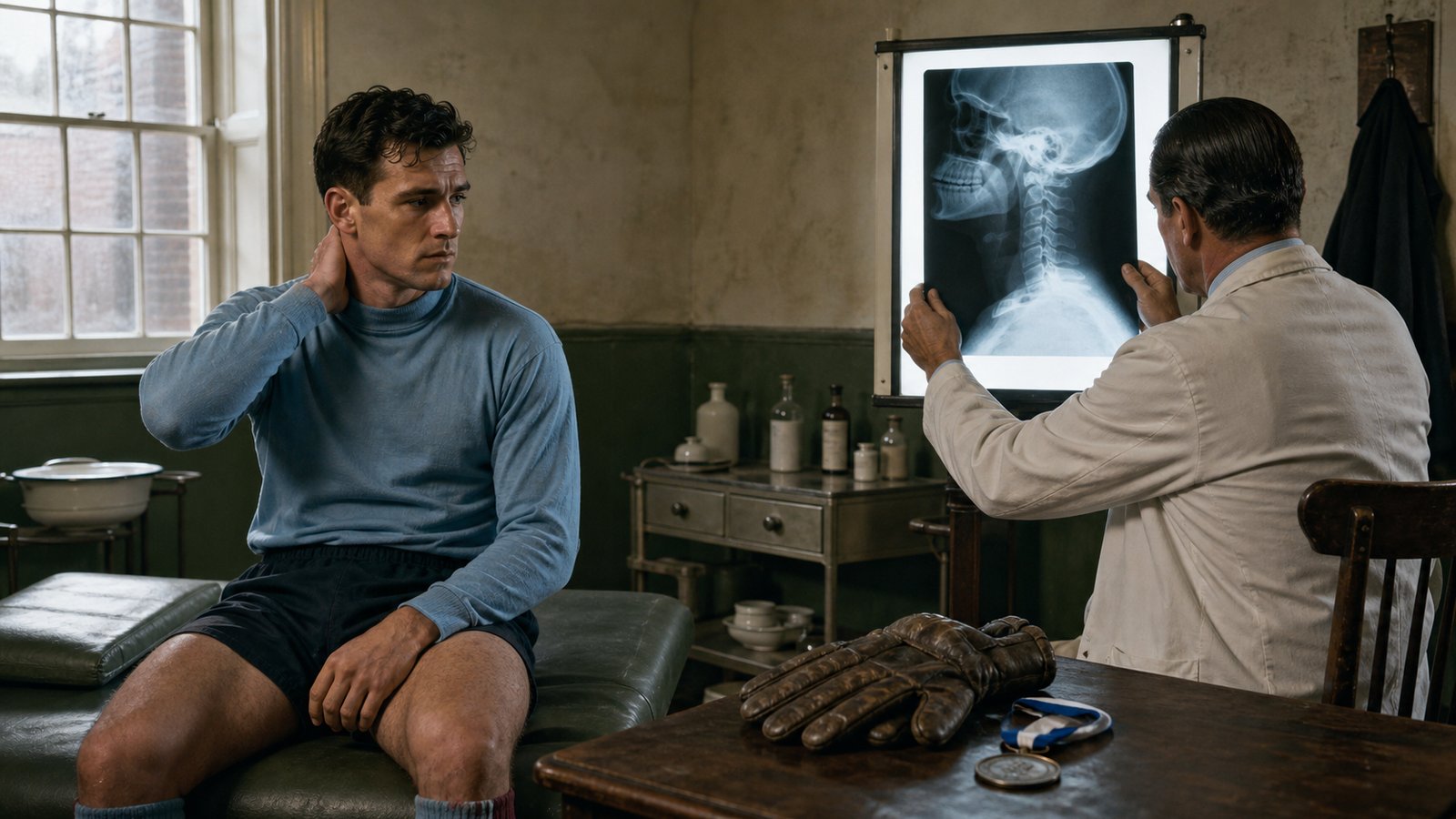
The first medical verdict also missed the danger. Trautmann went to a London hospital the following day and was told he had a crick in his neck. He was sent away. The pain remained, so three days after the final he visited an osteopath in Manchester. An X-ray showed five dislocated vertebrae. Trautmann said doctors told him he might have been paralysed or killed.
His later explanation stripped some romance from the common idea of heroic sacrifice. If he had known his neck was broken, he said, he would have left immediately. He played on with incomplete information, not because he had weighed paralysis against an FA Cup medal and chosen the medal. The bravery lay beside shock, faulty diagnosis, competitive instinct and the era’s limited options. That mixture is more human than the polished legend.
Lancashire had already changed the course of his life
Trautmann’s route to Wembley began as a German prisoner of war in Britain. After the war, he chose not to return to Germany. He remained in Lancashire and joined St Helens Town, first through an informal arrangement after his release. His goalkeeping transformed the scale of the local occasion. The Guardian reported that St Helens crowds rose from 250 to 6,000 as his reputation spread.
Manchester City signed him in 1949, only four years after the end of the Second World War. The decision could not be separated from what Manchester’s families had endured. A 2019 Guardian account estimates that 20,000 protesters gathered outside Maine Road, directing abuse at Trautmann and threatening to boycott the club. City had recruited a talented goalkeeper; many supporters saw the uniform he had worn before football.
Rabbi Alexander Altmann intervened with an open letter to the Manchester Evening Chronicle. Altmann’s parents had been killed in the Holocaust. He argued that Trautmann should not be punished simply for being German and should be judged on his own conduct. The protests stopped after the letter. Acceptance remained something Trautmann had to earn in matches, but Altmann created room for that process to begin.
The numbers at St Helens and Maine Road show two very different kinds of attention. A crowd that grew from 250 to 6,000 followed the discovery of an exceptional local goalkeeper. The estimated 20,000 outside City’s ground represented fear, anger and recent loss. Trautmann’s football career moved between those responses. Performance could attract people, but it could not by itself answer the moral questions attached to his past. Altmann’s letter mattered because it did not ask supporters to forget the war; it asked them to examine the individual now living among them.
Footballer of the Year entered Wembley under pressure
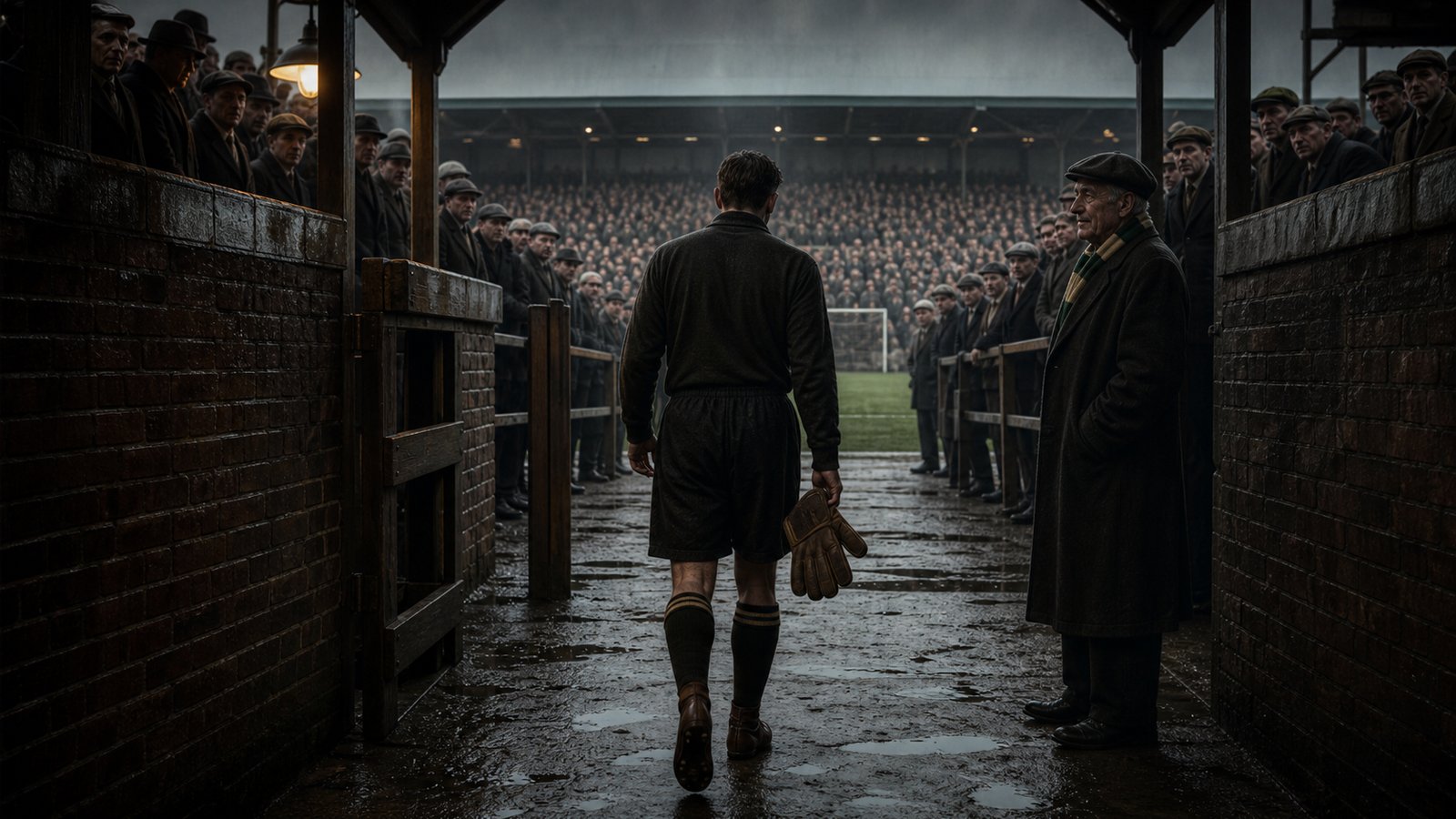
By May 1956, the argument around Trautmann had changed. Two days before the final, the Football Writers’ Association named him Footballer of the Year. He was the first goalkeeper to receive the award. The honour recognised a season of elite work before the most famous injury of his career.
That timing matters because the final is sometimes allowed to swallow everything that came before it. Trautmann was not an uncertain novelty who became a great goalkeeper through one afternoon of endurance. He arrived at Wembley already recognised by the writers who watched him throughout the season. His command of the penalty area—the instinct that sent him toward Murphy’s cross—was part of the ability being honoured.
The same instinct also created the collision. Goalkeeping rewards decisions made before danger is fully formed: leave the line, claim the ball, close the angle. Once Trautmann committed, he and Murphy had too little space to avoid one another. His best professional habit and his worst injury occupied the same movement.
The seventeen minutes became a lifetime symbol
Trautmann recovered and played for Manchester City for another eight years. By his retirement in 1964, he had made 545 appearances for the club. The final was therefore neither his last match nor the whole measure of his career. It became the scene through which a larger story was repeatedly told.
Returning also changed the meaning of the injury. If Wembley had ended his career, the final would read like a brutal closing chapter. Eight more years made it a rupture inside a much longer body of work. Every later appearance stood beyond the first hospital’s reassurance, the Manchester X-ray and the warning that the collision could have killed or paralysed him. The recovery did not erase the danger; it gave the danger a measurable aftermath.
For City supporters, the image of the goalkeeper finishing in pain expressed loyalty to the team. For a wider British public, it complicated the identity of a former enemy who had stayed, worked and been accepted. Trautmann later received an OBE for his contribution to Anglo-German relations, recognition that reached beyond saves and medals.
The medical sequence keeps the story grounded. A thigh struck a neck. A goalkeeper lost consciousness, saw fog, collapsed again and collected a medal while holding his head rigid. A hospital sent him away. An X-ray finally disclosed five displaced vertebrae. The facts resist both easy myth and easy dismissal. Trautmann did not knowingly gamble his life for a trophy, but he completed a final while gravely injured—and the country that once protested his signing saw him leave Wembley as one of its football heroes.
Sources
- The Guardian — “If I’d known my neck was broken I’d have been off”
- The Guardian — “05.05.1956 Bert Trautmann breaks his neck”
- The Guardian — “From Nazi to football hero: the incredible story of Man City’s Bert Trautmann”