
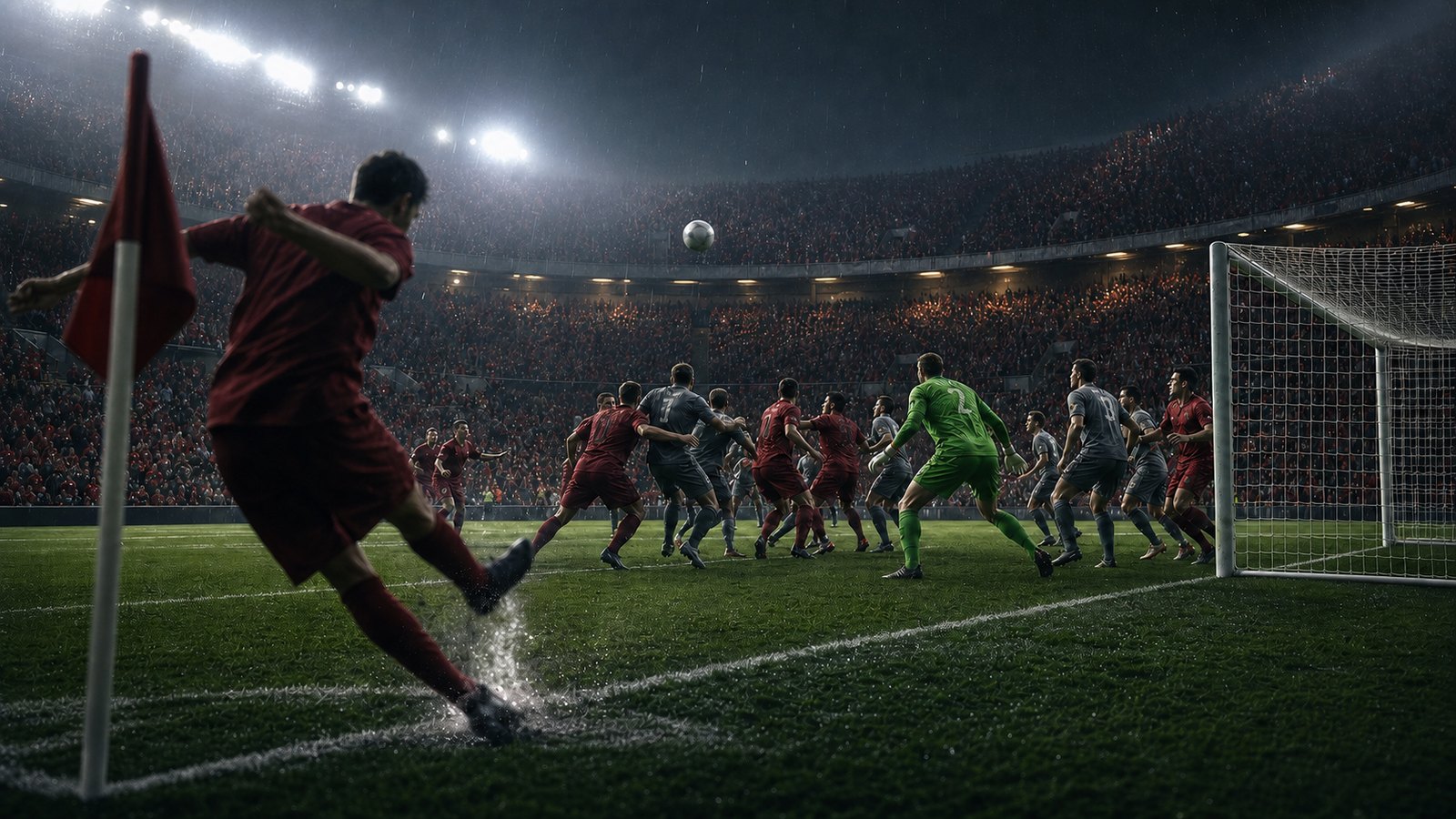
The match had been slipping away for eighty-five minutes when Peter Schmeichel left his goal. Bayern Munich had led since Mario Basler bent a sixth-minute free-kick around Manchester United’s wall. Now, with three minutes of added time announced, United’s goalkeeper ran the length of the pitch to join one last corner. His presence did not create the equaliser. It revealed the emergency.
What followed is remembered as football magic: Teddy Sheringham scored, Ole Gunnar Solskjær scored, and a European Cup final reversed itself before the first celebration had properly ended. Yet the finish was not detached from the match before it. Bayern had repeatedly come within one touch of making the result safe. United had changed their attacking personnel without finding a clean route through. The final turned when those substitutions, a goalkeeper’s desperate run and David Beckham’s set-piece delivery all converged inside the same crowded penalty area.
An early free-kick changed every remaining decision
The first decisive scene arrived after only five minutes. Ronny Johnsen’s challenge on Carsten Jancker gave Bayern a free-kick near the left edge of United’s box. Basler struck it around the base of the wall and into the far corner in the sixth minute. The German champions had the lead before United’s improvised midfield could settle.
Improvised is the important word. Roy Keane and Paul Scholes were suspended, so Alex Ferguson used Beckham beside Nicky Butt in central midfield. Ryan Giggs moved to the right and Jesper Blomqvist started on the left. It was a major European final with the team’s familiar geometry already altered. Conceding early forced that reshaped unit to chase.
Bayern could now attack the spaces created by United’s urgency. Alexander Zickler drove narrowly wide in the 29th minute. Basler later tried to catch Schmeichel from near halfway. Stefan Effenberg forced the goalkeeper into a close-range save in the 73rd. These were not decorative chances around a one-goal lead. Each one offered a way to close the night before United could reorganise again.
The bench changed the cast before it changed the score
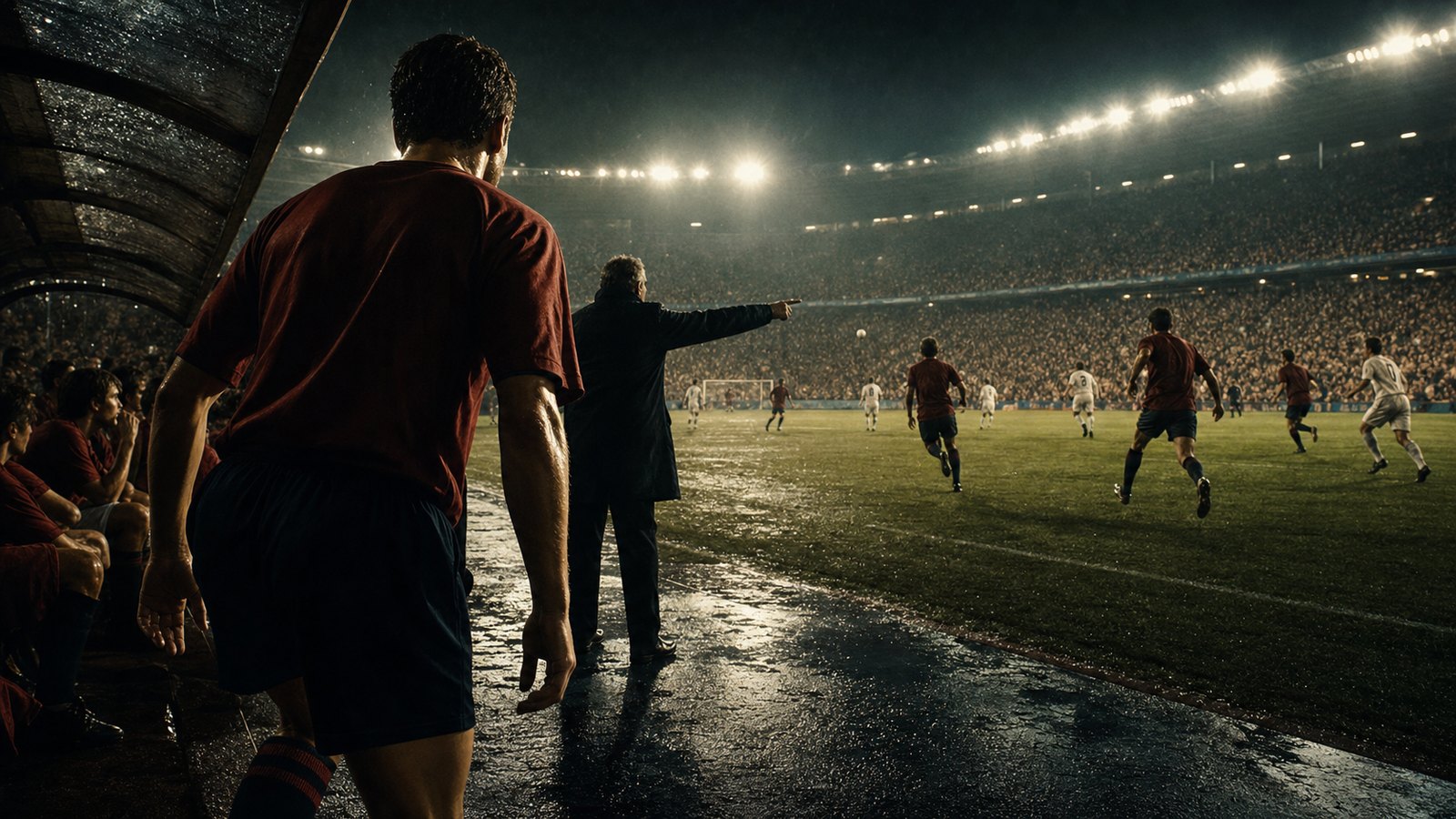
Ferguson’s first attacking change came in the 67th minute. Sheringham replaced Blomqvist, the same Sheringham who had scored in the FA Cup final four days earlier. In his later first-person account, Sheringham admitted he had been upset not to start. He also remembered Ferguson telling him at half-time to be ready if the score remained unchanged for another ten or fifteen minutes.
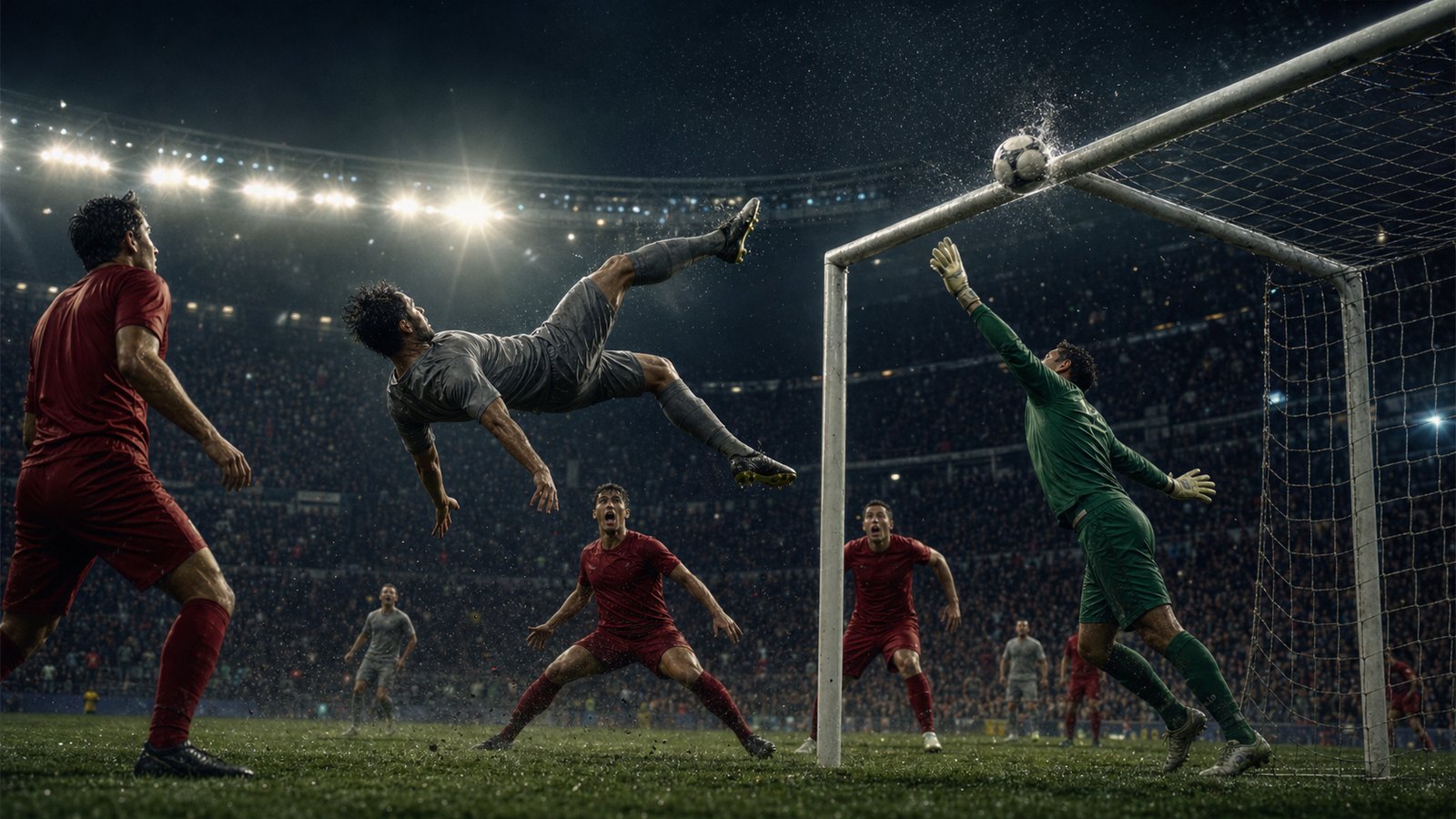
The substitution moved Beckham toward the right and put another central attacker near Dwight Yorke and Andy Cole. It did not immediately make United fluent. Bayern remained the more dangerous side. Mehmet Scholl, introduced for Zickler, chipped beyond Schmeichel in the 79th minute and struck the post. Five minutes later Jancker’s overhead kick hit the crossbar. United were not steadily building toward an inevitable comeback; they were surviving the moments that should have ended it.
Solskjær replaced Cole in the 81st minute. His first intervention was nearly a goal, a header from Gary Neville’s cross that forced Oliver Kahn to save. The detail matters because it showed what the second substitute added: movement that attacked the goal immediately. United now had Sheringham’s ability to read a crowded box and Solskjær’s instinct for its final space, but still no equaliser.
The woodwork kept the final open
Finals are often retold backwards, as though the winner’s late actions prove a hidden control. This one resists that comfort. Scholl’s shot struck the post. Jancker’s overhead kick struck the bar. Bayern had led for eighty-five minutes and produced the clearer late chances. A few centimetres in either scene would have made the two substitutions irrelevant to the trophy.
That tension shaped the famous finish. United’s persistence was real, but so was Bayern’s superiority in the match’s dangerous middle. Ferguson could add forwards because there was no useful reason to protect a 1–0 defeat. Bayern could replace Lothar Matthäus with Thorsten Fink around the 80th minute because the lead appeared ready to survive. Both benches acted logically. Only one set of decisions would survive the ending.
The match clock increased the pressure without changing the task. Three minutes of injury time were shown. United needed one goal to force extra time. Bayern needed to defend one lead they had held almost from the opening whistle. As the first of those minutes drained away, Schmeichel ran forward for a Beckham corner. The goalkeeper’s journey turned United’s shape into pure risk: nobody was left in the usual place.
The first corner created belief, not control
Beckham sent the corner into the far side of the box. Yorke headed it back, a Bayern defender partly cleared, and the ball reached Giggs near the edge of the area. Giggs scuffed a right-footed attempt rather than striking cleanly. That imperfect contact carried the ball to Sheringham, who turned it into the net from close range.
Sheringham later said he checked the assistant referee before fully trusting the goal. A Bayern player had been on the line when the shot developed, keeping him onside, then stepped out before Sheringham finished. The sequence looked untidy because it was untidy: a goalkeeper in the box, a recycled header, a partial clearance, a mishit shot and a substitute reacting first.
The equaliser appeared to promise extra time. United’s supporters had barely processed that escape when the restart produced another attack and another corner. This is where memory can flatten the finish into a single blur. The two goals came from separate set pieces with separate functions. The first was assembled from a broken second ball. The second was a rehearsable near-post idea executed inside chaos.
The second corner used the substitutes together
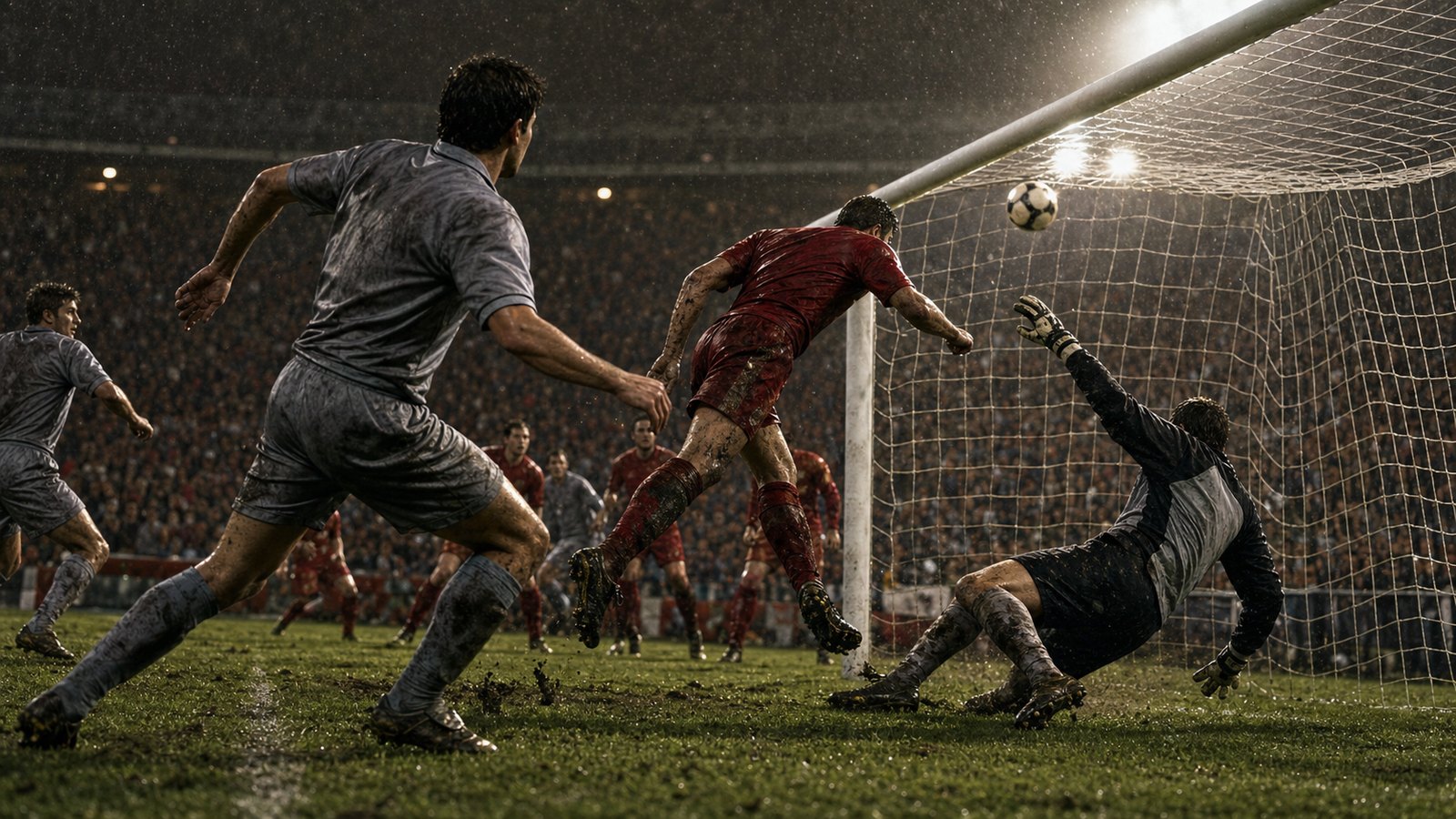
Beckham delivered again. Sheringham attacked the near-post flight and reached the ball before his marker, but he knew he could not score directly. He flicked it across the goal instead. Solskjær was waiting in the far-post channel and lifted his finish into the roof of Kahn’s net. The two players who began the final on the bench had touched the decisive move in succession.
Sheringham remembered how quickly the goals arrived. People were still celebrating replays of the equaliser when the winner went in; some initially did not realise they were seeing a second goal. On the pitch, the compression was even more severe. Bayern restarted after conceding, lost the next phase, defended another corner and were suddenly behind. Pierluigi Collina’s final whistle followed in the 93rd minute.
The reversal completed more than one match. United had won the Premier League and FA Cup during the previous eleven days. Victory in Barcelona made them the first English club to complete the league, FA Cup and European Cup treble. It also came on the date when Matt Busby, manager of United’s 1968 European champions, would have turned ninety.
Bayern’s players experienced the same three minutes from the opposite direction. They had hit both post and bar, protected Basler’s lead deep into added time and stood one clearance from the trophy. The result did not prove their plan foolish. It showed that a plan can be sound and still remain unfinished.
Barcelona is remembered because the finish supplied a complete story at impossible speed. But its mechanism was concrete. Suspensions forced a reshaped midfield. An early free-kick gave Bayern the game they wanted. Two substitute forwards changed the targets available to United. The woodwork preserved the one-goal margin. A goalkeeper abandoned his post. Then two corners gave Sheringham and Solskjær different problems to solve.
The final three minutes did not erase the previous eighty-seven. They collected every unresolved detail from them and forced those details into the penalty area at once. That is why the ending still feels less like a lucky interruption than football compressed to its most unforgiving scale.
Sources
BBC News, European final — key moments
BBC News, United crowned kings of Europe
The Guardian, Solskjaer takes Treble chance
Teddy Sheringham in The Guardian, Manchester United’s moment of magic that completed an historic treble
UEFA, 1998/99 Manchester United 2–1 Bayern München report