
IFK Göteborg’s 1982 UEFA Cup run sounds, at first, like one of those tidy underdog stories football tells itself after the fact. A Swedish club from outside the richest leagues beats Hamburg, Kaiserslautern and Valencia, then wins a two-legged European final against Hamburg again. The easy version is that a small side caught a few giants on the wrong nights.
The better version is sharper. Göteborg did not win because Europe briefly forgot how to play. They won because Sven-Göran Eriksson and a group of players who still felt close to ordinary Swedish working life made the gap between part-time rhythm and elite continental habit smaller than anyone expected. They turned organization, conditioning, and collective nerve into a weapon that traveled.
The underdog was not loose. It was rehearsed.
Göteborg’s European identity in 1981-82 was built around repetition rather than romance. Swedish domestic football did not offer the week-to-week glamour of Serie A, the Bundesliga, or La Liga, so the side had to carry its own intensity into Europe. That mattered. The UEFA Cup was still a brutal competition, crowded with clubs good enough to punish any romantic adventure, and two-legged ties gave richer opponents time to solve a fluke.
Eriksson’s team made itself difficult to solve. The lines were compact, the distances short, and the first defensive action was rarely isolated. The point was not simply to defend deep and hope. Göteborg tried to make opponents spend attacks in crowded areas, then move quickly into the spaces they had just emptied. Against clubs accustomed to technical superiority, that kind of collective timing could feel like the pitch had shrunk.
It also helped that the players had an unusually strong shared reference point. They knew the demands of Swedish pitches, weather, and travel. They knew how to manage long stretches without looking glamorous. In Europe, those habits became virtues. A cold evening, a heavy surface, or an opponent impatient for the beautiful solution all pushed the tie toward Göteborg’s comfort zone.
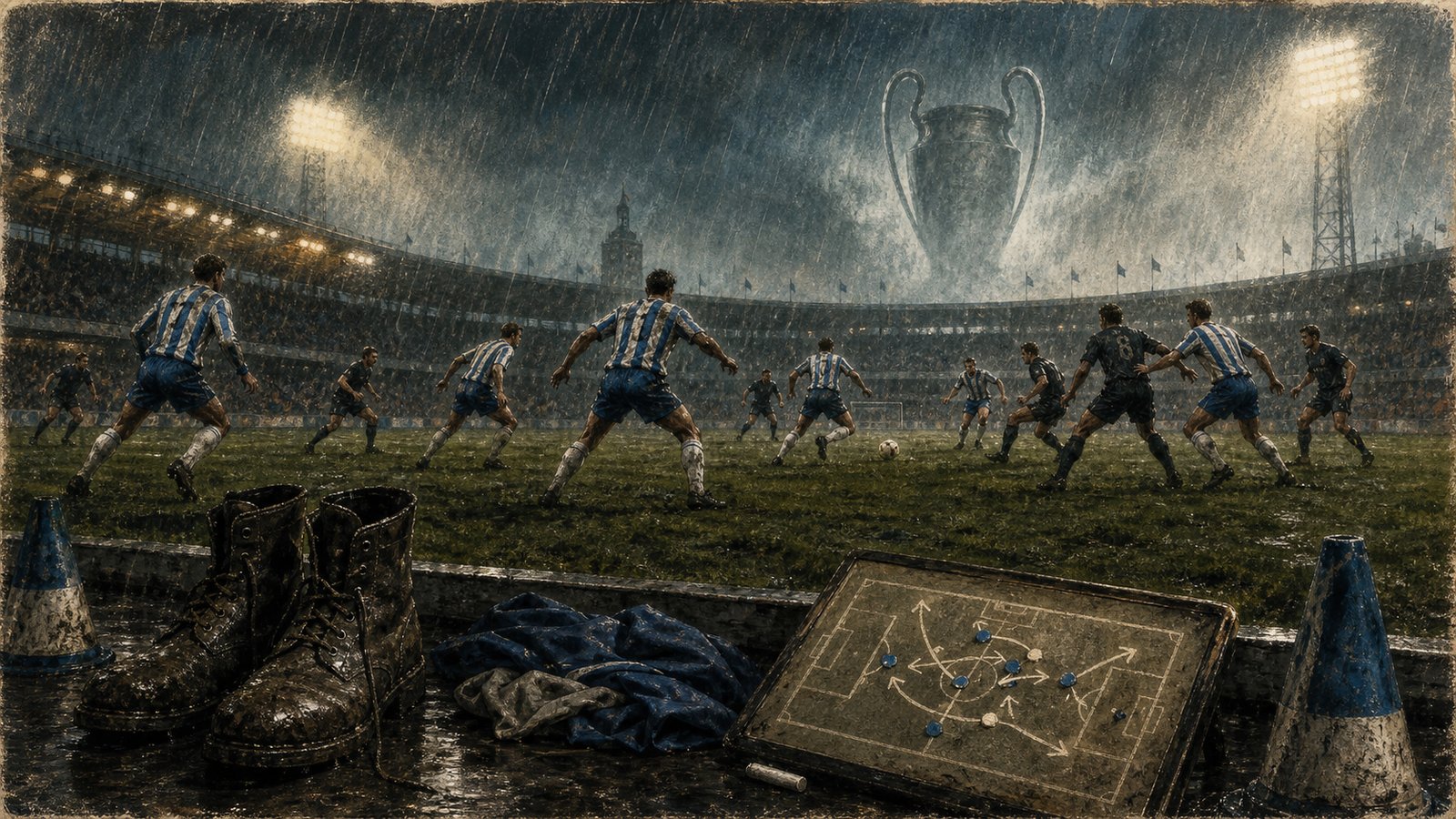
Europe met a team that refused to play the expected role.
The most famous detail is the final against Hamburg, but the route mattered just as much. Göteborg had to survive opponents from larger football economies before the final ever arrived. Each round reinforced the same question: when does an underdog stop being a surprise and start being a system? By the spring of 1982, the answer was visible. Teams kept expecting Swedish modesty. They kept receiving a match in which every second ball, every recovery run, and every narrow channel was contested.
The final carried that contrast to its cleanest form. Hamburg were not tourists. They were one of West Germany’s serious powers, strong enough to become European champions the following year. Göteborg did not beat a sleeping giant; they beat a club whose quality made the achievement larger. The first leg in Sweden ended 1-0 to IFK, a result that looked narrow enough for Hamburg to repair. The second leg in Germany turned the tie from possibility into proof. Göteborg won 3-0 away and took the final 4-0 on aggregate.
That scoreline is why the story should not be filed under “cup magic” alone. A lucky side steals one night. Göteborg controlled enough of two finals, one at home and one away, to make the aggregate look almost severe. Their edge was not only tactical. It was emotional discipline: the ability to keep playing the same way after the first goal, after the crowd noise changed, after the supposedly bigger club started forcing the issue.
The Swedish model traveled because it was practical.
Göteborg’s football was not a manifesto pinned to a dressing-room wall. It was practical football for a squad that had to maximize every shared movement. The distances between players were a kind of insurance policy. If one player pressed, the next had to be close enough to make the press mean something. If the ball was won, the first forward pass had to be useful rather than decorative. If the game became scrappy, the team could not treat that as a failure. Scrappiness was often where the advantage lived.
That makes the 1982 run a useful correction to how European history is usually told. Tactical revolutions are often credited to famous cities, famous academies, or famous managers after they arrive at the biggest jobs. Göteborg shows a different route. A team from a less fashionable market can force innovation by necessity. It cannot buy its way out of structural disadvantages, so it learns to turn coordination into value.

Eriksson’s later career can obscure the original achievement.
Because Eriksson later managed major clubs and England, it is tempting to treat Göteborg as a footnote in a famous coach’s rise. That undersells the players and the environment. The 1982 side was not merely a résumé line for a future celebrity manager. It was a specific collective with a specific way of solving European football’s hierarchy problem.
Winning the UEFA Cup also changed how Swedish club football could imagine itself. It did not mean Sweden suddenly had the resources of the major leagues. It meant that a well-drilled, ambitious side could enter Europe without apologizing for its origins. That kind of belief is not sentimental. It affects recruitment, training standards, and the way a club speaks to its own players before a tie against a richer opponent.
The run also sits in a wider Scandinavian lesson. Football cultures outside the richest leagues often export individuals: a striker, a defender, a coach. Göteborg briefly exported a team idea instead. The idea was that the collective could travel intact, even when the transfer market would eventually pull the best pieces apart.
The final score was a warning, not a fairy tale.
The 4-0 aggregate over Hamburg remains the headline because numbers give the story its hard edge. But the deeper lesson is about control. Göteborg did not need to look like a superclub to make a superclub uncomfortable. They needed to make the game narrower, colder, and more honest than the favorite wanted it to be.
That is why the 1982 UEFA Cup still feels modern. In every era, clubs outside the wealthiest circle search for a way to make structure compete with purchasing power. Some press. Some recruit earlier. Some build academy continuity. Göteborg’s answer was a disciplined European machine wearing underdog clothes.
The squad’s details make the machine feel less abstract. Torbjörn Nilsson supplied European-class forward quality, but Göteborg were not built as a team waiting for one famous attacker to solve everything. Glenn Hysén, Conny Karlsson, Stig Fredriksson, and the rest of the group mattered because the distances between them made individual actions count twice. A tackle was not just a tackle if the next pass was ready. A clearance was not just survival if the side was already set to squeeze the second ball.
The competition format also made the achievement harder to dismiss. A two-legged UEFA Cup campaign tests memory. Opponents get ninety minutes of evidence, then a chance to adjust. Göteborg kept giving them a similar problem in different weather and different stadiums: how do you break a team that refuses to become stretched, refuses to panic, and treats every supposedly ugly phase as part of the plan?
Sources
UEFA historical competition records; IFK Göteborg club history; RSSSF UEFA Cup 1981-82 records; contemporary European football reports; Sven-Göran Eriksson career histories.