
The easiest way to flatten the 1954 World Cup final is to call it a miracle and stop there. West Germany beat Hungary 3-2 in Bern, yes. Hungary had been the best side in the world for years, yes. The group-stage meeting had ended 8-3 to Hungary only two weeks earlier, and the final turned after West Germany fell 2-0 behind inside eight minutes. Those facts make the story dramatic enough. But they can also hide the more interesting football lesson: Bern was a match where preparation, weather, rotation, recovery, and nerve all met inside ninety wet minutes.
Hungary arrived with the aura of a team that had already bent the sport toward the future. The side around Ferenc Puskas, Nandor Hidegkuti, Sandor Kocsis, Jozsef Bozsik, and Zoltan Czibor had beaten England 6-3 at Wembley in 1953 and 7-1 in Budapest in 1954. They had also won Olympic gold in 1952. Their football was not just a list of famous names; it was movement, positional confusion, and technical security played at a speed many opponents could not read. In the old story, West Germany were simply lucky to survive them. In the sharper story, Sepp Herberger’s team treated the final as a second examination, not a repeat of the first.

The 8-3 Defeat Was Also Information
The group-stage defeat has always been part of the Bern myth because it makes the final feel impossible. But Herberger did not treat that 8-3 as only humiliation. West Germany rotated several players in the group match, while Hungary lost something more costly than a scoreline when Puskas was injured after a heavy challenge. By the final, Puskas returned, but the question was not merely whether he could stand on the pitch. It was whether Hungary’s most elegant attacking reference point could move with the same certainty through a wet, physical, emotionally loaded match.
That distinction matters. A great team can be present and still be slightly altered. Hungary’s attacking structure depended on timing: Hidegkuti pulling defenders, Kocsis attacking space, Bozsik supplying rhythm, Puskas changing angles with one touch. In dry conditions, at full confidence, that machine could make opponents look late to every pass. At Bern’s Wankdorf Stadium, under rain and pressure, small delays became larger facts. West Germany did not need to become the better team across four years. They needed to make one final feel different from the match Hungary expected to control.
Rain Made the Final a Different Kind of Test
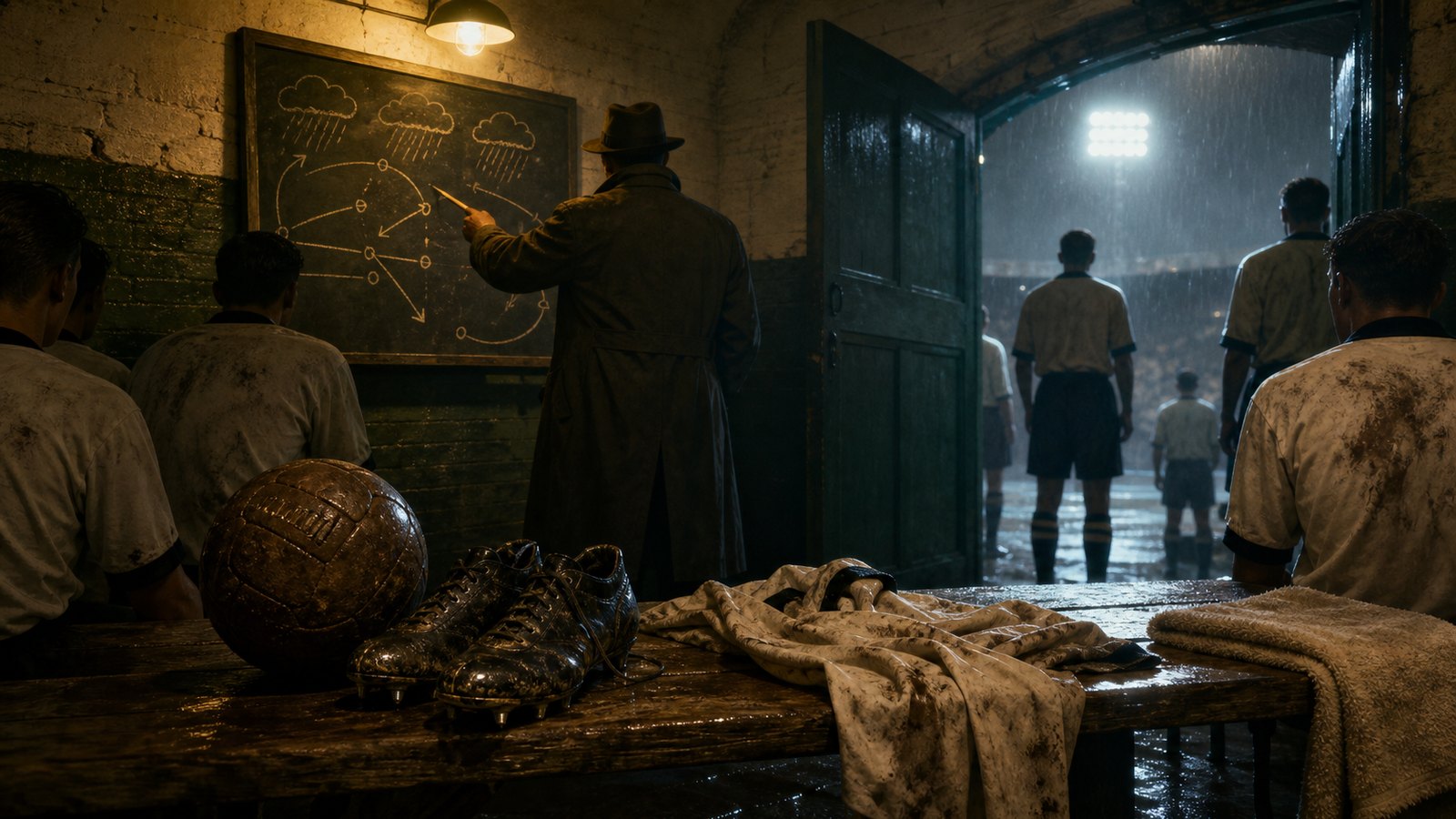
The weather is sometimes treated like atmosphere, a black-and-white detail for the film version. In football terms it was more practical. A heavy pitch changes acceleration, turning, tackling, first touch, and the confidence of a side that expects combinations to arrive cleanly. The phrase “Fritz Walter weather” survived because West Germany’s captain was associated with thriving in rain. Whether or not that phrase explains the match by itself, it points toward the real mechanism: the final became less like a technical exhibition and more like a contest of traction, repeat running, loose balls, and second chances.
Boots became part of the legend too. Adi Dassler’s involvement with the West German equipment and the use of changeable studs have often been folded into the story. It would be too neat to say studs won the World Cup. It is more useful to say the equipment suited the problem in front of the players. On a pitch where the ball skidded and bodies slid, the side that felt fractionally more secure in its footing could press one step earlier, shoot one beat cleaner, and recover after mistakes with less panic. In a 3-2 final, fractions do not need to explain everything to matter.
Eight Minutes Could Have Ended the Game
Hungary’s start should have crushed the match. Puskas scored after six minutes, Czibor made it 2-0 after eight, and the expected order seemed to have arrived before West Germany had settled. This is where the miracle version often jumps straight to destiny. The football version pauses on the reaction. Max Morlock pulled one goal back in the tenth minute, not after a long emotional recovery but almost immediately, and Helmut Rahn equalized eight minutes later. West Germany did not spend the first half trying to keep the score respectable. They dragged the final back into a state where Hungary could still dominate but could no longer treat domination as proof.
That mattered psychologically and tactically. At 2-0, Hungary could imagine the final becoming a procession. At 2-2, every attack carried a different weight. The favorite now had to solve a match that had stopped behaving. West Germany’s defense and midfield could stay in the game long enough to make Hungary repeat their patterns through fatigue and doubt. Toni Turek’s saves became part of the national memory because they were not isolated heroic decorations. They were the visible end of a match plan that kept demanding one more block, one more recovery run, one more decision under rain.
Rahn’s Winner Was a System Reaching Its Moment
Helmut Rahn’s 84th-minute goal is remembered as a thunderclap: the ball coming loose, the left-footed shot, the commentary line that became cultural memory. But the moment had been prepared by the shape of the match. Hungary had attacked, chased, and been denied. West Germany had stayed close enough that one late action could decide the final. Rahn was not a random figure stepping into a fairy tale. He had already scored the equalizer. He represented the practical side of West Germany’s response: direct, forceful, ready to punish the one moment when the great Hungarian side could not reset quickly enough.
The disallowed late Hungarian equalizer, with Puskas flagged offside, added another layer to the argument because the final did not end in clean emotional geometry. Hungary felt the edge of the call. West Germany felt the edge of survival. That is part of why Bern still works as football history rather than just national folklore. It contains no single explanation. It was tactical adaptation, wounded favorite, difficult weather, equipment detail, recovery after an awful opening, goalkeeper resistance, and one forward who struck when the match had become most fragile.
Why Bern Still Changes How Underdogs Are Remembered
The Miracle of Bern helped West Germany imagine itself through football after the Second World War, but reducing the match to national symbolism also risks losing the sport inside it. It showed that an underdog does not always win by being naive, pure, or magically inspired. Sometimes the underdog wins because it absorbs information faster than the favorite, survives the favorite’s best spell, and turns the conditions into a shared problem rather than an excuse. Herberger’s side could not copy Hungary’s long-term footballing brilliance. It could, however, narrow one game until Hungary had to win it in the mud, with pressure rising every minute.
That is why the final still feels modern. Great teams are still vulnerable when a match changes the surface beneath their strengths. Favorites still carry the burden of proving control after an opponent refuses to disappear. Underdogs still need more than courage; they need a mechanism that keeps them alive until courage can matter. Bern was not a miracle because football logic vanished. It was a miracle because enough small football reasons survived inside a result that looked impossible from the outside.
Sources
FIFA World Cup archive; UEFA historical features; German Football Association historical material; Jonathan Wilson, Inverting the Pyramid; David Goldblatt, The Ball Is Round.