
Sampdoria’s 1991 Scudetto is usually told as a beautiful exception: a stylish club from Genoa, a beloved strike partnership, a blue shirt that looked too romantic to survive Serie A’s hardest years. The romance is real, but it can hide the harder truth. Sampdoria did not win Italy because the league briefly became sentimental. They won because Vujadin Boskov turned a club with personality into a disciplined contender, because Gianluca Vialli and Roberto Mancini gave the attack repeatable solutions, and because the biggest Italian powers discovered that reputation did not press, mark, or finish chances for them.
A title that came from structure, not just charm
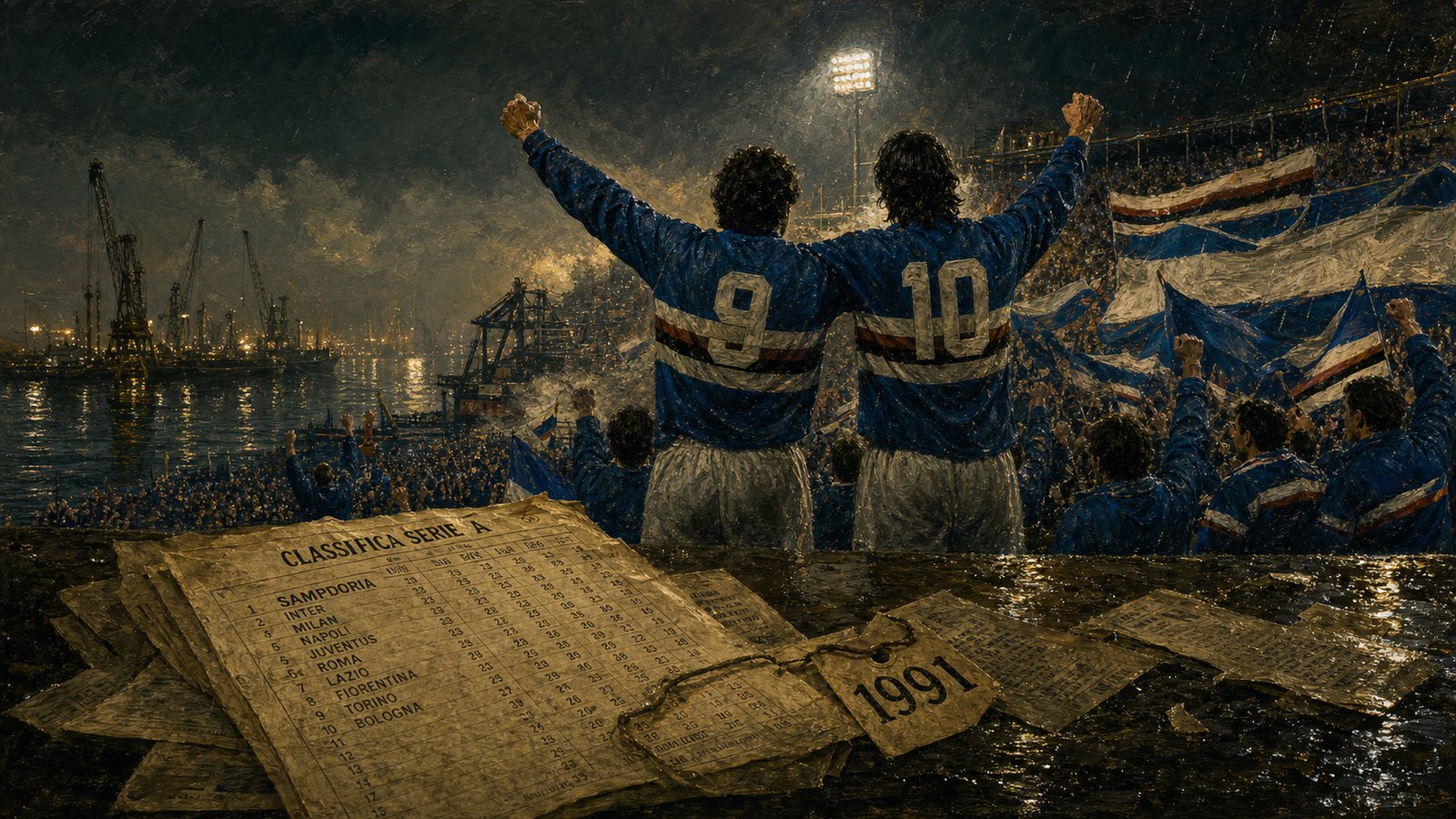
Serie A in 1990-91 was not a soft stage. Milan still carried the aura of Arrigo Sacchi’s revolution. Inter had financial muscle and enormous expectations. Juventus remained Juventus, even during seasons that felt transitional by their standards. For Sampdoria to finish above that field, they needed more than a good story. They needed a team that could collect points when the match was awkward, when away grounds were hostile, and when opponents decided that letting Vialli and Mancini play was a form of negligence.
Boskov’s genius was not that he made Sampdoria simple. It was that he made their risks legible. The side could attack with personality, but it did not behave like a loose collection of forwards waiting for inspiration. The midfield understood distances. The defence was protected by habits rather than hope. When the famous partnership up front dropped, spun, or attacked the box, the rest of the team knew what the movement demanded behind them.
That is why the 1991 title should not be filed only under nostalgia. Sampdoria were a club outside the traditional northern superpower pattern, but their football was not a holiday from seriousness. It was a serious answer to a league where the margins were brutal. The charm made the story memorable. The structure made it possible.
The Vialli-Mancini partnership was a mechanism
Vialli and Mancini are often remembered as a pair because football loves partnerships it can name quickly. Yet the reason this one mattered was not simply friendship, flair, or complementary hairstyles in old photographs. Their connection changed the geometry of Sampdoria’s attacks. Vialli could threaten depth and power. Mancini could receive between lines, slow the rhythm, and give a move its second idea. Defenders were not facing two separate forwards. They were facing a conversation that kept moving.
That conversation helped Sampdoria solve a central problem in Italian football: how to create chances without opening yourself to punishment. Serie A defences were too educated to be beaten by enthusiasm alone. The best attacks had to create hesitation. If a centre-back followed Mancini, space could open behind him. If he held his position, Mancini had time to turn or combine. If the back line focused on Vialli’s runs, Sampdoria could use the space underneath. The partnership worked because every defensive answer created another question.
The sensory memory of the side belongs as much to the spaces as to the goals: the half-turn near the edge of the box, the clipped pass into a channel, the sudden acceleration after a patient exchange. It was not chaos. It was rehearsed uncertainty. Sampdoria made defenders feel as if they had made the right decision one second before the ball proved them wrong.
Boskov gave a small giant the right temperament
Vujadin Boskov’s public persona could be dry, funny, and disarming, but reducing him to quotes misses the managerial job. Sampdoria had to believe they belonged in a title race without behaving as if belief alone would carry them. That is a delicate psychological task. A club unused to being the hunted can start playing the occasion instead of the match. Boskov’s team generally avoided that trap because their identity was practical enough to survive pressure.
The title campaign also demanded squad trust. It is easy to celebrate the forwards after the fact, but league championships are built across ordinary weekends. They require full-backs who repeat sprints, midfielders who accept unglamorous covering work, defenders who treat a blocked cross like a goal, and substitutes who keep the level from cracking when the first choice plan is unavailable. Sampdoria’s 1991 side had enough of that hidden labor to make the headline talents count.
This is where the club’s scale becomes important. Sampdoria were not a tiny amateur miracle, but they were not Milan, Inter, or Juventus either. Their margin for waste was narrower. A bad signing, a fractured dressing room, or a tactical identity that depended too heavily on one mood could have pulled them back toward normality. Winning Serie A required the whole club to spend its energy with unusual accuracy.
Italy’s giants were not beaten by accident
Calling the Scudetto a fairy tale can accidentally flatter the giants. Fairy tales imply that the normal rules were suspended. In 1991, the rules were very much in force. Points were counted the same way. Away games were still hostile. Tactical mistakes were still punished. Milan and Inter did not step aside out of generosity. Sampdoria forced a season in which the larger clubs could not convert their advantages into the table position they expected.
The significance grows when placed against the league’s era. Italian football was the destination for many of the world’s best players, and tactical preparation was relentless. A champion in that environment had to solve both the glamour and the grind. Sampdoria’s title did not happen because Serie A briefly forgot how to defend. It happened because Sampdoria found enough repeatable attacking relationships and defensive discipline to make one year bend around them.
There is also a time-limit built into the story. The following season’s European Cup run to the 1992 final showed that 1991 was not a fluke, but it also underlined how difficult the model was to sustain. The club could reach Wembley and still feel the shadow of a system that needed everything aligned: key players, coaching clarity, financial realism, and competitive hunger. One title was not the beginning of a dynasty. It was the peak of a machine operating at its cleanest setting.
The legacy is sharper than nostalgia
Sampdoria’s Scudetto still matters because it challenges how football talks about outsiders. Some underdog stories are built on a single upset, but a league title is different. It is not one emotional night. It is a long audit. Every weak habit eventually receives another chance to betray you. Sampdoria passed that audit in the most demanding domestic competition of the period, which makes the achievement less whimsical, not more.
The club’s later history adds melancholy, but it should not turn the 1991 team into a museum piece. Their lesson is alive whenever a non-superclub tries to compete through coherence rather than imitation. You cannot always buy the depth of the giants. You cannot always keep your best players forever. But for a season, if the coach, the partnerships, the dressing room, and the risk management align, a club can make the table tell the truth it wants.
That truth in 1991 was simple and startling. Sampdoria were not merely charming. They were the best team in Italy, and they became that by making romance obey a system.
Sources
- Lega Serie A historical tables
- Sampdoria club historical records
- RSSSF Italy 1990-91
- Contemporary Italian football reports
- UEFA archive for Sampdoria’s 1991-92 European Cup run