
PSV’s 1988 European Cup win is easy to misremember as a penalty-night curiosity: a 0-0 final, Benfica blinking first, and a Dutch club leaving Stuttgart with the trophy. That version is too small. The real story is stranger and more useful. PSV were not the most glamorous European champions of the decade, but they were one of its clearest examples of how a club can turn domestic superiority, squad continuity, and tournament nerve into a machine that survives nights when the football itself becomes ugly.
A treble built before the final ever started
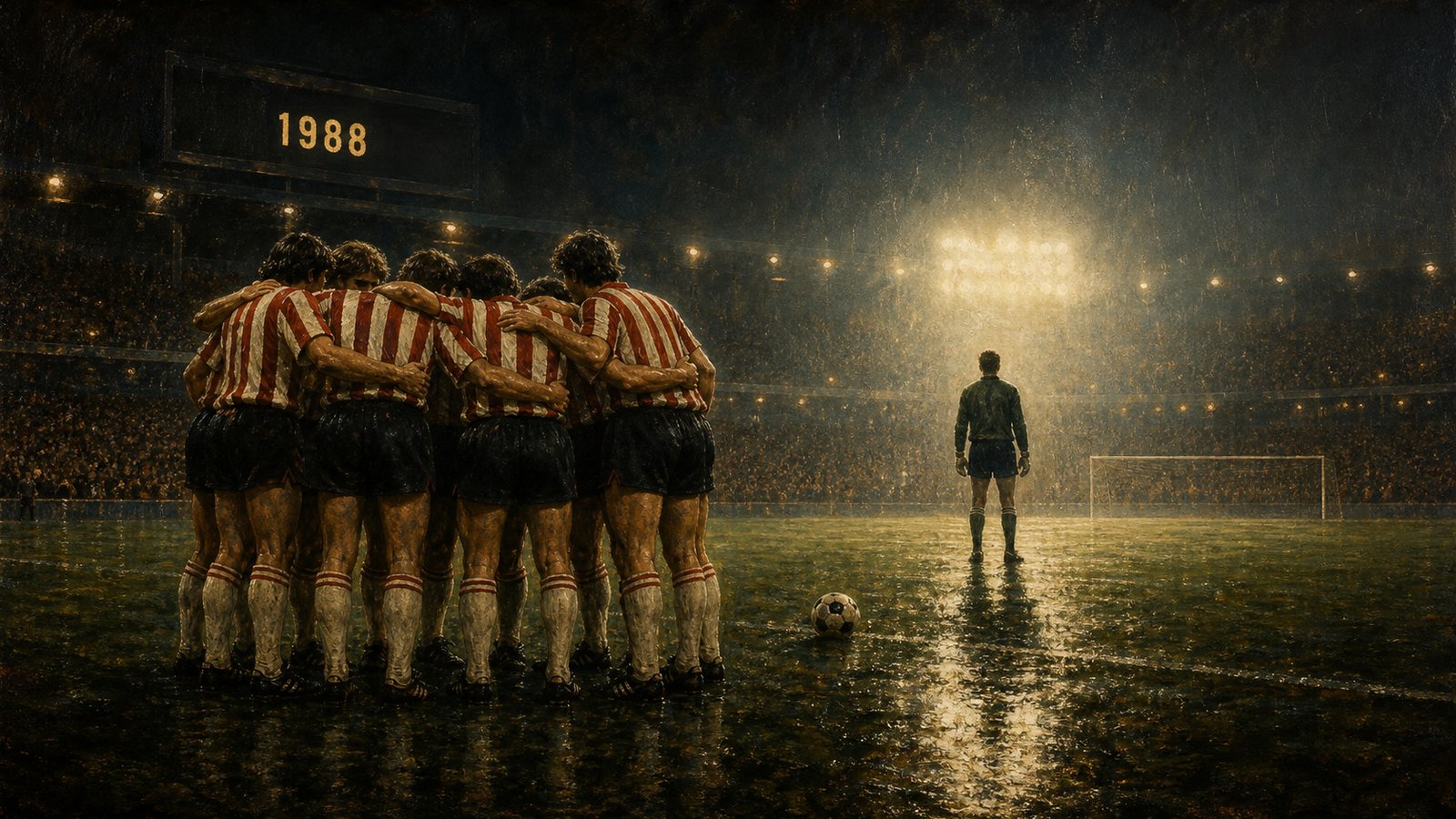
By the time PSV reached the European Cup final in May 1988, their season had already created a different kind of pressure. Guus Hiddink’s side were not trying to rescue a campaign with one famous night. They were carrying the weight of a domestic double and chasing a treble that would put them beside the rarest club seasons in European football. The Eredivisie title and KNVB Cup did not make Stuttgart easier; they made the final feel like the last exam in a year where everything had to connect.
That matters because PSV’s European run was often judged by the final scoreline rather than the system that delivered it. They were not a side built around one romantic burst of attacking genius. The spine had experience, the midfield could absorb long spells without panic, and the forwards understood that European knockout football often rewards control before beauty. Hiddink did not need his team to win every argument with a flourish. He needed them to keep the argument going until the opponent ran out of clean answers.
There was also a Dutch context that gets flattened by the trophy photograph. Ajax and Feyenoord carried much of the Netherlands’ older European mythology, but PSV had become the country’s most reliable power in the late 1980s. Their run was not a provincial accident. It was a sign that Eindhoven had learned to compete through organization, recruitment, and repeatable habits rather than through the single great generation model that had defined so many earlier Dutch stories.
Why the route looked less heroic than it really was
The knockout trail gave critics an easy line of attack. PSV advanced through several ties without producing the kind of spectacular statement that becomes archive shorthand. They could draw, protect, and survive. In a competition still shaped by two-legged caution, away goals, and thin margins, that was not a defect. It was an operating method. A team that can keep a tie alive for 180 minutes is not merely lucky; it has mastered the emotional tempo of the format.
This is where the 1988 side becomes more interesting than a highlight reel. Tournament football punishes teams that need every match to resemble their preferred script. PSV could play inside a mess. They could accept a night where rhythm broke, where the midfield became crowded, where the ball spent too long in safe zones and not enough in the penalty area. The glamour was limited, but the resilience was real. A European champion does not always announce itself by overwhelming opponents. Sometimes it announces itself by refusing to give them the mistake they are waiting for.
Benfica made that reality sharper in the final. The Portuguese club had their own European pedigree and enough technical security to prevent PSV from turning the match into a comfortable Dutch procession. The 0-0 was not a blank page. It was a match of narrowing options: tired legs, conservative choices, and the knowledge that one rash movement could ruin an entire season. By extra time, the final had become a test of who could keep thinking clearly while the trophy sat almost within reach.
Stuttgart turned penalties into a season verdict
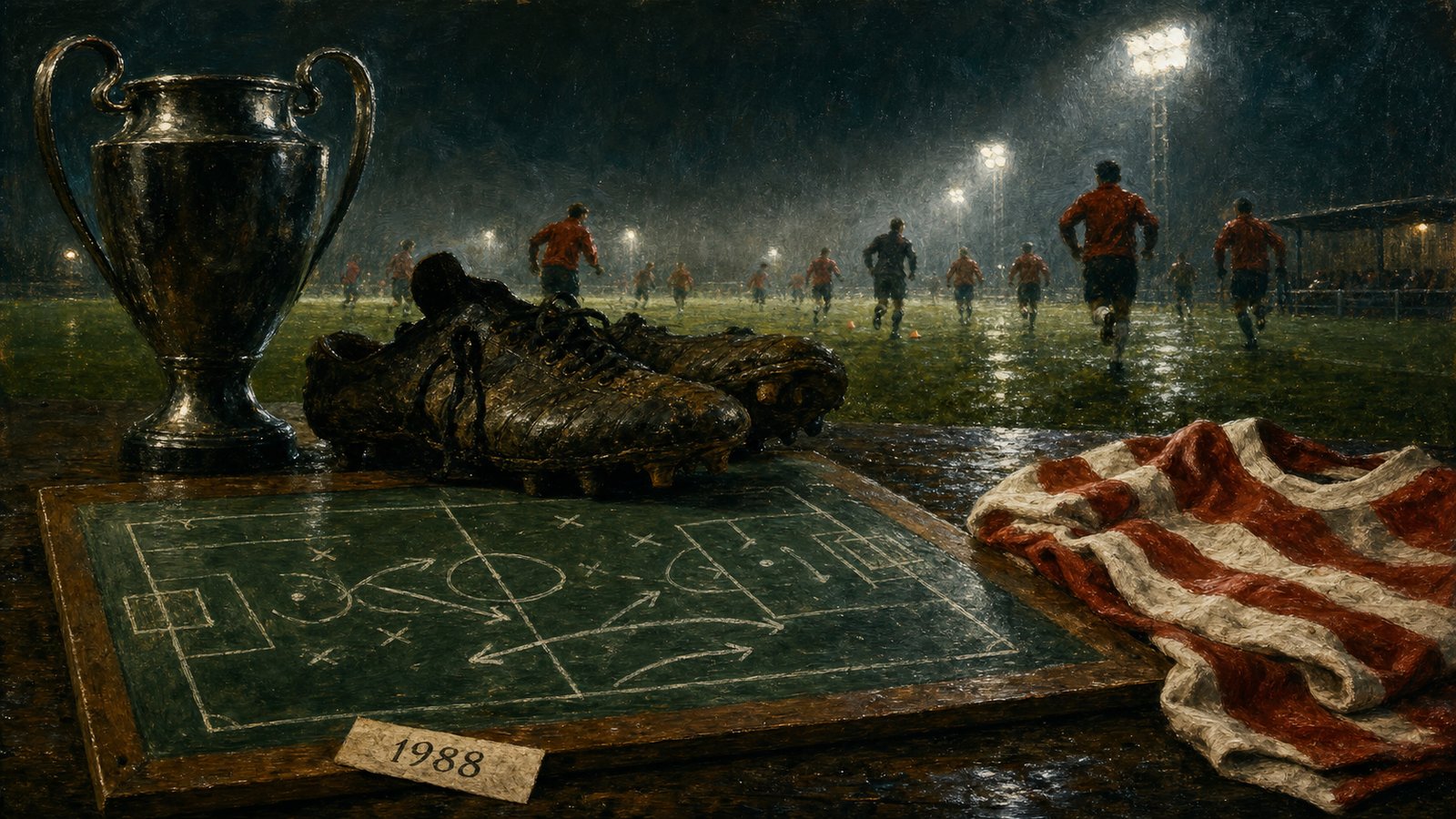
Penalty shootouts are often described as lotteries by people who want the story to feel merciful. They are not pure lotteries for the players standing twelve yards out with a year’s work behind them. In Stuttgart, every kick carried the pressure of PSV’s treble chase and Benfica’s chance to end a long wait. The stadium detail that survives is not a tactical diagram but a physical sensation: the long walk from the centre circle, the goalkeeper alone in a bright rectangle, and the pause before the run-up when a season becomes suddenly personal.
PSV’s win on penalties did not mean their European Cup was small. It meant the final verdict arrived through the narrowest instrument football owns. That distinction matters. A side can be fortunate in moments and still worthy across a campaign. PSV had already built the platform that allowed penalties to matter. Without the league consistency, the cup endurance, and the ability to keep European ties under control, there is no treble waiting to be completed from the spot.
The penalty ending also explains why the team is sometimes under-loved. Football memory prefers champions with a signature image: a great dribble, a crushing final, a tactical revolution visible in one frame. PSV 1988 offers a different image. It is the huddle, the calculation, the refusal to collapse when the match gives nobody space. That kind of greatness is harder to sell, but it is closer to how many competitions are actually won.
The hidden lesson of a quiet champion
The 1988 treble says something uncomfortable about European football’s storytelling habits. We often separate teams into artists and survivors, as if the best sides cannot be both. PSV were not remembered as artists in the way Ajax 1971 or Milan 1989 were remembered, but they were not merely survivors either. They had the league dominance to prove repeatability, the cup record to prove depth, and the European nerve to prove they could carry those qualities into hostile, compressed games.
Hiddink’s later reputation also makes the season look less accidental in retrospect. His career would become associated with pragmatic tournament management: building belief quickly, giving teams a structure they could trust, and finding ways to make stronger or more famous opponents uncomfortable. PSV 1988 was not just a young coach stumbling into a miracle. It was an early demonstration of a football temperament that valued clarity under stress.
That is why the final score should not shrink the achievement. A 0-0 can be dull as entertainment and enormous as evidence. PSV did not win the treble because one shootout smiled at them. They reached the shootout because their season had been engineered to keep doors open, and then they walked through the last one.
Why 1988 still feels modern
Modern Champions League football is full of clubs trying to solve the same problem PSV solved in an older format. How do you build a squad that can dominate domestically without becoming naive in Europe? How do you keep enough attacking ambition to win titles while retaining enough control to survive knockout friction? How do you make players believe that an ugly night is not a betrayal of the plan but part of it?
PSV’s answer was not a universal blueprint, but it was a real answer. Their season shows that a club outside the loudest glamour markets can still create a year of maximum return if its internal logic is strong enough. The 1988 European Cup was not the prettiest chapter in the competition’s history. It was something colder and in some ways more impressive: a proof that consistency, nerve, and structure can drag a team all the way to the edge of history, even when the final itself refuses to sing.
Sources
- UEFA competition archive
- PSV Eindhoven historical records
- RSSSF European Cup 1987-88
- Dutch league historical tables
- Contemporary reports from the 1988 European Cup final