
Greece’s Euro 2004 victory is often filed under miracle because miracle is a convenient word for a result that humiliates prediction. It lets everyone admire the shock without examining the mechanism. But the tournament in Portugal was not won by mist, luck, or one heroic night. Greece built a repeatable contest from things every opponent could see: compact distances, disciplined marking, set pieces, narrow scorelines, and a refusal to become embarrassed by their own plan.
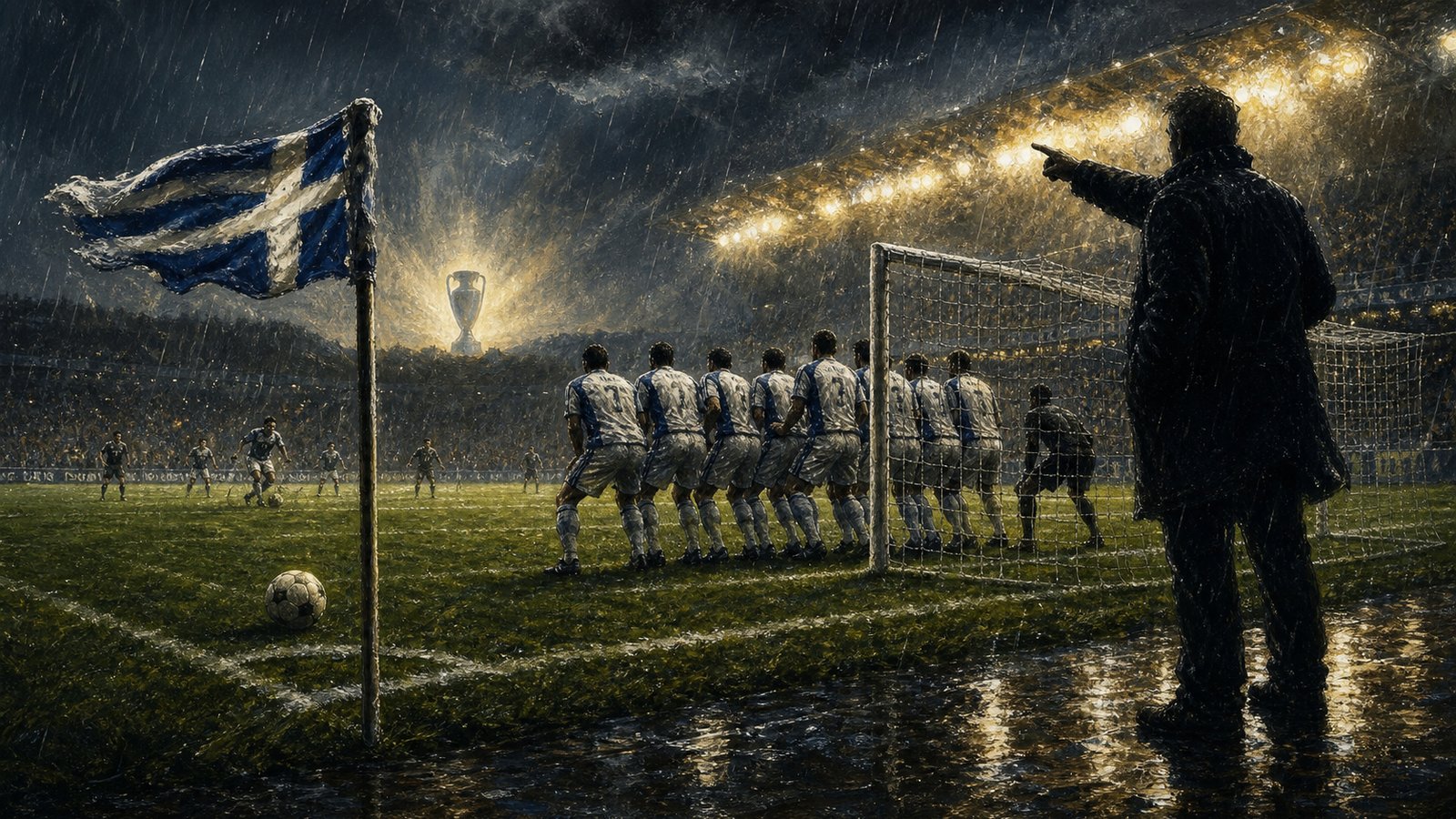
The oddity is that none of this was hidden. Otto Rehhagel’s team did not arrive with a tactical secret wrapped in a new formation name. They offered a simple bargain. They would reduce the match, protect central spaces, compete fiercely on crosses and restarts, and ask technically stronger teams to prove they could stay calm for ninety minutes. Portugal, France, the Czech Republic, and Portugal again all had more fashionable attacking language. Greece had a tournament grammar that became harder to break the longer it survived.
The opening match changed the room
The first match against Portugal mattered because it turned the host nation’s party into a warning. Greece won 2-1 in Porto, with Giorgos Karagounis scoring early and Angelos Basinas converting from the penalty spot. For Portugal, the defeat could be framed as a nervous opening night. For Greece, it was evidence that the plan could work against a team carrying talent, crowd expectation, and a presumed route deep into the competition.
That result gave Greece something underappreciated in tournament football: permission to keep believing in restraint. A lesser outsider sometimes wins once and then tries to become expansive because the first shock changes its self-image. Greece did the opposite. The win told them their narrow path was not cowardice. It was structure. They could let opponents have more of the ball in safer places if the dangerous zones remained contested. They could accept long stretches without glamour because the match’s emotional center was moving toward frustration.
Compactness turned stars into decision-makers
Greece’s defensive work was powerful because it forced elite attackers to choose under conditions they disliked. The distances between defenders and midfielders were tight. Wide areas could be used, but not always converted into clean central chances. Crosses had to beat bodies who were already waiting. Passes into the box met defenders who treated the second action as seriously as the first.
This is where the word defensive can mislead. Greece were not merely retreating. They were deciding which parts of the pitch were worth arguing about. When opponents circulated the ball, Greece could look passive. When the ball entered a valuable zone, the team became aggressive. That contrast was the trap. It tempted opponents to interpret possession as progress, then punished them when the final pass required more patience than their anxiety allowed.
Set pieces were not decoration
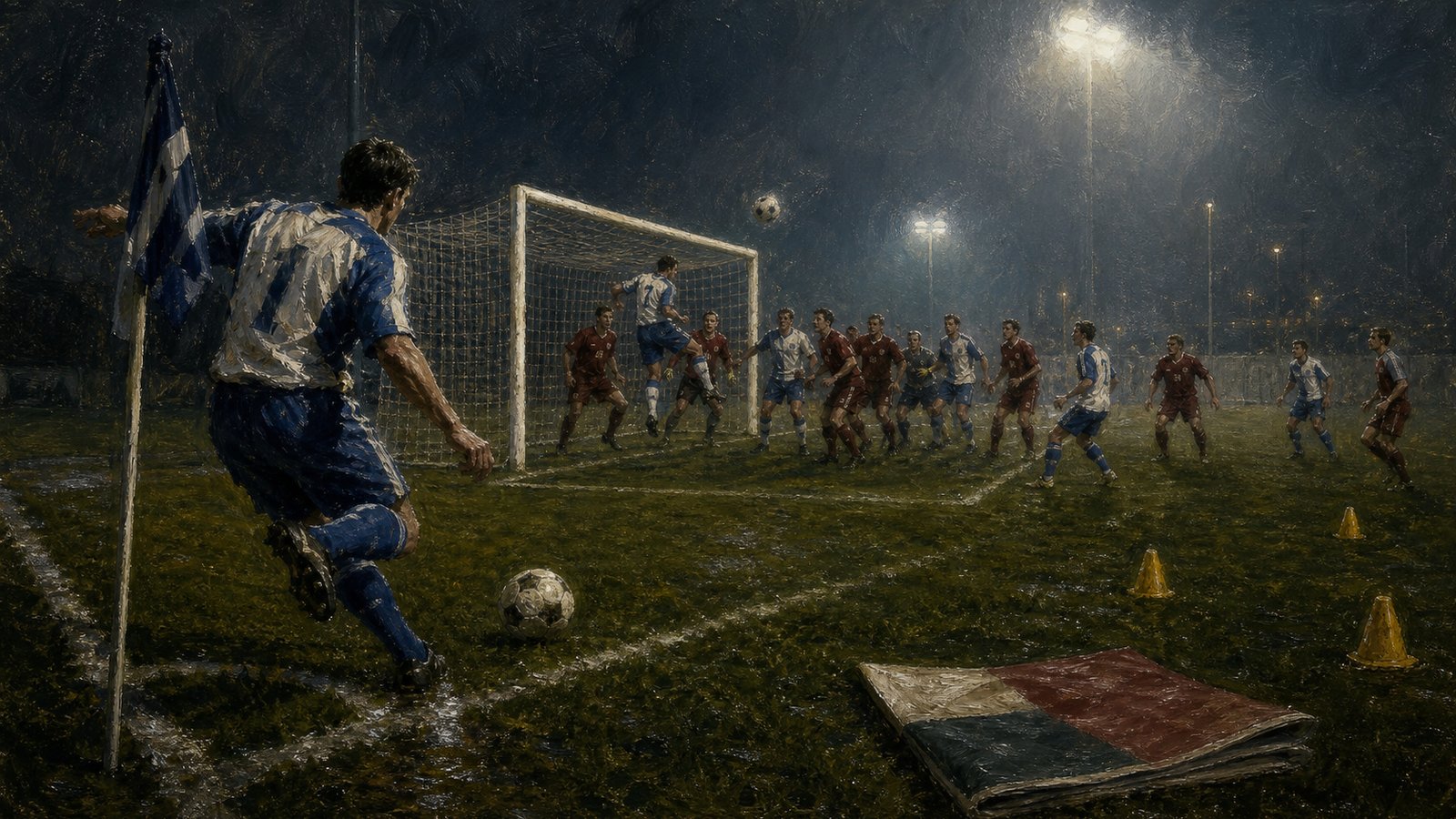
The tournament’s most famous moments showed how important dead balls and rehearsed pressure became. Greece beat France 1-0 in the quarter-final through Angelos Charisteas, a goal made from a cross that punished a champion side expected to solve the puzzle. In the semi-final against the Czech Republic, Traianos Dellas scored the silver goal from a corner in extra time. In the final, Charisteas headed in from a corner against Portugal. Those were not random scraps added to defensive football. They were the attacking half of the design.
A set piece shrinks football to a sequence of jobs. Block the run. Attack the space. Hold the line. Deliver with enough quality. Greece were comfortable in that language. Their opponents, often pushed by expectation, were trying to create more complex superiority from open play. Greece kept returning them to simpler tests and won enough of those tests to tilt the entire tournament.
The favorites were fighting the scoreboard and themselves
The hardest thing about playing Greece in 2004 was not that they never allowed chances. It was that every missed chance made the next one heavier. France still had champions from the 1998 and 2000 cycle. The Czech Republic had been one of the tournament’s most attractive and forceful sides, with Pavel Nedved’s injury in the semi-final becoming part of the night’s turning point. Portugal had Luís Figo, Deco, Cristiano Ronaldo, and a home crowd desperate for release. Greece made all of that talent perform under narrowing emotional conditions.
Football culture often praises the team that imposes its identity with the ball. Greece imposed identity through the scoreboard. Once a match stayed level or became 1-0, the favorite’s superiority started to feel theoretical. The longer the favorite failed to turn quality into control, the more Greece’s plan looked less like resistance and more like authorship.
Rehhagel’s authority was the invisible glue
The plan required players to tolerate being underestimated in public. That is difficult. A footballer wants the ball, wants proof, wants a visible way to show he belongs. Rehhagel gave the squad a different kind of dignity. The discipline was not presented as a lack of ambition. It was the route to ambition. Players such as Theodoros Zagorakis, Dellas, Basinas, Karagounis, and Charisteas became central not because they matched every opponent’s star power, but because they matched the tournament’s demands.
Zagorakis embodied the emotional register: calm enough to keep the team connected, combative enough to make every opponent feel the match was being contested in uncomfortable places. Greece needed that leadership because the plan left little room for vanity. If one midfielder chased applause, if one defender switched off after an initial clearance, the fortress became a wall with a door left open.
The victory still irritates people for a reason
Greece 2004 remains divisive because it challenges the comforting idea that tournaments are moral tests of attacking imagination. The better story, according to that view, is supposed to belong to the side with more invention. Greece answered with a colder truth. Tournament football rewards the team that best understands the exact competition it is playing. Six or seven matches do not require the same skills as a league season. They reward emotional control, repeatability, and the ability to make opponents live inside a problem they hate.
The details are also why the upset aged better than many shocks. Greece did not need to win a penalty shootout to become champion. They eliminated France in normal time, survived the Czech semi-final through the silver-goal rule, and beat Portugal in the final with the same corner-kick severity that had defined the run. The pattern gave the title weight. Opponents changed, stadiums changed, pressure changed, and the same narrow doorway kept appearing.
There was glamour in the refusal as well. A header from Charisteas, a captain’s duel from Zagorakis, a defender’s run from Dellas, a goalkeeper’s command of crowded spaces: these were not lesser football acts. They were tournament acts, exactly suited to the conditions. Greece made the summer less about who could produce the most beautiful passage and more about who could keep repeating the necessary one when the noise rose.
The result was not a blueprint every outsider can copy. It required timing, coaching authority, set-piece quality, defensive concentration, and a group willing to accept public misunderstanding. But it was not a miracle either. Greece built a fortress from visible materials, with touchline discipline, aerial timing, and collective nerve, repeatedly. The rest of Europe saw the walls, felt the clock moving against them, and still spent the summer running into them.
Sources
UEFA Euro 2004 official archive; RSSSF European Championship 2004 records; FIFA historical tournament summaries; Guardian tournament reports; World Soccer Euro 2004 review.