
Celtic’s 1967 European Cup win is remembered as romance, but the deeper story is a local squad turned into a modern attacking system.
The postcard version hides the machinery
The usual telling of Celtic in 1967 is so beautiful that it almost gets in the way. Eleven players born within roughly thirty miles of Celtic Park went to Lisbon and beat Inter in the European Cup final. It sounds like folklore because it has the shape of folklore: local boys, green and white shirts, a sunny afternoon, and a trophy that had usually belonged to richer or more glamorous powers.
But that version can make the match feel like a moral fable rather than a football system. Celtic did not win because geography gave them magic. They won because a local squad had been trained into a rhythm that made the pitch feel smaller for them and larger for Inter. The famous origin detail matters, yet it matters because the players shared references, habits, dressing-room language, and a weekly domestic environment that made Jock Stein’s demands easier to absorb quickly.
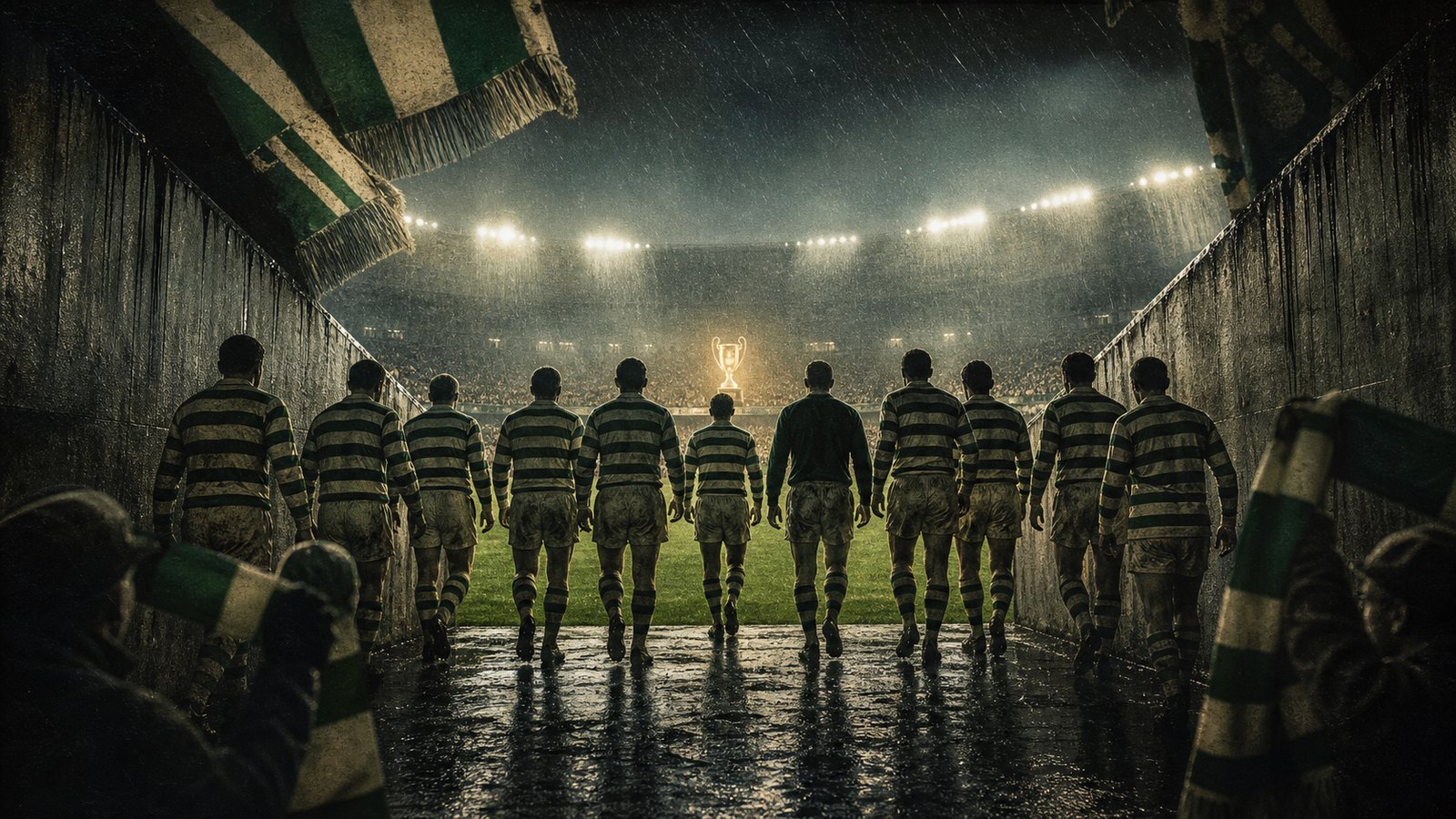
The Lisbon Lions were romantic. They were also brutally practical. Their story is not only that eleven local men reached the top of Europe; it is that a club without continental aristocratic status built enough collective understanding to attack a defensive empire without losing its nerve.
Inter forced Celtic to prove the idea in real time
The opponent is essential. Inter were not a decorative final boss. Helenio Herrera’s side carried the aura of catenaccio, European control, and emotional suffocation. They were comfortable making matches feel like locked rooms. When Inter scored early from the penalty spot, the final immediately became a test of whether Celtic’s attacking identity was genuine or just domestic momentum dressed up for Europe.
Celtic’s response was not a frantic rebellion. They pushed the ball wide, kept bodies moving around the box, and asked repeated questions until Inter’s structure had to defend too many actions. The shots kept coming. The full-backs did not behave like men grateful to be there; they behaved like extra attackers. The midfield did not treat possession as decoration; it treated it as a way to keep Inter from breathing.
That is the mechanism the myth can flatten. Celtic needed patience as much as passion. They needed local confidence without local parochialism. They needed enough technical security to continue attacking after the match had handed them the worst possible start.
The local core made repetition cheaper
A local squad is not automatically coherent. Plenty of local teams have been limited by exactly the same closeness that later makes nostalgia glow. Celtic’s advantage was that the local core reduced the cost of repetition. Players knew each other’s tempers, angles, and weaknesses. Stein could demand bravery because the dressing room already had social pressure built into it.
That social pressure mattered when the full-backs went forward, when the forwards rotated, and when the team kept squeezing the game toward Inter’s penalty area. A player who hesitated was not only failing a manager’s instruction; he was letting down men he had grown up alongside, men whose families and streets were part of the same football weather.
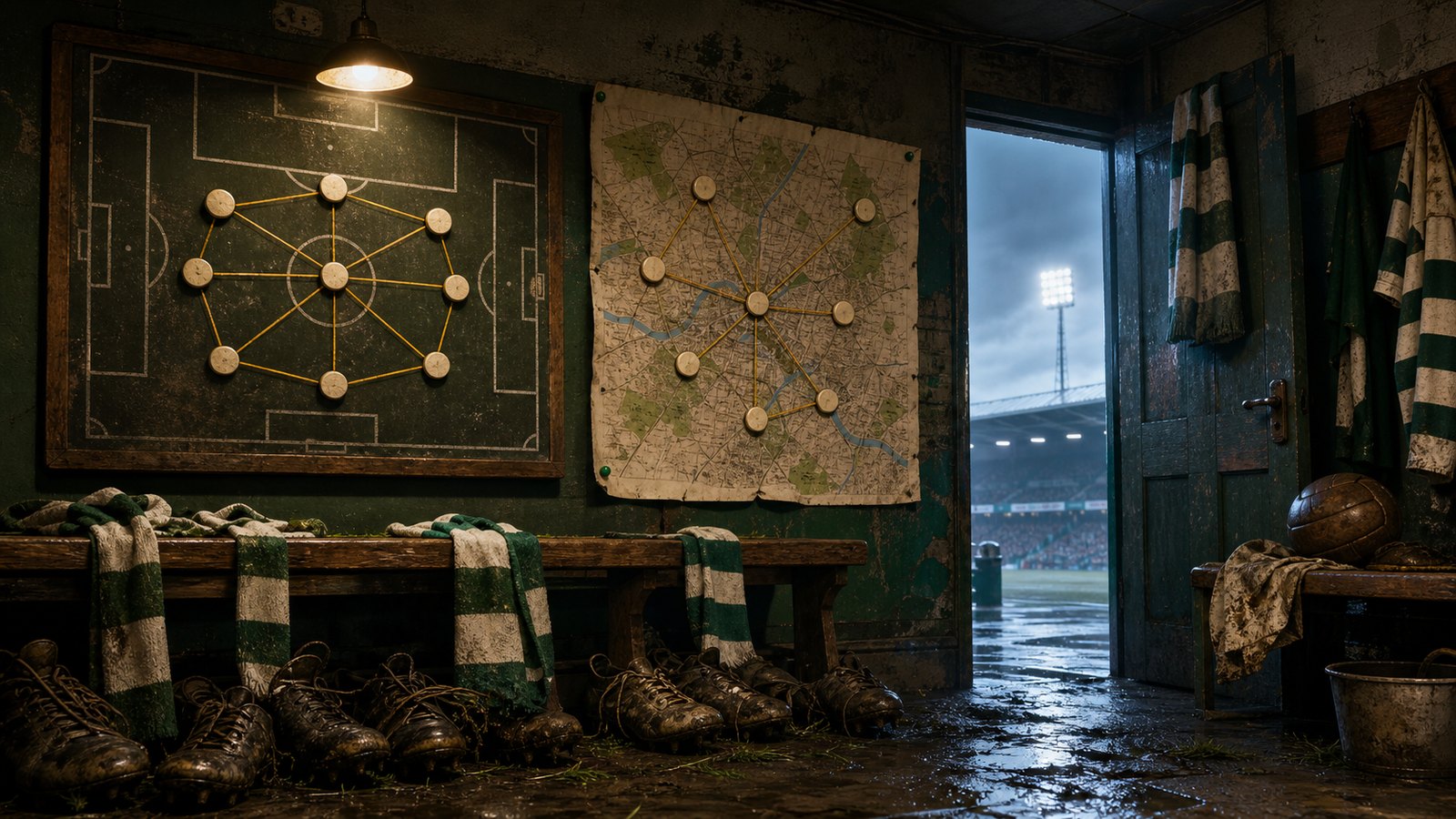
There is a tactical lesson here that still travels. Recruitment is often discussed as a search for individual upgrade. Celtic’s 1967 team shows another route: assemble a group whose shared timing allows a manager to ask for more collective risk than a looser dressing room might tolerate.
The goals were releases, not accidents
Tommy Gemmell’s equalizer is often remembered as the emotional detonation of the final, and rightly so. But it was not a random thunderbolt from nowhere. It belonged to a match in which Celtic had kept asking Inter’s back line to shift, block, and reset. When a full-back arrives as a shooting threat in that context, he is not simply a surprise visitor; he is evidence that the whole attacking plan has stretched the opponent’s attention.
Stevie Chalmers’ winner carried a different kind of proof. It was close-range, sharp, and born from pressure rather than from a single heroic run. By then the final had become a siege with a football logic. Inter were not beaten by a sentimental script. They were beaten by a team that made defensive certainty feel increasingly expensive.
The scoreline, 2-1, looks narrow. The match memory feels wider because Celtic’s method seemed to reverse the usual European hierarchy. The outsider did not steal the final. The outsider imposed the more convincing game.
Why Lisbon still matters
The legacy of the Lisbon Lions is not just that Celtic became the first British club to win the European Cup. It is that the win preserved an argument about how clubs can build power. Money helps. Continental experience helps. But there are moments when identity, coaching, and repetition become a kind of infrastructure.
Modern football often treats local identity as branding once the serious work is done elsewhere. Celtic in 1967 suggests a harder possibility: identity can be operational if it changes how quickly a team trusts the next pass, the next overlap, and the next risk. The local detail did not replace tactics. It made tactics more believable under stress.
That is why the Lisbon story survives without needing to be softened. It was emotional because it was local. It was historic because it was European. And it was football history because the romance had a working engine underneath it.
The mistake is treating locality as sentiment only
The sharper reading is that locality gave Celtic a lower-friction operating system. Training instructions did not have to travel through a dressing room of strangers assembled from five leagues and three languages. The players could challenge one another quickly because the social bonds were already there. In a final that demanded repeated attacking commitment, that speed of trust was not ornamental; it was competitive infrastructure.
It also helped Stein sell an aggressive plan without making it sound reckless. A team that attacks with both full-backs against Inter needs more than slogans. It needs center-backs who believe the next pressure action will arrive, midfielders who trust the wide overloads, and forwards who keep making runs even when the first six crosses are blocked. Celtic’s local story becomes more impressive, not less, when it is treated as a mechanism rather than a postcard.
What opponents copied and what they could not
Other clubs could copy parts of the lesson: wide aggression, high technical standards, a manager with a clear collective demand. They could not easily copy the social density of that squad. The Lisbon Lions came from a football culture in which Celtic was not an abstract employer. It was a neighborhood sound, a family argument, a weekly identity. That gave the final a pressure ordinary professional projects rarely reproduce.
The danger is romantic overreach. Local birth certificates did not win duels by themselves, and nostalgia can turn players into symbols too quickly. The better legacy is more demanding. Celtic showed that a club outside the richest continental centers could create a European-level team if its recruitment, coaching, and identity all pulled in the same direction at exactly the right time.
That is why the final still feels modern. Clubs still search for ways to make collective behavior arrive faster than the market expects. Celtic found one route through proximity, coaching authority, and a shared sense of place. Lisbon was not a museum piece. It was an early proof that culture can become tactical speed when a manager knows how to turn it into daily work.
Sources
- UEFA historical match records
- Celtic FC historical archive
- Jonathan Wilson, Inverting the Pyramid
- The Guardian retrospective coverage
- RSSSF European Cup records