
Catenaccio is one of football’s most abused words. It is often used as a lazy insult, a way to describe any team that defends deep, slows the rhythm, or refuses to entertain the neutral. The caricature contains a piece of truth because the system was built around denial. But it misses why Helenio Herrera’s Inter became so powerful in the 1960s. Catenaccio was not just anti-football. At its best, it was a complete theory of control: protect the central spaces, free a spare defender, turn winning the ball into a trigger, and make the opponent’s impatience part of your attack.
The name itself means bolt, and the image is useful. A catenaccio side wanted the door to close at exactly the moment an attack believed it had found an opening. Yet the system was not simply eleven men standing near their own goal. Herrera’s Inter depended on roles, timing, and mental pressure. It was theatrical in a way that modern viewers can miss. The team made the opponent feel as if every hopeful pass was being drawn into a trap.
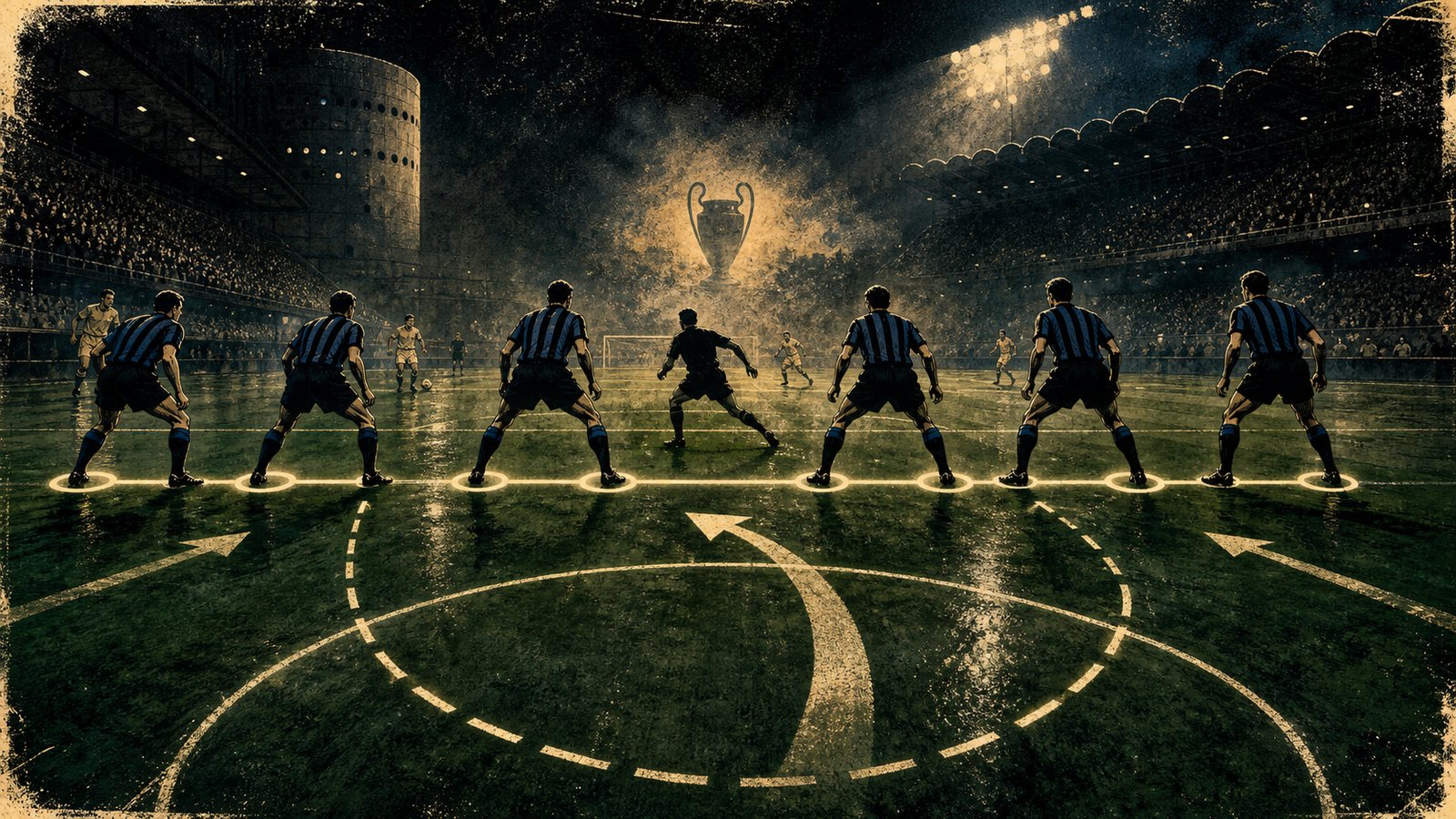
The libero changed the emotional geometry
The libero, or free defender, is central to the story because he altered how danger was interpreted. Instead of every defender being tied to a direct duel, one player could sweep behind, read the break, and repair what the first line could not stop. That did not remove pressure from the rest of the team. It changed the kind of pressure they could accept. Markers could engage more aggressively because there was cover. Midfielders could funnel attacks into areas where the spare man’s reading mattered.
This role gave catenaccio its sense of inevitability. An attacker might beat the first challenge and still discover that the real problem had been waiting behind it. The opponent’s best move could become just another invitation to the trap. The libero was not merely a safety valve. He was the reason the defensive system could feel calm while everyone else grew frantic.
Herrera turned tactics into theater
Herrera’s Inter were never only a diagram. The manager understood the psychological side of elite football. He used slogans, discipline, and public intensity to make his squad feel like a mission. Training and preparation carried the message that the team’s suffering was purposeful. Defending was not a sign of inferiority. It was a form of command. The opponent could have the ball, but Inter wanted the match’s nervous system.
This is why the anti-football label is too blunt. Herrera did not ask his side to be passive. He asked them to control which parts of the match mattered. If the opponent’s possession happened in harmless areas, it was tolerated. If a passing lane opened into a dangerous zone, it was closed. If a turnover arrived, Inter could attack quickly into the space left by a frustrated team. The beauty was not always in the number of passes. Sometimes it was in the cruelty of the timing.
The system needed attacking weapons
Defensive systems are often discussed as if they exist apart from the players who finish the work. Inter’s catenaccio needed attacking quality because a low-scoring plan collapses if transitions never become threats. Giacinto Facchetti gave the team a modern kind of full-back force, carrying the ball and arriving in attacking positions from deep. Sandro Mazzola offered speed, craft, and penalty-area danger. The defensive lock worked because opponents knew the counterattack could punish them.
That balance is easy to overlook. A team that only clears the ball invites the next wave. A team that can break with purpose changes the opponent’s risk calculation. Every extra attacker pushed forward becomes a possible problem on the way back. Catenaccio did not simply reduce matches. It made opponents negotiate with fear: push harder and risk the counter, or slow down and play the game Inter wanted.
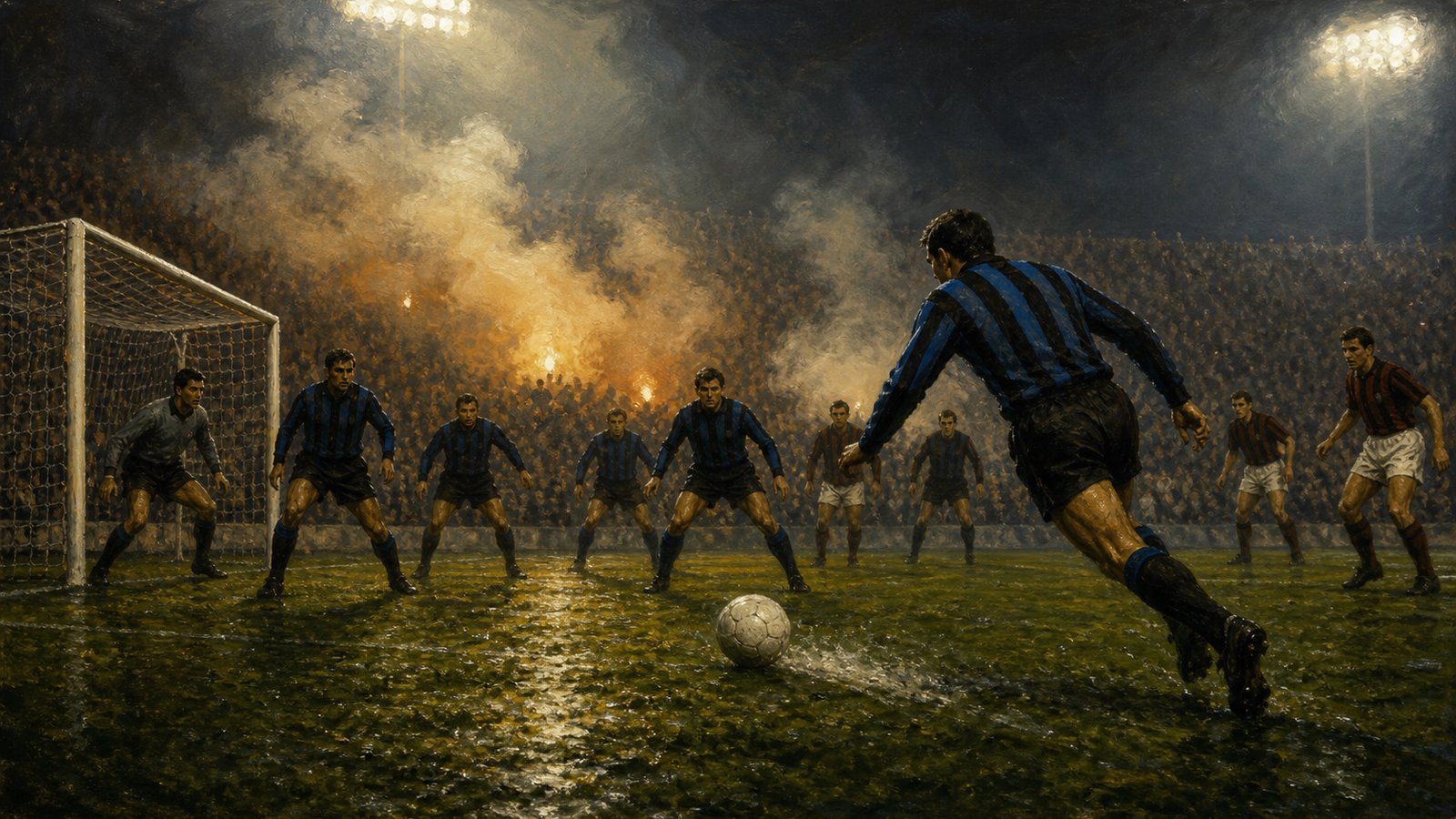
Europe rewarded control over volume
Inter’s European Cup wins in 1964 and 1965 gave the style its mythology. Knockout football is fertile ground for systems that can live with narrow margins. The best team over a season may be the one that produces the most chances and repeats its superiority across months. The best team in a two-legged tie may be the one that understands when not conceding is more valuable than looking expressive.
Herrera’s Inter mastered that tension. They did not need every match to become a festival. They needed the opponent to enter the final half hour with fewer options than they expected. A one-goal lead could feel enormous. A scoreless spell could become a form of pressure. The longer the opponent failed to find clean chances, the more every pass carried desperation. Inter’s control often became visible only when the other side lost patience.
The backlash was part of the legacy
Catenaccio’s reputation suffered because football culture often equates moral worth with attacking display. There is a fair criticism here. Defensive systems can become cynical. Time management, tactical fouls, and the narrowing of spectacle can frustrate supporters. But the stronger critique should not pretend that catenaccio lacked intelligence. The system influenced how coaches thought about spare defenders, compactness, transition threat, and the psychological value of making an opponent chase a locked match.
The backlash also shows how tactical ideas are remembered by their worst imitators. Many later teams borrowed the word without the quality, turning it into an excuse for retreat. Herrera’s Inter were different because the defensive idea connected to elite players and a complete competitive culture. The bolt was attached to a door that could swing open quickly.
The modern game still argues with it
Modern football looks very different. Pressing, positional play, high lines, and data-driven recruitment have changed the language. Yet catenaccio’s questions remain alive. How much risk should a team accept? Is control the ball, the territory, or the emotional state of the opponent? When does defending become passive, and when does it become the most efficient route to attack?
Herrera’s Inter matter because they forced Europe to take those questions seriously. Catenaccio was not just a refusal to play. It was a decision about which game would be played. The opponent could bring artistry, reputation, and possession. Inter brought a lock, a spare man, and the confidence that frustration could be engineered. That is why the system still provokes argument. It did not kill football. It exposed how many different ways there are to control it.
The detail often missed is how demanding that control was. A defensive team cannot switch off simply because it spends time without the ball. The opposite is true. Distances have to be held, markers have to read body shape, and the spare defender has to decide whether to cover space, attack the ball, or delay long enough for the block to reset. The apparent simplicity of the style hid a constant chain of small decisions. If one link broke, the whole argument could look cowardly instead of commanding.
That is why catenaccio belongs in tactical history rather than only in football’s insult dictionary. It showed that defense could be proactive even when the line was deep. It made the opponent’s impatience measurable: a rushed cross, an extra touch, a hopeful shot from distance, a full-back stranded too high. Herrera’s Inter did not merely wait for mistakes. They arranged the match so that mistakes became more likely as the minutes disappeared.
Sources
UEFA European Cup records; Jonathan Wilson, Inverting the Pyramid; Gianni Brera tactical writing; Inter historical records; contemporary accounts of the 1964 and 1965 European Cup campaigns.