

A defender in 1860s football could solve danger with a deliberately ugly act: send the ball beyond his own goal line and take the restart. The laws did not yet punish that choice with an attacking corner. A threatened goal could disappear into a routine kick-out, so the safest defensive decision was sometimes to stop playing the ball forward at all.
Sheffield’s football community noticed the incentive before the national code corrected it. A newspaper correspondent complained in March 1867 that the existing restart encouraged “foul and dishonourable play.” Eighteen months later, the Sheffield Football Association adopted a corner rule proposed by Norfolk F.C. The rule was not identical to today’s Law 17, but it established the durable principle: the team that puts the ball behind its own goal line should surrender the next touch near that corner.

A Goal-Line Escape Had No Cost
The Football Association’s first laws of 1863 treated the ground beyond the goal line as a contest of its own. When the ball went behind, players raced to touch it down. An attacker arriving first could earn a free kick at goal, while a defender arriving first produced a defensive restart. This looked more like a surviving branch of rugby than the crisp goal-kick-or-corner decision familiar now.
By 1867 the FA had simplified the situation. A ball behind the goal line generally brought a goal kick, regardless of which side had sent it there. Sheffield’s new association used a similar rule in March of that year. The simplification removed the chase and touchdown, yet it also protected a defender who deliberately cleared behind. Pressure near goal could be cancelled without giving the attacking side any compensation.
That defect mattered because the codes were still being tested in public. Sheffield clubs had played under their own evolving rules since 1858, while the London-based FA had issued a different code in 1863. Neither possessed an automatic claim to every useful idea. Rules survived when clubs found that they produced a fairer, clearer or more entertaining match.
“Rouge” Named the Unfair Incentive
On 22 March 1867, a correspondent using the name “Rouge” wrote to the Sheffield Daily Telegraph. The pseudonym carried a local football meaning. Sheffield had previously used rouges, scored around the sides of the goal, as a secondary measure and tiebreaker. By 1867, however, the writer’s attention was on what happened after an ordinary ball crossed the goal line.
Rouge called the existing arrangement an inducement to dishonourable play because a defending side gained a free kick-out by allowing or sending the ball behind. The suggested remedy was different from the final law: players would run for touch beyond the line, and the team winning that race would kick in from the nearest corner flag. Even so, the letter identified the mechanism precisely. The restart had to remove the reward for defensive evasion.
The criticism arrived during a formative year. The Youdan Cup, played in February and March 1867, involved 12 local sides and is widely described as the first organised football tournament. Its final at Bramall Lane drew a reported crowd of 3,000. Competitive football made small defects harder to ignore: a loophole that seemed tolerable in a friendly could shape who advanced or won a cup.
Norfolk F.C. Supplied the Working Rule
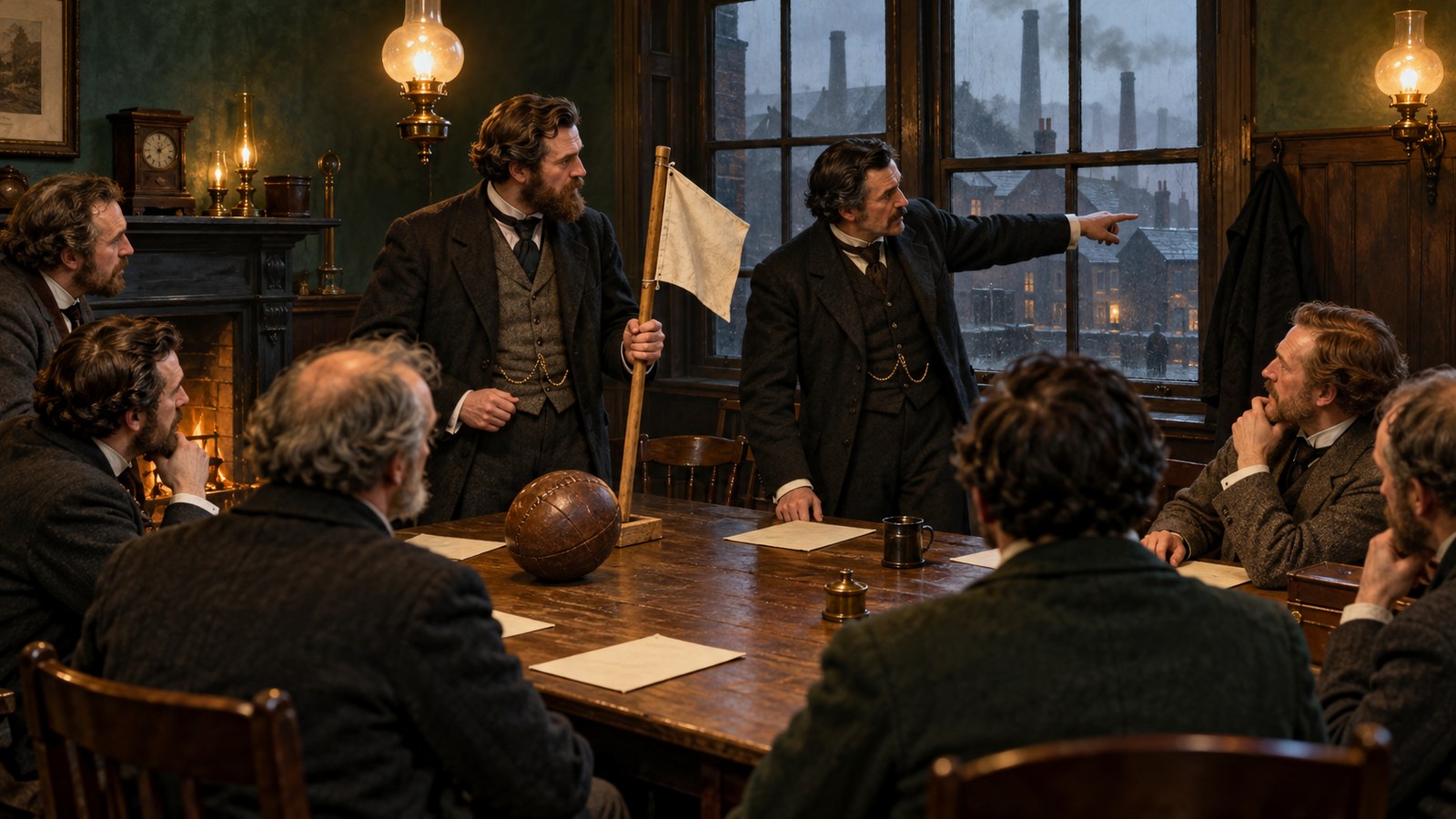
At the Sheffield Association’s October 1868 meeting, Norfolk F.C. proposed the change that created a recognisable corner kick. The new law said that when the ball crossed the goal line to the side of the goal, the restart went against the team that had kicked it out. The kick was taken from the nearest corner flag. Opponents had to remain six yards away until the ball was kicked.
The language reveals both the invention and its unfinished state. Either side could receive a corner. If an attacker put the ball behind, the defending team could take the kick from its own corner. A ball sent directly over the crossbar still produced a defensive kick from within six yards of goal. Sheffield had created a responsibility-based restart, but it had not yet separated the modern attacking corner from the goal kick in every situation.
The same 1868 revision abolished the rouge and removed its flags. It replaced the touchline throw with a kick-in that could travel in any direction, while also restoring the fair catch. The corner therefore emerged inside a broad experiment, not as an isolated flash of modernity. Some Sheffield ideas endured, some disappeared, and others were altered when the regional and national codes converged.
This experimental culture also shaped the city’s playing spaces. Sheffield had already used a solid crossbar before the London code fully accepted one, a story preserved in the contest between a crossbar and a strip of tape. The corner kick belonged to the same practical habit: notice what the game invited players to do, then change the geometry or restart until the incentive improved.
Sheffield Carried the Idea Into the FA Code
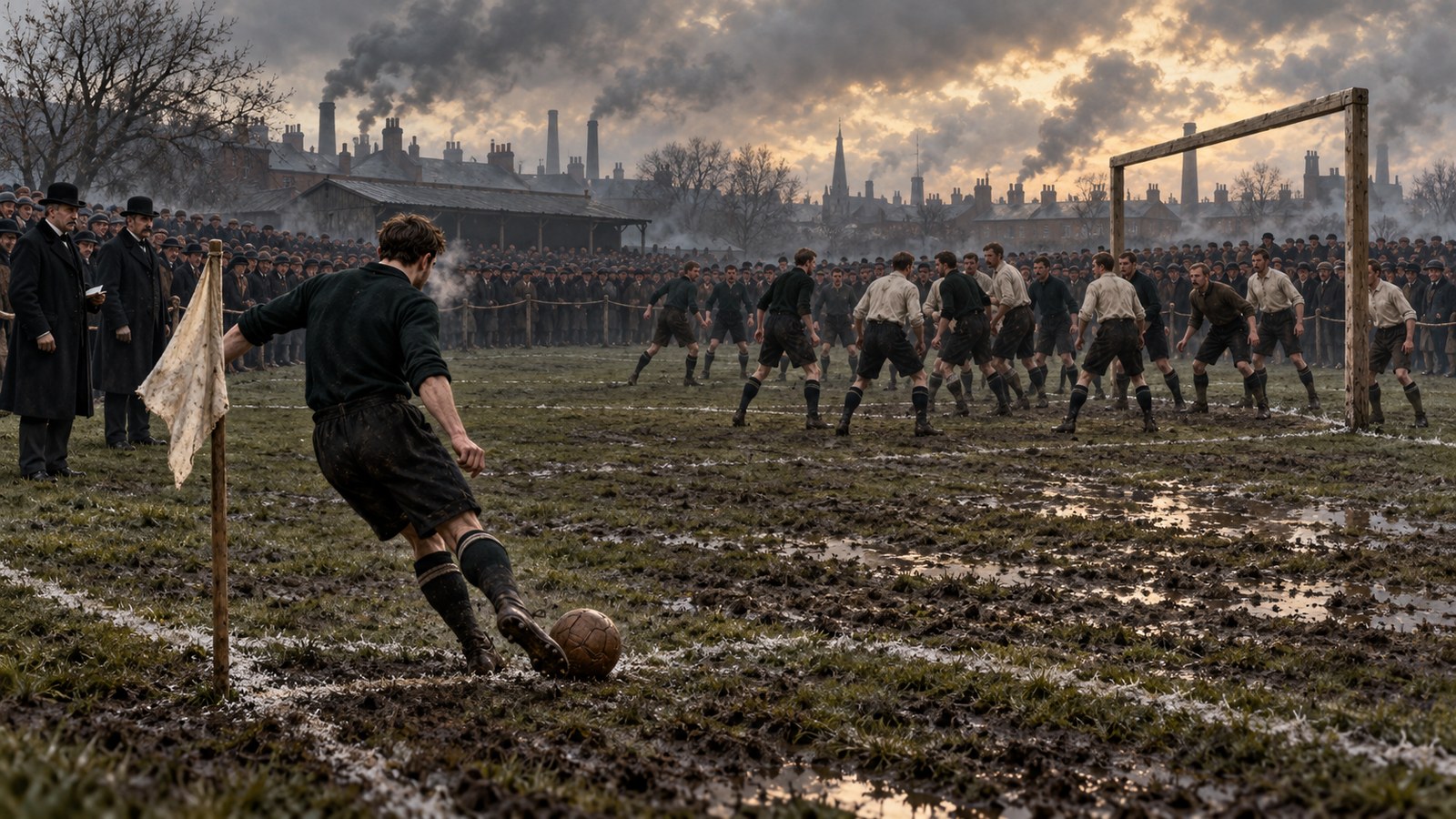
The Sheffield Association successfully proposed its corner rule to the Football Association in 1872. The FA version still reflected the regional experiment. When a player kicked the ball behind the opposing goal line, a player from the other side took the restart from the nearest corner flag. Nobody could approach within six yards until it was kicked.
A year later, the code moved closer to the modern division. If an attacker put the ball behind, the defenders received a goal kick. If a defender did it, the attackers received a corner. The restart now expressed possession and responsibility in the form supporters recognise: attacking error gave the defending side the ball, while defensive escape gave the attacking side a set piece.
The Sheffield clubs continued using their own wider code until 1877, when they accepted the FA laws. That merger should not be mistaken for London simply defeating a provincial alternative. Sheffield proposals had already entered the common rules. The national game grew through negotiation between football cultures, and the corner is one of the clearest surviving traces of that exchange.
The city’s influence was visible beyond paper. Sheffield and Hallam had staged a snow-covered match on Boxing Day 1860, years before a unified code existed; that winter fixture shows how clubs learned by playing through local conditions. The law meetings that followed converted those repeated experiments into rules other regions could share.
One Restart Kept Evolving
The 1872 corner was only a framework. The term “corner kick” itself first appeared in the laws in 1883; “corner-flag kick” had been used earlier. Players were exempted from offside directly from a corner in the 1883 laws. The exclusion mattered because the ball could be played into a crowded goalmouth without an attacker being punished at the instant of the restart.
Other details changed as tactics and technique developed. A player was forbidden in 1875 from touching the ball twice before anyone else played it. The required distance for opponents eventually increased from six yards to ten. The one-yard quarter-circle was named explicitly in the laws in 1938, although diagrams had shown the marking decades earlier.
Direct scoring followed its own path. The early rule did not prohibit a goal straight from the kick, but the laws banned that route in 1875. IFAB legalised it again in 1924 for the following season. Such a goal later became known as an “Olimpico,” a rare reward for enough curl, wind or goalkeeping confusion to carry the ball directly over the line.
Today’s Law 17 is concise by comparison. A corner is awarded when the ball wholly crosses the goal line, outside the goal, after last touching a defender. The ball goes in the nearer corner area, the flagpost stays in place, opponents retreat at least 9.15 metres, and the kicker cannot play it again before another player touches it. A goal may be scored directly against the opponents.
Those details can make the corner seem inevitable, as though a rectangular pitch always demanded four attacking restarts. It did not. The rule began as a correction to behaviour. Sheffield’s lawmakers saw that the old restart paid defenders to remove danger by putting the ball out. Their answer transferred the advantage to the attackers and placed the ball where the evasion occurred. Every crowded penalty area at a modern corner still carries that 1868 bargain: safety behind your own line comes at a price.
Sources
- Sheffield Rules (1868)
- Laws of the Game (1872)
- Corner Kick
- Sheffield Rules
- IFAB, Law 17 — The Corner Kick