
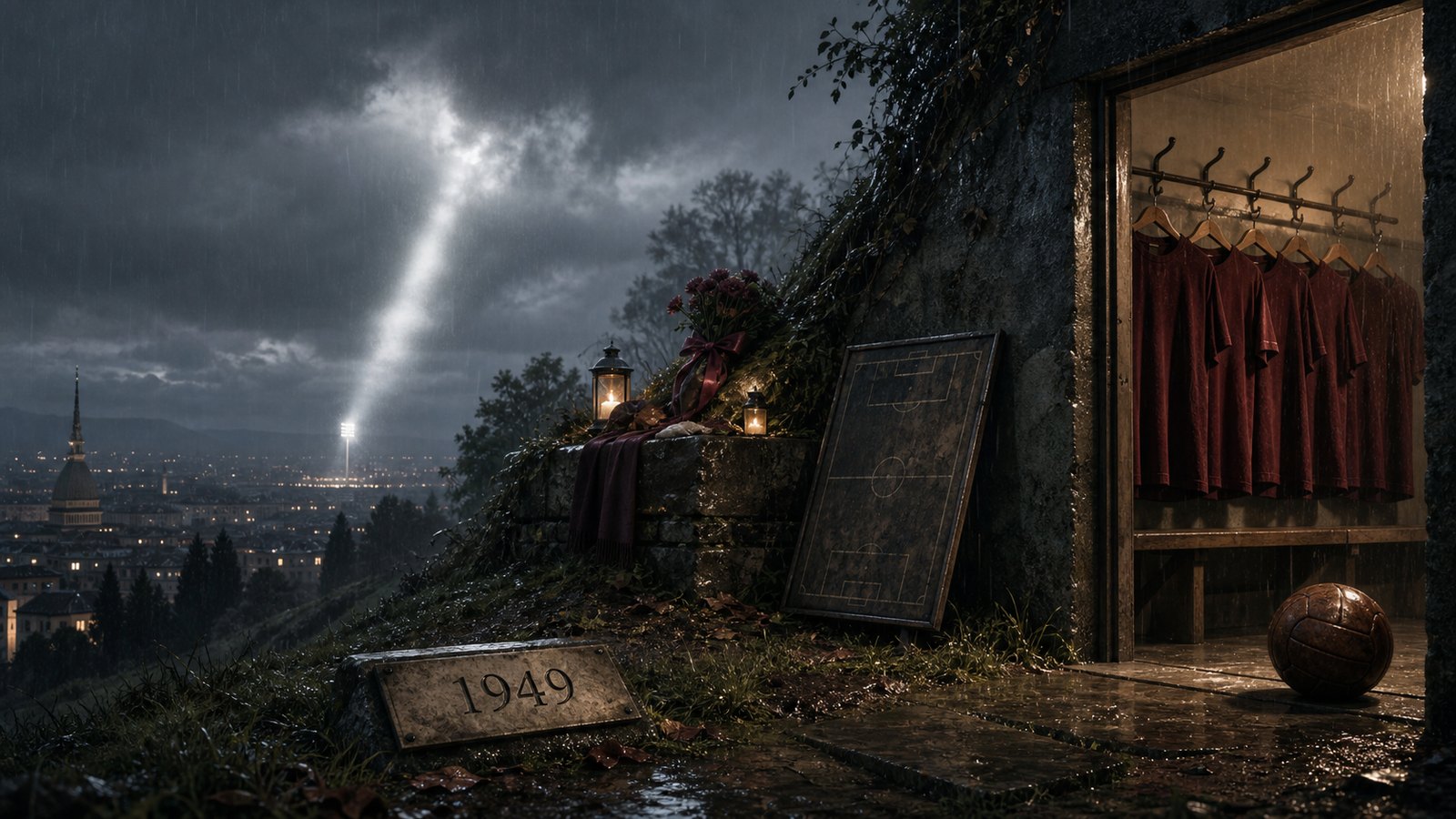
Superga is often remembered first as a disaster, and that instinct is human. On 4 May 1949, the aircraft carrying Torino’s team back from a friendly in Lisbon crashed into the retaining wall behind the Basilica of Superga near Turin. Thirty-one people died, including the players who had made Grande Torino the dominant force in Italian football. But to understand the weight of the loss, the team has to be seen before the fog, before the hillside, before the memorial language. Torino were not just a good side that suffered a terrible accident. They were a football machine that had become part of Italy’s postwar sporting structure.
A domestic dynasty with national-team weight
Torino’s dominance in the 1940s was not a one-season flare. The club won five Serie A titles in the decade, including a run interrupted only by the Second World War’s disruption of normal competition. Their 1947-48 league season became a symbol of excess superiority: huge goal totals, repeated heavy wins, and a sense that the rest of Italy were chasing not simply better players but a more complete sporting organism. The side’s reputation was built on continuity as much as glamour.
The names still carry an institutional sound in Italian football history: Valentino Mazzola, Ezio Loik, Guglielmo Gabetto, Romeo Menti, Aldo Ballarin, Virgilio Maroso. They were club heroes, but they also formed the backbone of the national side. In 1947, Italy fielded ten Torino players in one match against Hungary, a detail that explains the scale of the club’s influence more sharply than any adjective. Torino were not feeding the national team; for stretches, they almost were the national team.
That is why Superga cannot be measured only by the number of titles left behind. The crash removed a tactical culture, a dressing-room hierarchy, a scouting and training standard, and a public point of identification. Clubs survive individual departures all the time. They even survive losing several stars. Torino had to survive the sudden destruction of a whole competitive ecosystem.
The team played with authority, not just talent
Grande Torino are sometimes described through the Metodo system, the Italian tactical framework associated with a 2-3-2-3 shape and inside-forward combinations. Systems on paper can be misleading, but Torino’s authority came from how comfortably their players interpreted roles inside that structure. Mazzola could drive attacks, finish them, and impose emotional tempo. Loik provided relentless connective work. The side attacked with waves rather than isolated moments, and opponents often found that stopping one lane simply opened another.
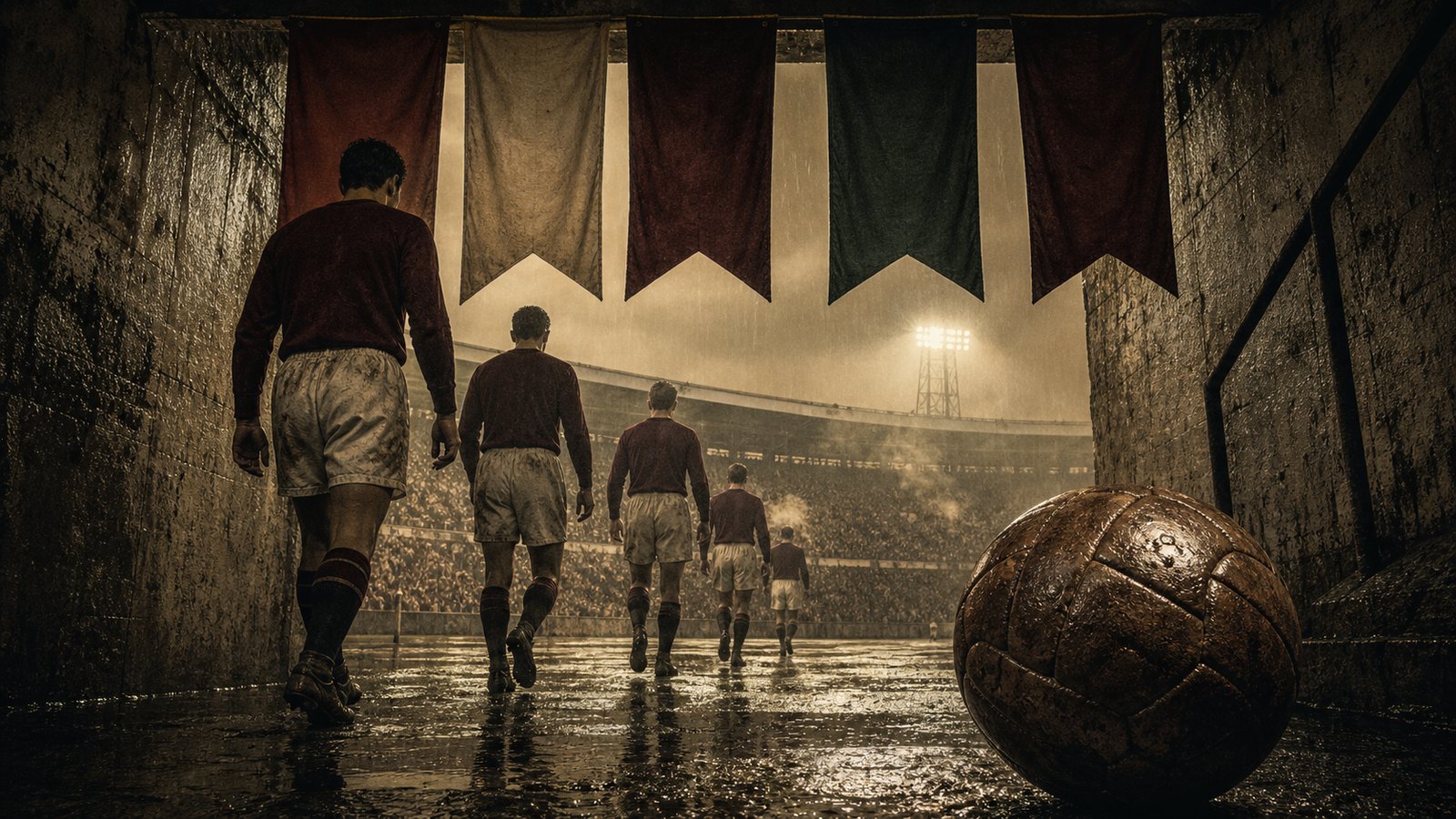
There was a physical reality to the dominance. Old accounts dwell on Torino’s power, stamina, and late surges, the feeling that their pressure could become heavier as matches wore on. Filadelfia, their home ground, was not merely a venue. It functioned as a furnace of expectation where the team’s rhythm and the crowd’s certainty reinforced each other. Imagine claret shirts advancing through winter air, a heavy leather ball skidding from boot to boot, defenders clearing only for another Torino runner to arrive. That is the football Superga interrupted.
The machine was also administrative. President Ferruccio Novo had helped assemble and protect a squad that felt ahead of its domestic environment. He was not on the flight because of illness, a grim accident of survival that left him to face the aftermath. The club had created something rare: a team whose style, recruitment, and public identity all pointed in the same direction.
Why the disaster became a rupture rather than a pause
Football often processes tragedy by returning quickly to fixtures. Torino had league matches left in 1949, and the season was completed with youth players, while opponents reportedly fielded youth sides in respect. The title was awarded to Torino, but the gesture could not replace the living team. The table could record continuity; the pitch could not reproduce it.
The timing intensified the rupture. Italy was rebuilding after war, and sport offered collective stories that were not only about politics or scarcity. Grande Torino had given supporters a model of excellence that felt stable during an unstable era. Their loss therefore moved beyond club grief. It became a national event, with funeral crowds in Turin and a long memory carried by people who had watched the team and by people who inherited the story.
The Italian national side also felt the consequences. The 1950 World Cup arrived the next year, and Italy traveled to Brazil under the shadow of the tragedy. Historians should be careful with simple cause-and-effect claims, but the disappearance of so many elite players at once clearly changed the competitive landscape. A generation of Italian football had to be rebuilt without its central reference point.
The danger of remembering only the ending
Superga’s memorial power is necessary. It keeps names from becoming statistics and reminds football that clubs are communities of actual people, not just lists of honors. Yet the ending can accidentally shrink Grande Torino if the team is remembered only as victims. Their historical importance lies partly in how good they were before they became a tragedy.
They showed how a club can become an engine for a national football culture. They showed how continuity, recruitment, tactical clarity, and emotional command can create dominance that feels larger than a cycle. Their fall also exposed how fragile such institutions are when they depend on people traveling together, training together, and carrying knowledge in their bodies rather than in manuals.
Grande Torino were more than a lost team because what disappeared at Superga was more than talent. It was a working football memory: who moved where, who shouted when, who accelerated the attack, who calmed the dressing room, who made supporters believe the next wave was coming. The crash stopped all of that at once. The reason the story still hurts is that the football before it was so alive.
The club’s dominance also had a social geography. Turin was an industrial city, and Torino’s rise sat beside the city’s factories, routines, and postwar anxieties. Juventus would later become the more globally familiar Turin name, but Grande Torino belonged to a moment when the maroon shirt could feel like the city’s loudest sporting voice. Supporters did not only watch a strong side; they watched a side that seemed to organize local pride into weekly evidence.
Their attacking records are easy to admire from a distance, but the more important point is the pressure those records placed on opponents before kickoff. Playing Torino meant entering a match where survival often came before ambition. That psychological force is part of any dynasty. When opponents adjust their expectations downward, the champion’s control begins before the first whistle. Grande Torino had reached that level: the level where reputation itself becomes a tactical asset.
The aftermath shows how much knowledge can disappear when a team disappears. Replacement players can wear the shirt, supporters can fill the same ground, and administrators can reopen the office, but the small understandings are gone: the glance before a diagonal run, the voice that settles a nervous back line, the shared memory of how to rescue a difficult match. Superga cut through those invisible threads. That is why rebuilding was not simply a recruitment problem. It was a cultural problem.
The source lists and season summaries can make this sound tidy, but the human scale was never tidy. A whole dressing-room order vanished: starters, reserves, coaches, staff, journalists traveling with the team, and the assumptions that tomorrow’s training session would look like yesterday’s. Football history usually changes through transfers, tactics, and money. Here it changed through absence.
Sources
John Foot, Calcio
Torino FC historical materials
FIGC historical accounts
RSSSF Serie A records