
The easiest way to remember Hungary’s 6-3 win at Wembley is as an English humiliation. That is also the safest way to miss why the match still echoes. On 25 November 1953, England lost at home to a foreign opponent for the first time outside the British Isles, but the more lasting defeat was conceptual. The home side had names for positions, habits for marking them, and a belief that the game’s geometry was basically settled. Hungary arrived with a forward line that refused to stand where those names expected it to stand.
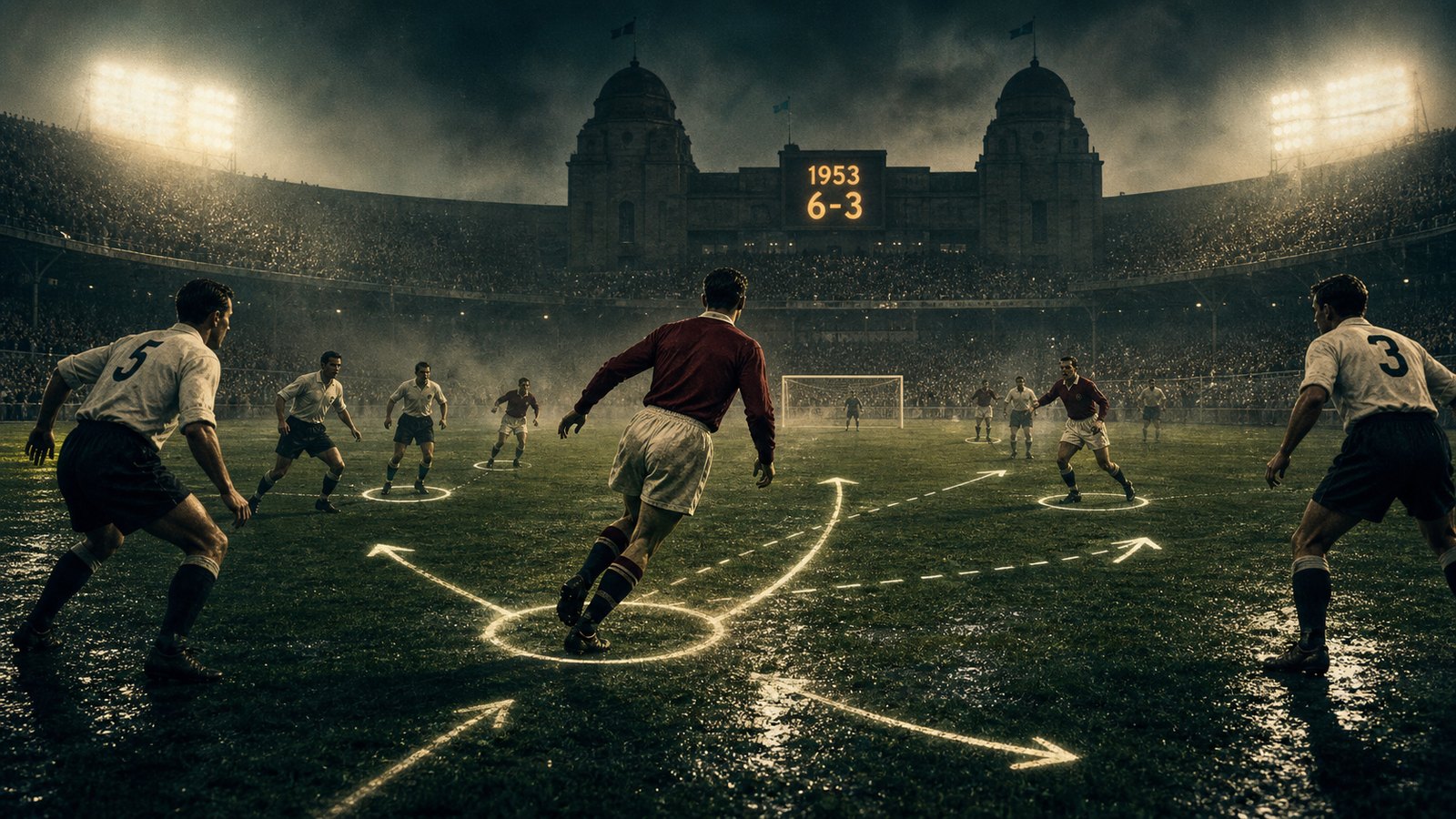
A result that attacked the vocabulary of English football
The score looked brutal enough: Hungary 6, England 3, in front of a huge Wembley crowd and a press corps trained to treat the stadium as a kind of proof. Yet the match was not a fluke produced by finishing luck or one bad afternoon. Hungary had already won Olympic gold in 1952, were unbeaten for years, and carried a settled system under Gusztáv Sebes that connected club habits, national training, and political-era sports planning. England were not ambushed by unknown players; they were ambushed by a game model their own categories struggled to process.
The most famous problem was Nándor Hidegkuti. English centre-halves were used to a centre-forward who provided a fixed reference point. If he stood high, the marker stood with him. If he battled for crosses, the duel was obvious. Hidegkuti did something more damaging: he kept withdrawing into midfield, receiving passes in spaces that were nobody’s comfortable responsibility. Harry Johnston could follow and open a hole behind him, or stay and allow Hungary an extra passer between the lines. Neither answer restored the old shape.
The match is often described through the phrase deep-lying centre-forward or, in modern shorthand, a false nine. The modern label can flatten the history. Hungary were not simply inventing a trick that would later reappear with Barcelona or Spain. They were showing that a forward’s value could come from moving defenders away from structure rather than merely occupying them. Wembley made the idea impossible to dismiss because the damage happened in public, repeatedly, and on the scoreboard.
Hungary turned movement into a collective weapon
Hungary’s attack was not one disappearing man and ten spectators. Ferenc Puskás, Sándor Kocsis, József Bozsik, Zoltán Czibor, and Hidegkuti worked as a linked mechanism. Puskás could start from the inside-left channel rather than behave like a static striker. Kocsis brought aerial threat and penalty-box timing. Bozsik passed with the calm of a midfielder who knew his team would give him angles. Czibor stretched and bent the left side. The famous drag-back by Puskás before scoring became a highlight because it looked like humiliation; the deeper humiliation was that Hungary had already moved England’s defensive assumptions before the shot arrived.
The physical details mattered. England players were pulled into wet grass sprints that began half a second late. Hungarian passes often arrived to the receiver’s safer foot, not into a wrestling contest. The ball moved before tackles could become tackles. Wembley’s broad pitch, usually a stage for English confidence, became a map on which Hungary drew diagonal lanes. Spectators could see white shirts turning, pointing, and hesitating; those gestures were the visible signs of a system losing its cues.
The 6-3 also made preparation visible. Hungary warmed up with ball work and patterns that looked unusually deliberate to British observers. Their fitness was not only stamina; it was repeatable timing. Their club base at Honvéd helped because several key players already understood each other’s rhythms. England had outstanding footballers, but the national side still leaned on selection, pride, and position-specific tradition. Against Hungary, individual quality could not compensate for collective uncertainty.
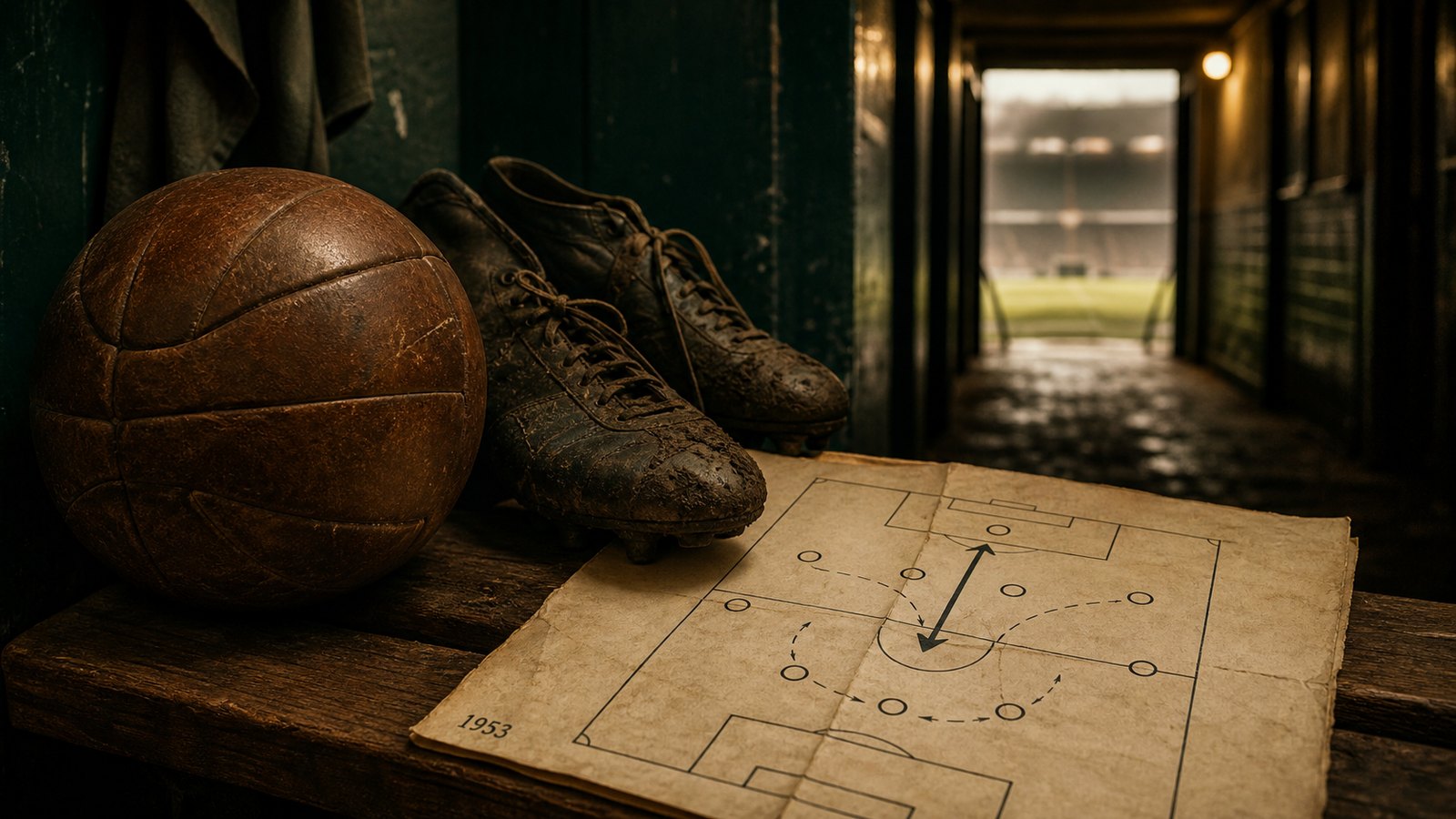
The lesson was uncomfortable because it came from outside the old center
The match landed so hard in England because it challenged more than tactics. The Football Association had helped codify the sport. English clubs had exported coaches, vocabulary, and status. Wembley represented an older cultural authority: the home of a game England believed it understood by inheritance. Hungary’s win suggested that football knowledge could now be produced elsewhere, tested elsewhere, and brought back to England as a problem rather than a lesson.
There was also a Cold War texture around the fixture. Hungary’s players came from a state-sport environment and a national project that British newspapers could describe politically even when the football explanation was tactical. But reducing the result to ideology misses the mechanism. The ball did not move because of propaganda. It moved because Hungary had rehearsed rotations, passing angles, and positional overloads that turned man-marking into a series of bad choices.
The rematch in Budapest in 1954, which Hungary won 7-1, removed any surviving comfort that Wembley had been an accident. England’s problem was not one afternoon of soft defending. It was a lag between how the game was being described and how the best teams were beginning to play it. The later English embrace of continental coaching ideas was uneven, but after 1953 the island could no longer pretend that insularity was the same thing as authority.
Why the 6-3 still feels modern
Modern viewers recognize the pattern instantly: a forward drops off, center backs hesitate, midfielders are outnumbered, and the attack runs beyond the line that has been disturbed. That familiarity can make Hungary’s achievement seem inevitable. It was not. Tactical revolutions become obvious only after somebody has absorbed the risk of making them obvious. Hidegkuti’s movement worked because the rest of the team understood the spaces he created. Without that support, dropping deep would have looked like absence. With it, absence became an invitation.
The match also warns against treating formations as static diagrams. England did not lose because the numbers on a chalkboard were morally inferior. They lost because Hungary’s roles changed during play while England’s defensive references stayed literal. A center half marking a center-forward is a sensible plan until the center-forward becomes a midfielder, the inside forwards become runners, and the passing rhythm makes every correction late.
So the 6-3 endures not merely as a national scar or a famous score. It endures as one of football’s cleanest demonstrations that tactics are a language. England spoke fluently in an older grammar. Hungary arrived speaking the next sentence before the old one had finished.
The detail that keeps the match useful is the chain reaction. Once Hidegkuti left the forward line, England had to decide whether a defender should become a midfielder. If he did, Puskás and Kocsis had room to attack the gap. If he did not, Bozsik and Hidegkuti could receive with their heads up. That sequence is the heart of many later positional problems: the first movement is not meant to win the match by itself, but to force the opponent to reveal which space they are willing to abandon.
The lesson also reached coaching language. After Wembley, arguments about technique, practice, and international comparison became harder to dismiss as foreign fussiness. England still produced great players, and English clubs would keep winning in Europe later, but the assumption that courage and directness were enough had been publicly damaged. Hungary made modernity feel visible: shorter passing, rehearsed support angles, and a willingness to make a named position behave like a temporary role.
There is a reason coaches still return to the match even when the footage looks distant and grainy. The tactical problem is clean. It can be drawn on a board, but it was first felt by defenders turning their shoulders in real time. The game remains a reminder that the most dangerous player is not always the one closest to goal. Sometimes he is the one who moves away from goal and takes the entire defensive map with him.
Sources
Jonathan Wilson, Inverting the Pyramid
FIFA account of Hungary v England 1953
The Football Association historical archive
UEFA historical features on the Mighty Magyars