

Barcelona had agreed the most expensive transfer in football, but its new player still could not enter a league match. Johan Cruyff arrived from Ajax in the summer of 1973 for six million Dutch guilders, roughly two million US dollars at the time. His registration remained incomplete while Barcelona’s season began without him. By 28 October, when he was finally cleared to face Granada, the club stood 14th in La Liga.
Ninety thousand people came to Camp Nou for the delayed debut. Cruyff scored twice in a 4–0 win. The transfer had already exposed the machinery surrounding an international move: league eligibility, federation approval, negotiation between clubs, and weeks in which an elite player was available but unusable.
Barcelona’s 1973–74 title began before Cruyff was allowed onto the pitch. The club committed a record fee to a particular way of playing, endured the registration delay, and then reorganised possession around a footballer who moved between the formal positions on the team sheet.
A six-million-guilder deal left Barcelona waiting
Cruyff reached Spain after Ajax had won three consecutive European Cups, in 1971, 1972 and 1973. He had been central to a side associated with constant movement and exchanges of position. The transfer therefore carried more than celebrity value. Barcelona were acquiring a player who could receive as a centre-forward, withdraw into midfield, direct a teammate’s run and then appear in the penalty area during the same attack.
The price reflected that status. Ajax sold him for six million guilders, then a world-record fee. Barcelona already had a Dutch coach who understood the player. Rinus Michels had worked with Cruyff at Ajax before moving to Catalonia in 1971. Their reunion gave the purchase a tactical logic: the coach knew how Cruyff interpreted space, and Cruyff knew the demands behind Michels’s training and positioning.
Spain had barred foreign footballers from its league between 1962 and 1973. The rule changed in the same year as the transfer, reopening a route that had previously blocked Spanish clubs from fielding overseas recruits. That timing made Cruyff’s move possible, but possibility was not the same as immediate registration. Barcelona could complete the commercial agreement and introduce the player while still waiting for the administrative process that made him eligible for league football.
Registration turned a superstar into a spectator
While the paperwork remained unresolved, Cruyff played training matches against a variety of opponents, including lower-league sides. Those fixtures offered fitness and familiarity without carrying league consequences. They also placed Michels in an awkward intermediate phase. He could teach patterns around Cruyff, but the points still had to be contested by a team that would change once the registration arrived.
Barcelona’s league position sharpened that pressure. They were 14th when Granada visited on 28 October. The season was not beyond repair, but the table left little room for a ceremonial introduction. The debut needed to function as a competitive intervention. Cruyff entered a team requiring points rather than a settled champion adding decoration.
His freedom of movement was the practical answer. Instead of waiting between centre-backs for service, he could drop toward the ball and create an extra passing option. A defender who followed him risked opening depth behind. A midfielder who stepped forward risked leaving another Barcelona player free. The value of the transfer appeared in the choices Cruyff forced before he touched the ball as well as in what he did after receiving it.

Granada made the delay visible in 90 minutes
The crowd of 90,000 gave the first competitive appearance the scale of an event. Granada were not simply the next opponent on a calendar. They were the first test of whether the expensive, delayed signing could alter a team sitting near the lower end of the table. Barcelona won 4–0, and Cruyff scored two of the goals.
Those two finishes supplied the obvious proof, but the playmaking mattered just as much. Cruyff took control of how attacks developed. His movement connected midfield possession to the forwards and changed the places from which Barcelona could create danger. A rigid marker could not rely on finding him in one channel because he kept changing the reference point.
The result also removed a burden from the next match. Had the debut been hesitant, every following appearance would have carried questions about the fee, the delay and whether success in Amsterdam could travel. Two goals in a four-goal win compressed that uncertainty. The conversation moved rapidly from when Cruyff would be allowed to play to what Barcelona might become with him.
A sequence of four victories followed, taking Barcelona to the top of the table. That rise did not belong to one player alone. It required teammates to recognise the spaces his movement created and to respond at the right moment. Cruyff’s arrival changed the team because others could use the disorder he produced. The record fee purchased an organiser of collective options, not a separate attraction operating beside the side.
The 5–0 in Madrid changed the scale of the purchase
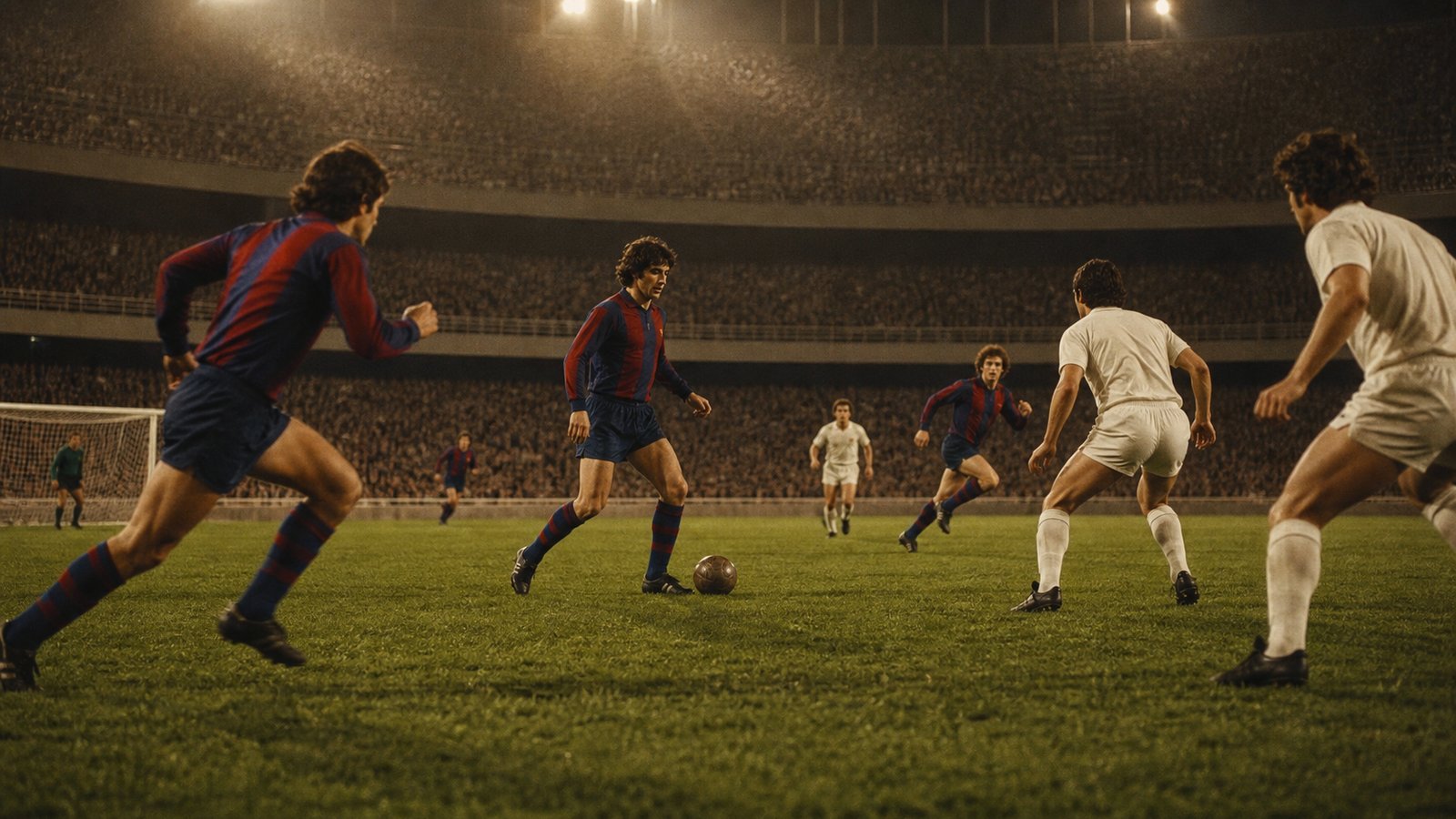
The season’s defining demonstration came in February 1974 at the Santiago Bernabéu. Barcelona beat Real Madrid 5–0. Cruyff scored the second goal after carrying the ball beyond several opponents, and his influence spread across the match as scorer, provider and playmaker. The victory gave a domestic title campaign the emotional force of a public statement.
Barcelona had not won La Liga for 14 years. Beating Madrid away by five goals did not mathematically secure the championship, but it changed how the race felt. The team that had waited for its record signing while sitting 14th now controlled the most charged fixture on the schedule. Supporters watching on television came into the streets after the match.
Barcelona secured the championship in April with a 4–2 win away to Sporting Gijón. The title ended the 14-year wait and gave the transfer a complete arc inside one season: record agreement, administrative pause, debut surge, decisive victory over Madrid and the league trophy. The sequence explains why the move became larger than a list of goals and appearances.

The fee paid for an idea that teammates could use
Michels could use him as a moving reference rather than a fixed endpoint. When Cruyff came short, a winger or midfielder could attack the space beyond. When he carried the ball, defenders had to choose between confronting him and protecting a runner. When he switched the direction of play, the opponent’s compact shape had to turn. These effects depended on recognition between players, which is why the training matches during the registration delay were not empty preparation.
The move also demonstrated that a transfer is a chain rather than a signature. Ajax had to agree the sale. Barcelona had to commit a world-record sum. Spanish rules had to permit a foreign player, and the registration had to be completed. Michels then had to place the newcomer inside a functioning side. The purchase acquired the right to attempt sporting integration; it did not guarantee the integration itself.
Later Barcelona transfers would arrive under different regulations and much larger nominal fees. The struggle around Luís Figo’s record move and Camp Nou return showed how a contract can carry rivalry, identity and public emotion far beyond the balance sheet. Cruyff’s 1973 move created its own version of that expansion. The fee was measured in guilders, but the football argument was measured in where teammates could move and what supporters believed the club could become.
The weeks before 28 October are therefore essential to the story. They reveal every layer that had to align before the celebrated football could happen. Barcelona waited with the world’s costliest player unable to enter a league match. Once he was cleared, the club rose from 14th, won 5–0 in Madrid and claimed its first championship since 1960. The transfer succeeded when paperwork, coaching and collective movement finally occupied the same pitch.
Sources
FC Barcelona player archive; Johan Cruyff biographical record; 1973–74 FC Barcelona season record; 1973–74 La Liga record.