
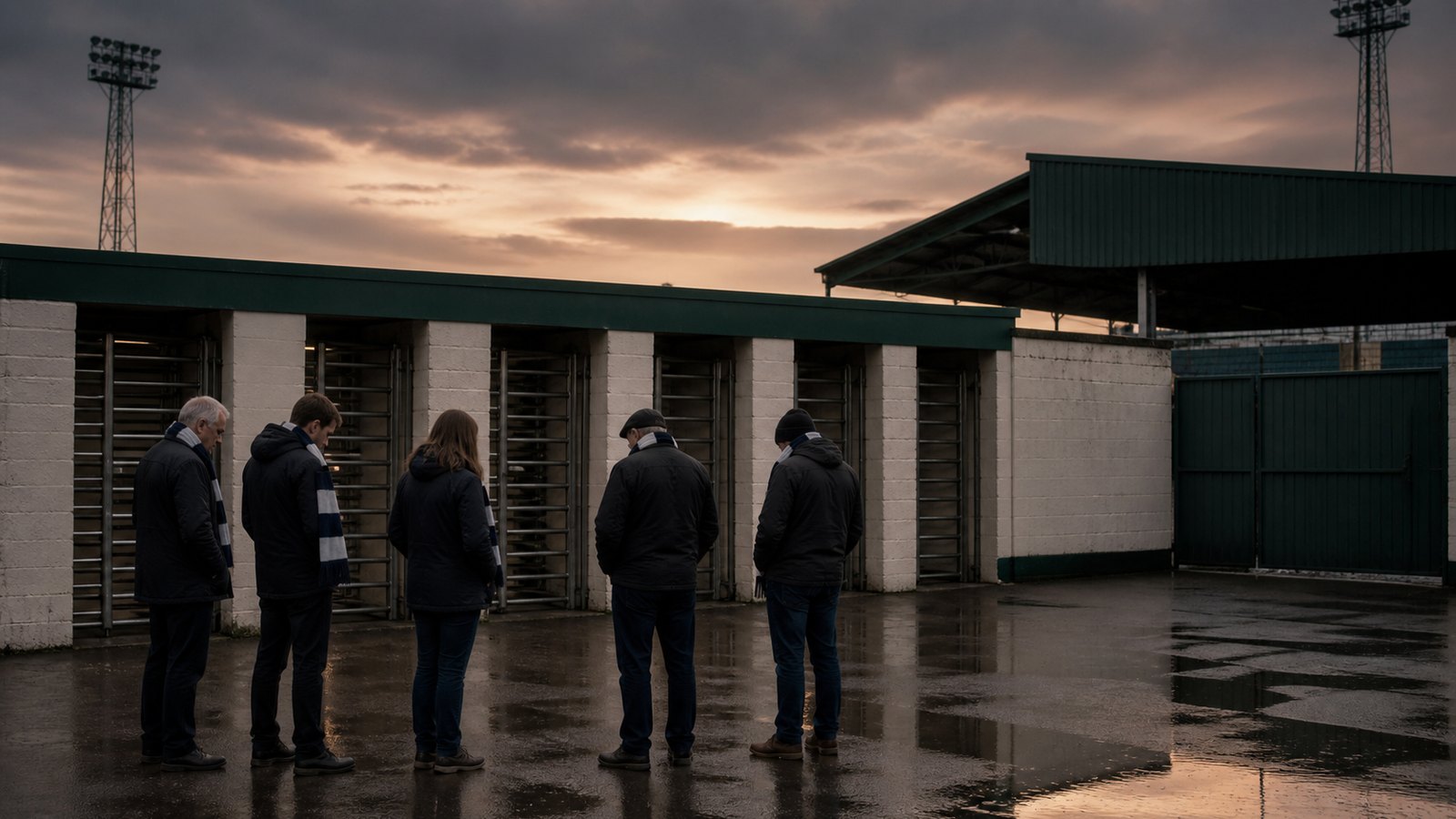
Three hundred volunteers came to Gigg Lane on Tuesday, 27 August 2019, to prepare a football ground for Saturday. They cleaned seats, worked around the stadium and acted on the ordinary assumption that a pitch, a fixture and enough willing hands could still produce a match. Elsewhere, a different clock was running. Bury Football Club had until 17:00 to complete a takeover that might persuade the English Football League it could finance a season.
The volunteers finished with no game to welcome. C&N Sporting Risk withdrew from the proposed purchase, the deadline passed, and at 23:05 the EFL announced that Bury’s membership had been withdrawn. Supporters at the ground cried, walked away or crouched on the floor. A club founded in 1885 and elected to the Football League in 1894 had lost its place before playing a single fixture of the campaign for which it had just won promotion.
That four-month reversal is the useful way into Bury’s collapse. Promotion in April and expulsion in August can look like opposite events accidentally placed beside one another. They were connected. The team’s achievement delivered a place in League One, but the club behind it could not show that wages, creditors and a full set of fixtures could be funded. The summer became a struggle between sporting entitlement and financial evidence. The league place existed on paper while every postponed match made it less usable.
Promotion Arrived While the Bills Were Already Waiting
Bury finished the 2018–19 League Two season as runners-up. On the field, that meant a return to the third tier. The achievement belonged to players and staff working through instability rather than to a settled institution enjoying the reward of sound planning. Payments had often arrived late, and the club was already in serious financial trouble when Steve Dale bought it from Stewart Day for £1 in December 2018.
A winding-up petition moved through the High Court and was adjourned three times before being dismissed on 31 July. Creditors had approved a company voluntary arrangement, or CVA, intended to settle part of what was owed. Under its terms, unsecured creditors, including HM Revenue & Customs, were due 25 per cent of their claims. The agreement also triggered a 12-point deduction under EFL rules.

A League Place Without Fixtures Became the Summer’s Central Contradiction
The EFL did not treat a completed CVA as sufficient proof that Bury could play the season. It asked for evidence that the club could meet its financial commitments, including payments to creditors, and fund the campaign ahead. Without that assurance, the league began postponing fixtures. Each postponement protected opponents and the competition from a match that might fail, but it also made Bury’s membership increasingly abstract.
The opening Saturday passed without Bury. Then another date moved. By the final week of August, the club’s first six fixtures had been suspended or postponed. A promoted team had a division, a published schedule and a ground, yet no permission to begin. Paul Wilkinson had been appointed manager on 2 July but never took charge of a competitive Bury match.
On 9 August, the league gave the club fourteen days to provide the required information or face expulsion. That notice changed the character of every subsequent negotiation. A new investor was no longer buying only a football club with debts and a historic ground. The buyer was racing a membership deadline whose expiry could remove the most valuable sporting asset in the transaction.
One Deadline Produced an Extension, Not a Rescue
The first decisive limit was 23:59 on Friday, 23 August. Bury needed either the necessary financial evidence or a completed sale. With the deadline near, Dale told BBC Radio Manchester that the club had been sold and would survive. The announcement secured more time. The EFL moved the final limit to 17:00 on Tuesday so that a deal with C&N Sporting Risk could be completed.
An extension can sound like relief, but it also concentrated the remaining risk. C&N had to inspect obligations accumulated over years while the value of membership was being measured in hours. The prospective buyer concluded that the financial problems were insurmountable within the available time and withdrew. The extra days had revealed the distance between interest in saving Bury and confidence that the rescue could actually be financed.
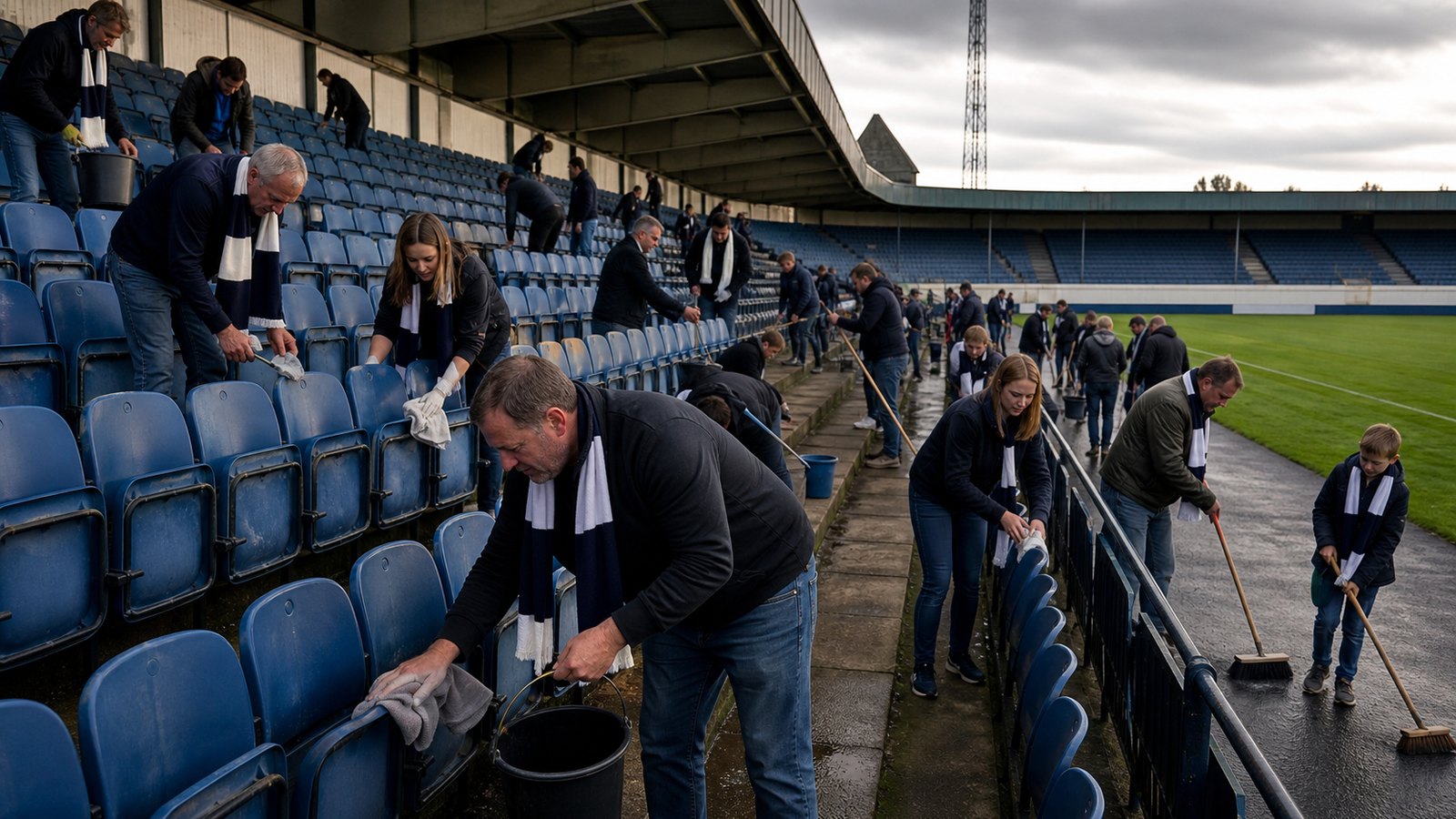
Meanwhile, supporters worked on the physical evidence that a club still existed. An estimated 300 volunteers arrived at Gigg Lane on the Tuesday to prepare for a scheduled game against Doncaster Rovers. Their labour mattered because a football club is not only a company record or a balance sheet. It is also a place that must be opened, cleaned and made ready by people who expect to gather there.
The scene carried a brutal mismatch. Volunteers could sweep concrete, wipe seats and prepare the touchline. They could not provide the financial proof required by the EFL or compel a buyer to accept the liabilities. Community effort and regulatory evidence answered different questions. Gigg Lane could look ready for football while Bury remained unable to prove that it could finance football.
At 23:05, the League Converted Missing Evidence Into Expulsion
The EFL board met after the takeover collapsed. Its decision cited repeated missed deadlines, postponed fixtures, the absence of the required evidence about financial commitments and the failure of the proposed sale. At 23:05, it withdrew Bury’s membership. League One would continue with 23 clubs, and the relegation plan was adjusted from four teams to three while four clubs would still come up from League Two.
That announcement did something a postponement had avoided. It stopped asking when Bury might play and accepted that Bury would not play in the competition at all. The distinction matters. During the summer, every delay had preserved a narrow possibility of rescue. Expulsion removed the fixture list, the third-tier place and the institutional relationship that had lasted 125 years.
Bury became the first club to drop out of the EFL since Maidstone United’s liquidation in 1992. It was also the first former FA Cup winner expelled by the league. Those labels were not decorative history. Bury had won the cup in 1900 and 1903, belonged to Gigg Lane from its founding year and had once occupied the top flight. In 2019, none of that history could substitute for proof that the next season was fundable.
The human response at the ground made the administrative language physical. BBC Radio Manchester’s reporter described a cry from supporters when the news arrived, followed by tears and people crouching on the floor. They had spent the day preparing for Doncaster. By night, the work no longer led toward a Football League match.
Gigg Lane Outlasted the Company’s League Place
Expulsion did not instantly settle what would happen to the company, employees, players or stadium. Bury entered administration in November 2020. A separate supporter-owned team began competing lower in the pyramid, while the future of Gigg Lane and the original club’s history remained subjects of rescue rather than a normal pre-season plan.
Supporters eventually recovered the physical centre of the story. In February 2022, a fan group completed the purchase of Gigg Lane and acquired the trading name, history and memorabilia of Bury FC. Supporter societies later merged, and the playing name Bury FC returned. After Football Association approval in 2023, football came back to the ground under the reunited identity.
Bury’s four-month fall was therefore neither a single bad result nor a collapse created at 17:00 on one Tuesday. Promotion exposed the contradiction; the postponed fixtures measured it; the failed takeover exhausted the final extension; and the EFL’s 23:05 statement closed the competition around it. The club had spent the summer owning a place it could not demonstrate the means to occupy. When the place vanished, the ground and the people around it became the starting point again.
Sources
BBC Sport, “Bury expelled by English Football League after takeover collapses”; English Football League, “Bury FC: Membership of the EFL withdrawn”; Wikipedia, “Bury F.C.” for club chronology and recovery cross-checking.