

Preston North End reached the last match of the 1888–89 English season with two records still open. They had already completed the first Football League campaign without losing. At the Kennington Oval, one more clean sheet would give them the FA Cup without conceding a goal.
The final on 30 March 1889 offered a neat test of whether a season could remain as severe as its statistics. Wolverhampton Wanderers had finished third in the new league and had scored twice at Deepdale in October. Preston now had to face them again in a cup final, in London, with the double available.
Fred Dewhurst scored after 15 minutes. Jimmy Ross added another after 25. Sam Thomson made it 3–0 in the 70th. Goalkeeper Robert Mills-Roberts completed his fifth FA Cup appearance of the campaign without allowing the other side onto the scoreboard.
That final did more than add a trophy. It fixed a definition of dominance that English football has never reproduced in precisely the same form: 22 league games, five FA Cup ties, no defeats anywhere, and no goals conceded in the cup.
The cup final completed two unbeaten competitions at once
Preston’s last league fixture had been played seven weeks earlier, away to Aston Villa on 9 February. Fred Dewhurst scored both goals in a 2–0 victory. The result closed the league record at 18 wins, four draws and no losses. Preston had scored 74 goals and conceded 15.
The margin was as striking as the unbeaten line. Under the two-points-for-a-win system, Preston finished with 40 points. Aston Villa were second on 29, with Wolverhampton Wanderers another point behind. Even if a defeat had finally arrived at Villa, the championship would not have been in danger. Instead, Preston ended the inaugural league season with another clean sheet.
The FA Cup continued after the league schedule ended. That meant the word “unbeaten” was still exposed. A loss in the cup would not alter the league table, but it would change the meaning of the season. Preston had to keep winning elimination matches while carrying a league achievement that was already complete.
William Sudell built the side during football’s argument over payment
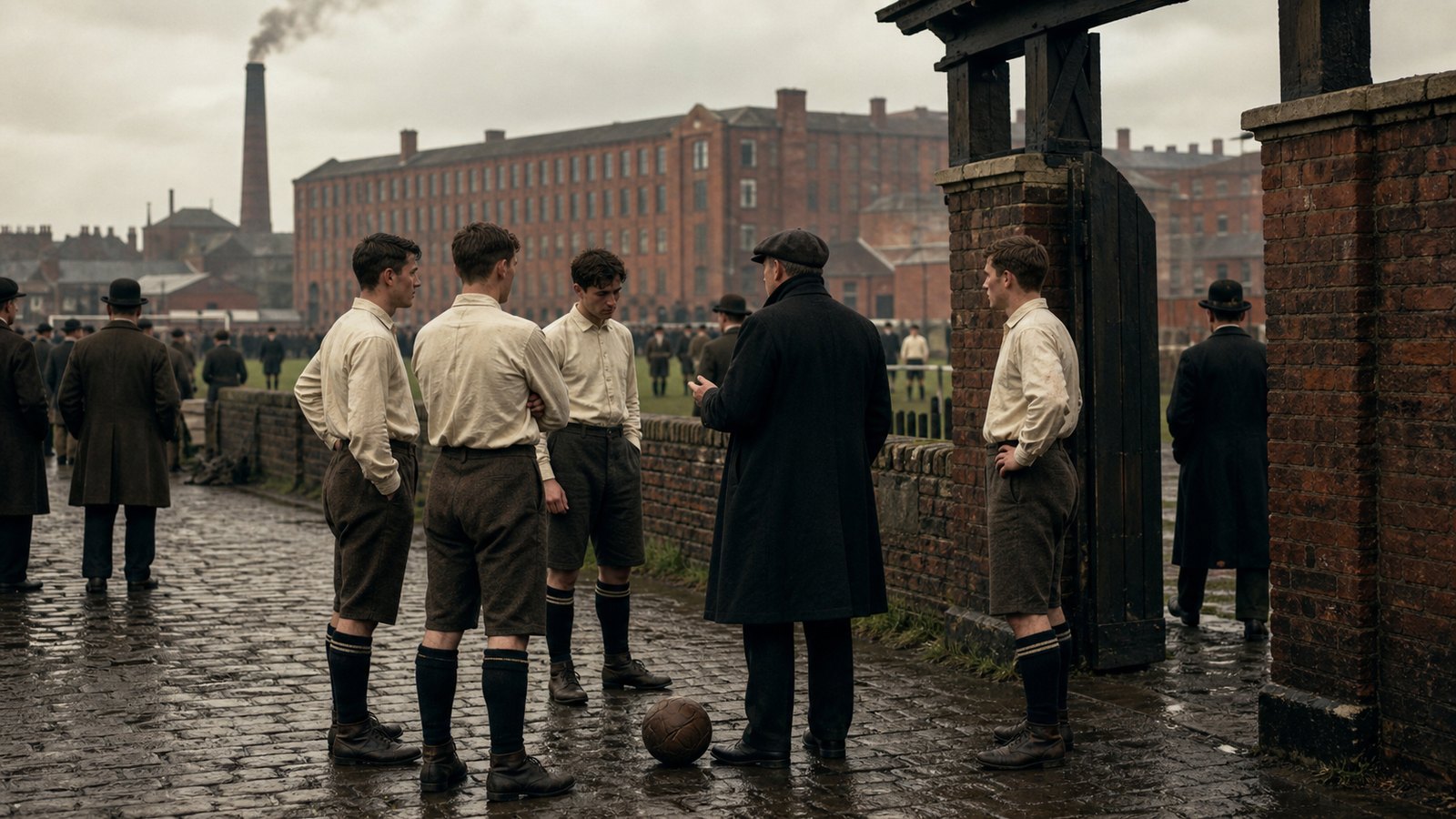
The team did not emerge from a settled professional game. William Sudell had guided Preston through the years when English football was deciding whether players could openly be paid. He recruited Scottish footballers and arranged nominal employment for some at the cotton mill he managed. The practice brought athletic talent to Deepdale while the sport’s official amateur code was becoming harder to defend.
In 1884, a dispute over payments led Preston to withdraw from the FA Cup. Sudell became a prominent advocate for professionalism, which the Football Association accepted in 1885 under restrictions. Three years later, Preston were among the 12 clubs in the new Football League.
Sudell’s later story ended badly. In 1895 he was convicted after diverting money from the mill to the football club and served a prison sentence. That collapse should not be folded into the triumph as if it were a hidden explanation for every result. It does, however, prevent the Invincibles from becoming a simple fable about innocent beginnings. Early professional football already involved ambition, disputed money and institutional risk.
Twenty-two league games produced 74 goals and four draws
The unbeaten record was not built from caution. Preston opened the league on 8 September 1888 by beating Burnley 5–2 at Deepdale. A week later they won 4–0 at Wolverhampton. By early November they had recorded two 7–0 victories, against Stoke at home and Notts County away.
The goals came from several directions. John Goodall led the league scoring with 21. Jimmy Ross supplied 19 league goals, Fred Dewhurst 12 and Jack Gordon 10. In a 22-match competition, those totals describe an attack that could change its scorer without changing its threat.
There were still moments when the record could have broken. Accrington held Preston 0–0 on 20 October. Aston Villa drew 1–1 at Deepdale in November. Burnley and Blackburn Rovers each earned 2–2 draws in December and January. Those four matches were the only points Preston dropped.
The response to the final draw is revealing. After Blackburn made it 2–2 on 12 January, Preston won 2–0 at Everton before 15,000 spectators and then repeated that score at Aston Villa. The closing sequence was not a ceremonial procession. It required two away victories against teams that finished eighth and second.
Five FA Cup opponents failed to score once
The cup record was narrower and, defensively, even cleaner. Preston began away to Bootle on 2 February and won 3–0. They then beat Grimsby Town 2–0, Birmingham St George’s 2–0 and West Bromwich Albion 1–0 before facing Wolves in the final.
Those scores add up to 11 goals for Preston and none against them. Mills-Roberts played in all five ties. He had appeared only twice in the league, where the goalkeeper’s position was more often held by James Trainer, yet the cup gave him a complete competition of his own.
The semi-final was the smallest margin. David Russell scored the only goal against West Bromwich Albion at a neutral venue. Two weeks later, Preston met a Wolves side they knew from the league. The earlier meetings had produced a 4–0 Preston away win and a 5–2 home win. The final still had to be played rather than inferred from those results.
Dewhurst’s opening goal settled the direction quickly, and Ross doubled the advantage ten minutes later. Thomson’s second-half goal completed the 3–0 score. The same Wolves who had scored 51 times in 22 league games did not score at the Oval.

The Invincibles were more than one famous statistic
The label survives because it is compact. “Invincibles” turns a complicated first league season into a single claim: Preston were not beaten. Yet the fuller record is more interesting than the nickname.
They won the first Football League title by 11 points. They completed the first English league-and-cup double. They scored in 26 of their 27 league and cup matches. Accrington alone held them scoreless, while the other three league draws contained goals. In the cup, every tie was won and every opponent was shut out.
Most of all, different players carried different pieces of the season. Goodall was the league’s leading scorer. Ross struck 21 times across the two competitions. Dewhurst scored in the decisive last league match and opened the cup final. Mills-Roberts guarded the cup run. Sudell organized the side, but the results were distributed across a team rather than resting on one celebrated name.
Even a small rule change in how the story is told alters its emphasis. If the focus stays on league invincibility, the cup becomes decoration. If it stays on the double, the defensive cup record disappears. Put the competitions together and the scale becomes visible: Preston played every league and FA Cup match available to them and left none as the losing side.
A short season still demanded complete control
Preston’s achievement can stand without pretending the game was unchanged. They were the strongest side in the first national league structure, then proved it again in the country’s established knockout competition. Their 27-match league-and-cup record contains 23 wins and four draws.
The clean cup run also gives the season a quality that the league table alone cannot show. Knockout football offers no points cushion. Preston’s 11-point advantage disappeared each time the FA Cup began again. Against West Bromwich Albion, one goal was enough. Against Wolves, three made the final secure.

English football would soon expand, professionalize further and produce champions over much longer calendars. Preston themselves retained the league title in 1889–90 but did not repeat the double. The first version remained singular.
The season’s clearest image is the final score at the Oval: Preston North End 3, Wolverhampton Wanderers 0. Behind it sat 26 earlier results, none carrying a defeat. When the last whistle ended the cup final, there was no unfinished exception to explain.
Sources
- Rec.Sport.Soccer Statistics Foundation
- Preston North End club history archive
- Spartacus Educational biography of William Sudell
- 1888–89 Preston North End season record
- 1889 FA Cup final record