
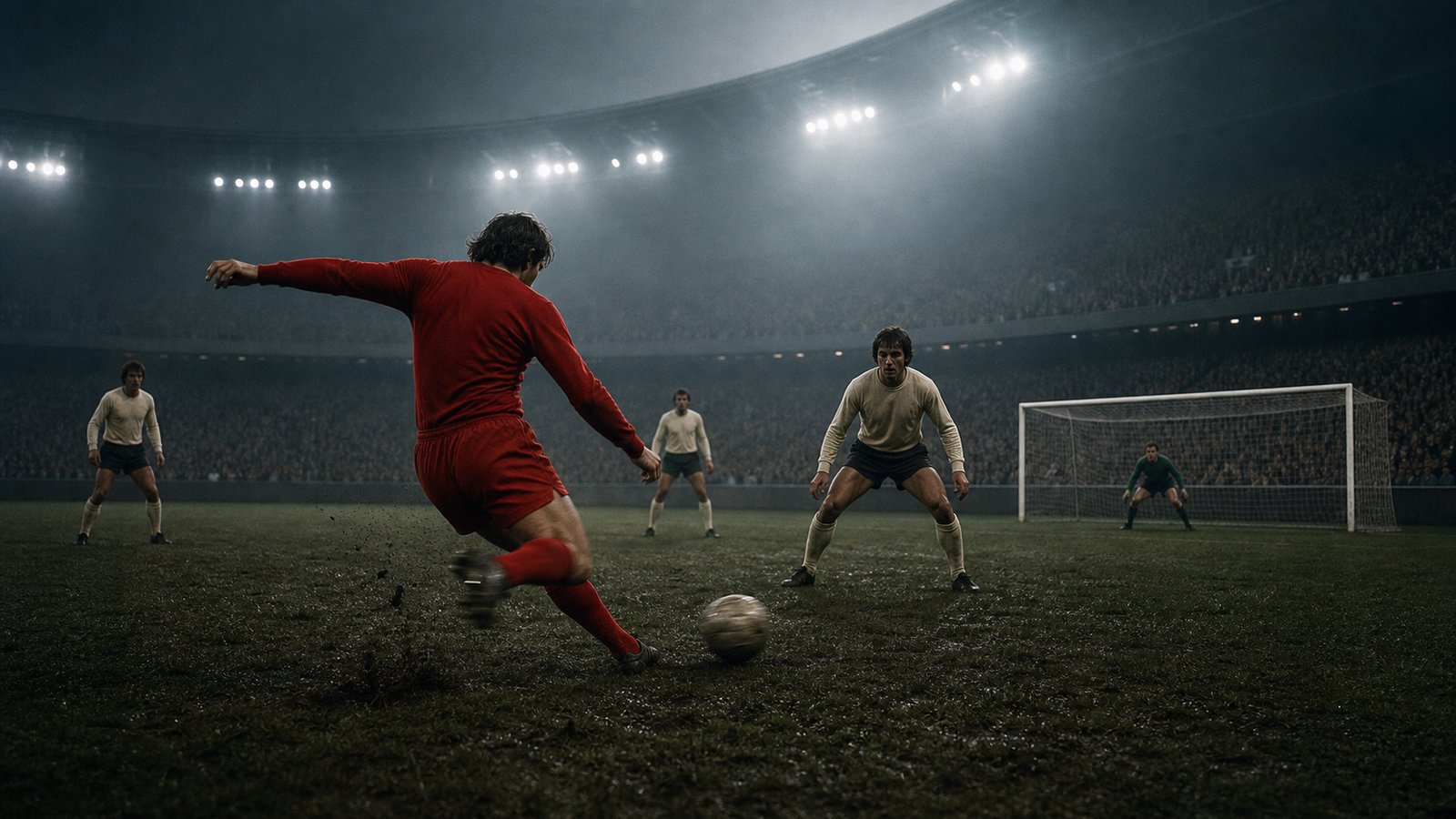
Seven seconds can be argued over for half a century. Atlético Madrid manager Juan Carlos Lorenzo used that estimate when he revisited the 1974 European Cup final: his side were ahead, Bayern Munich had a throw-in, and the trophy was nearly theirs. Franz Beckenbauer restarted play. The ball reached Hans-Georg Schwarzenbeck, a centre-back valued for covering other people’s risks rather than taking his own from 30 yards.
Schwarzenbeck shot anyway. The ball stayed low, goalkeeper Miguel Reina could not keep it out, and a final that had already run for almost two hours finished 1–1. There were no penalties waiting to settle it. Under the competition’s rules, everybody had to return to Brussels 48 hours later and play the European Cup final again.
Six minutes from Atlético’s first European Cup
The first match at Heysel Stadium on 15 May had resisted both sides through 90 minutes. Atlético arrived with a route to the final that had demanded control under pressure. They had eliminated Galatasaray, Dinamo Bucharest and Red Star Belgrade before meeting Celtic in the semi-final. Atlético finished the first leg in Glasgow with eight players but escaped at 0–0, then won the return 2–0 in Madrid.
Bayern had needed penalties against Åtvidaberg and a 7–6 aggregate escape against Dynamo Dresden. Maier, Beckenbauer, Müller, Hoeneß and Schwarzenbeck were already prominent, but Germany still had no European Cup winner.
Extra time brought the breakthrough in the 114th minute. Atlético won a free kick near the left corner of the Bayern penalty area. Maier arranged a six-man wall and moved across his goal. Luis Aragonés lifted the ball over the wall and beyond him. After 204 goalless minutes across Atlético’s semi-final first leg and the regulation portion of the final, the captain had apparently found the decisive opening.
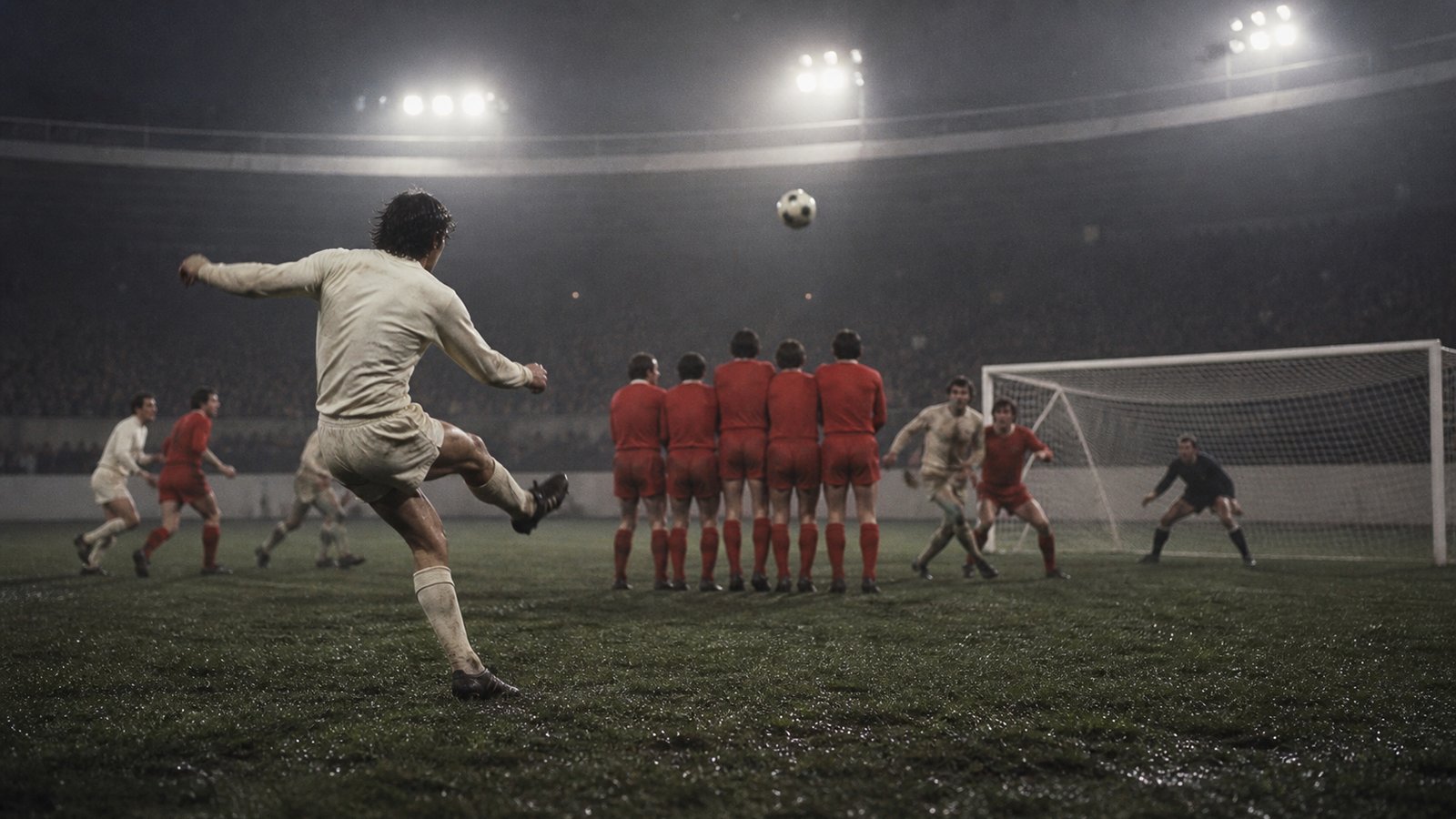
Atlético protected the lead for five of those six minutes. In later recollection, defender José Luis Capón said they practically had the cup in their hands. The phrase captures the cruel physicality of the moment: the object was waiting, the clock was almost empty, and one ordinary restart stood between possession and history.
The centre-back who ignored the safer choice
Beckenbauer’s throw did not produce an elegant attack. It found Schwarzenbeck, the defender whose usual function made somebody else’s adventure possible. UEFA’s tactical portrait describes him as the covering presence behind Beckenbauer, taking on the direct defensive labour while the captain moved forward. A German press nickname cast him as the Kaiser’s cleaner. A shot from distance was outside the role everyone expected him to perform.
That expectation gave him room. Atlético did not rush to close a centre-back so far from goal. Paul Breitner later remembered hoping his teammate would refrain from shooting. Schwarzenbeck moved forward and struck. Reina descended too slowly, the ball entered the net, and Schwarzenbeck pointed both arms upward while the match’s emotional direction reversed.
The seconds after the goal produced a dispute that outlived the score. Lorenzo blamed Reina and claimed the goalkeeper had been offering his gloves to a photographer as a souvenir. Reina denied the account. Capón’s version was less accusatory: nobody was at fault, he said, though the loss of the lead was a profound pity. What cannot be disputed is the sequence recorded by the match: Aragonés at 114 minutes, Schwarzenbeck at 120, then a final whistle without a champion.
Nearly 49,000 spectators had come to see one final. They instead witnessed the opening half of a two-match decision. The players had completed extra time, but the competition had no shootout at the end of it. Heysel would reopen for the same opponents on 17 May.
A final reset with fewer than half the spectators
The replay created an odd contrast between competitive importance and public attendance. The first match’s recorded crowd was 48,722. The second drew 23,283, fewer than half as many. The European Cup still required a winner, yet thousands who had occupied the stadium on Wednesday were absent on Friday. The decisive match looked and sounded different before a ball was kicked.
For Atlético, the reset did not erase the previous ending. Their first European Cup had been six minutes away, then seconds away, then moved to another date. For Bayern, the same rule converted an improbable equaliser into a complete second opportunity. No aggregate score carried forward. Aragonés’s free kick and Schwarzenbeck’s reply had created the right to begin again at 0–0.
The rematch began cautiously, but Bayern escaped that rhythm first. In the 28th minute, a rapid pass from the back released Hoeneß. He ran clear and sent the finish through Reina’s legs. The goal did more than put Bayern ahead. It forced Atlético to chase a match after spending the previous one protecting a late advantage.
Four goals separated the second night from the first
Atlético reached half-time only one goal behind. Eleven minutes after the interval, Müller controlled the ball at the back post and finished from a severe angle into the far corner. In the first match he had played 120 minutes without scoring. In the replay, the game’s most feared finisher now had the margin Bayern had lacked.
Müller struck again in the 69th minute. Hoeneß added his second in the 82nd. UEFA’s summary is brutally symmetrical: two Hoeneß goals on either side of two Müller finishes. Bayern won 4–0, a result so decisive that it can obscure how close the same matchup had been two days earlier.
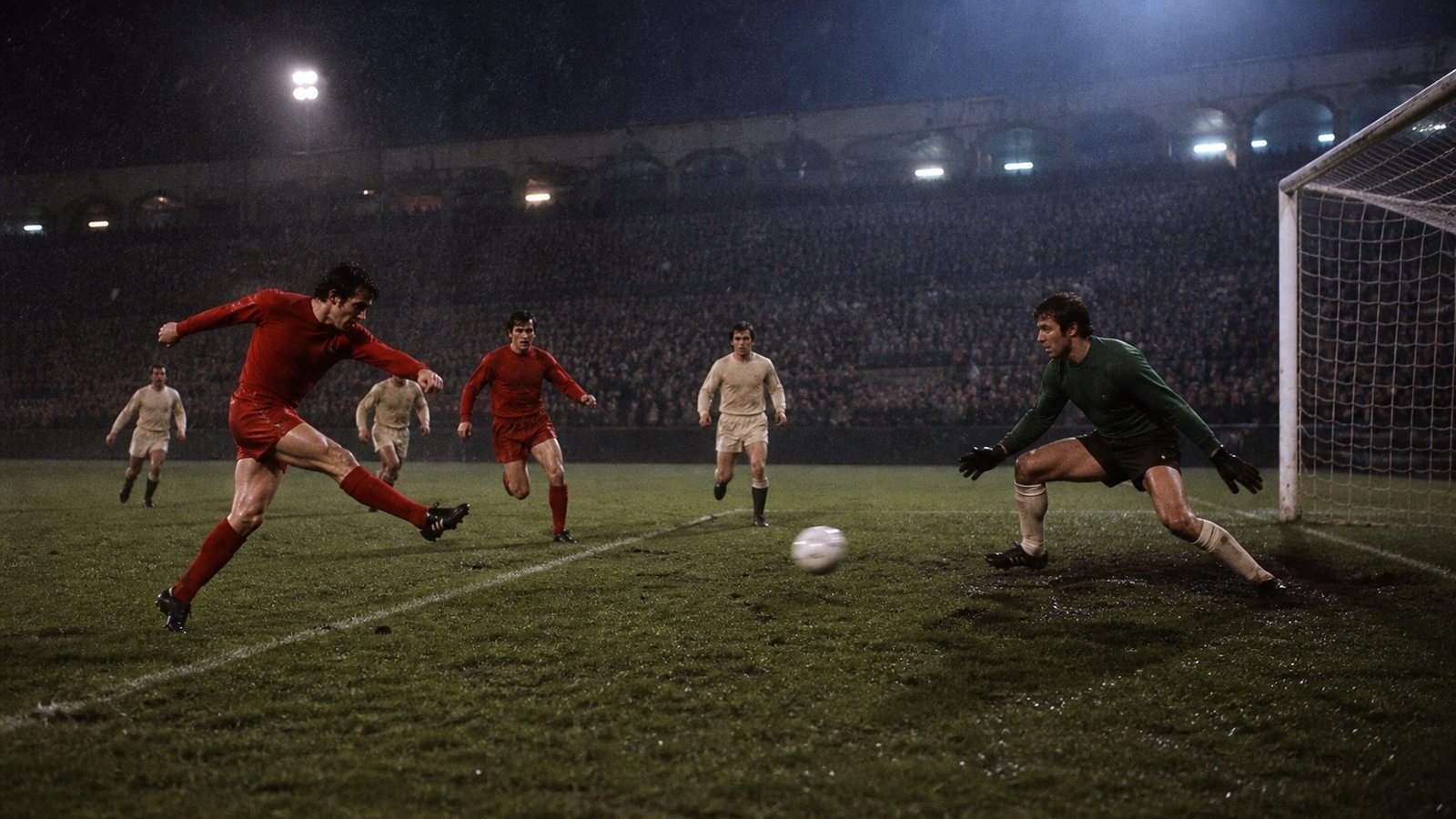
Bayern’s balance mattered once the replay opened. Coach Udo Lattek favoured attack, while Schwarzenbeck’s covering work allowed Beckenbauer greater freedom. Hoeneß supplied speed and Müller supplied economy near goal. The first final had reduced that collection to one desperate defender’s shot. The second gave its attacking pieces room to express the difference.
The replay that launched three consecutive wins
The 4–0 victory made Bayern the first German club to lift the European Cup. It also began a sequence rather than completing one. Bayern retained the trophy against Leeds United in 1975 and Saint-Étienne in 1976, becoming the first club since Real Madrid’s early dominance to win three consecutive European Cups.
Beckenbauer, Müller and Maier also formed the spine of the West Germany side that had won the 1972 European Championship and would win the World Cup that summer. Brussels made the same generation visible as a club dynasty.
That dynasty began with the kind of moment that does not fit its later image of control. Schwarzenbeck was the modest defender, the physical counterweight to Beckenbauer’s elegance. His unexpected shot prevented Bayern’s first title from belonging to Atlético. Forty-eight hours later, the celebrated attackers completed the work his intervention had preserved.
There is a distant echo in Bayern’s last three minutes against Manchester United in 1999, another final whose remembered shape was determined at the edge of the clock. In 1974, however, the late goal did not win anything immediately. It bought another entire match.
Why football never staged this ending again
The 1974 contest remains the only European Cup or Champions League final decided by a replay. Its format produced two different tests. The first was endurance through extra time and an emergency shot at the final limit. The second was a fresh match in which Bayern’s attack found four goals. Neither score alone tells the complete story.
Atlético’s memory is therefore attached to two forms of loss. They surrendered a lead when the clock had almost expired, then returned to suffer a heavy defeat. Bayern’s memory moves in the opposite direction: a defender’s improbable equaliser, a two-day reprieve, and the first trophy in a run of three.
The replay rule gave the same stadium another chance to answer the question. It did not reproduce the tension of Wednesday night. It exposed what the equaliser had made possible. A final that seemed to belong to Aragonés at 114 minutes became the beginning of Bayern’s European age by Friday evening.
Sources
UEFA; The Guardian; European Cup competition record.