
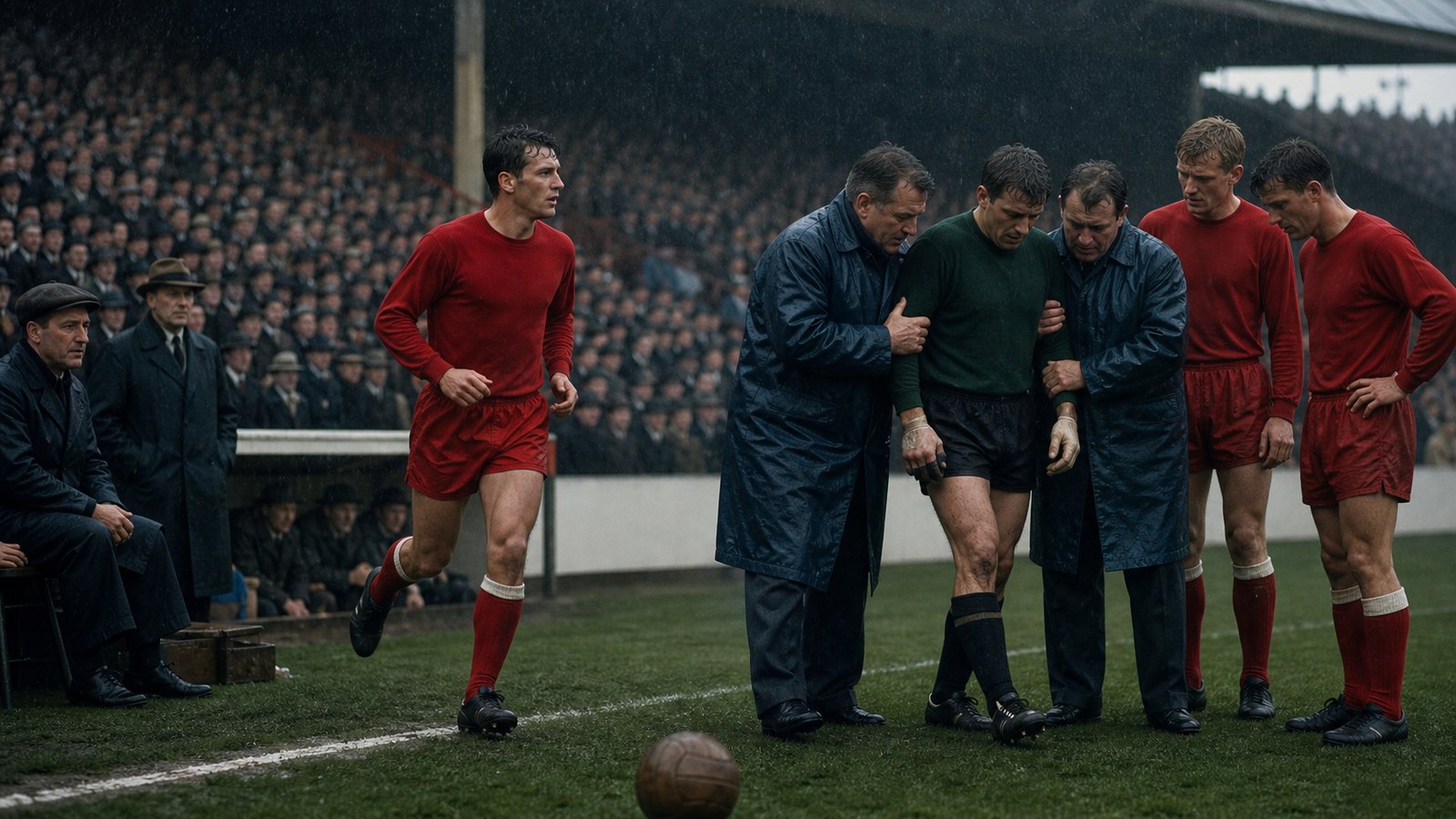
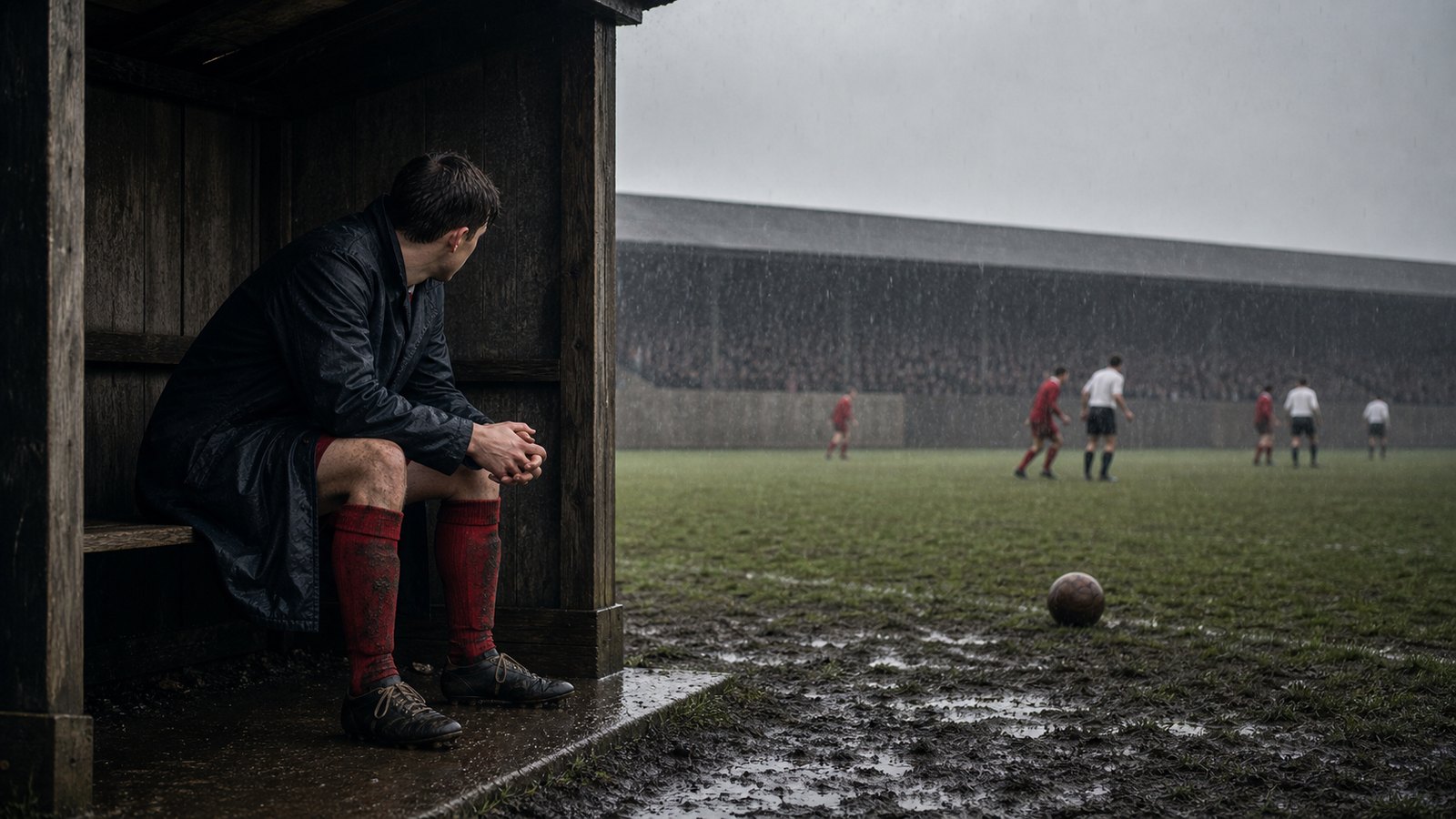
Keith Peacock had expected to start Charlton Athletic’s opening match of the 1965–66 season. His name was already in the programme. Then, roughly 75 minutes before kick-off at Bolton, manager Bob Stokoe told the 20-year-old midfielder that he would sit beside the pitch as the reserve. Peacock remembered the news as a crushing disappointment, partly because a reserve had almost no reason to expect a game.
English league football had only just admitted the substitute. One replacement could be named, and he was supposed to enter only when a player was injured. The rule looked like insurance against misfortune rather than a new tactical instrument. Eleven minutes into Bolton Wanderers against Charlton on 21 August 1965, that insurance was needed. Goalkeeper Mike Rose was hurt, Peacock was called, and an ordinary selection disappointment became a hinge in football history.
The name printed in the programme
Peacock’s frustration makes sense only in the world before benches became crowded workplaces. Until that August, an injured player could leave his side with ten men for the rest of the afternoon. There was no specialist ready to replace a goalkeeper, no late injection of pace and no manager scanning a row of alternatives. A starting eleven was expected to finish as an eleven if bodies allowed it.
Charlton’s choice also carried an awkward practical question. The designated reserve was a midfielder, not a goalkeeper. When Rose was injured after 11 minutes, Peacock entered the match but did not take the gloves. John Hewie moved into goal, while Peacock filled the vacancy among the outfield players. The first Football League substitution was therefore already a small rearrangement rather than a simple like-for-like exchange.
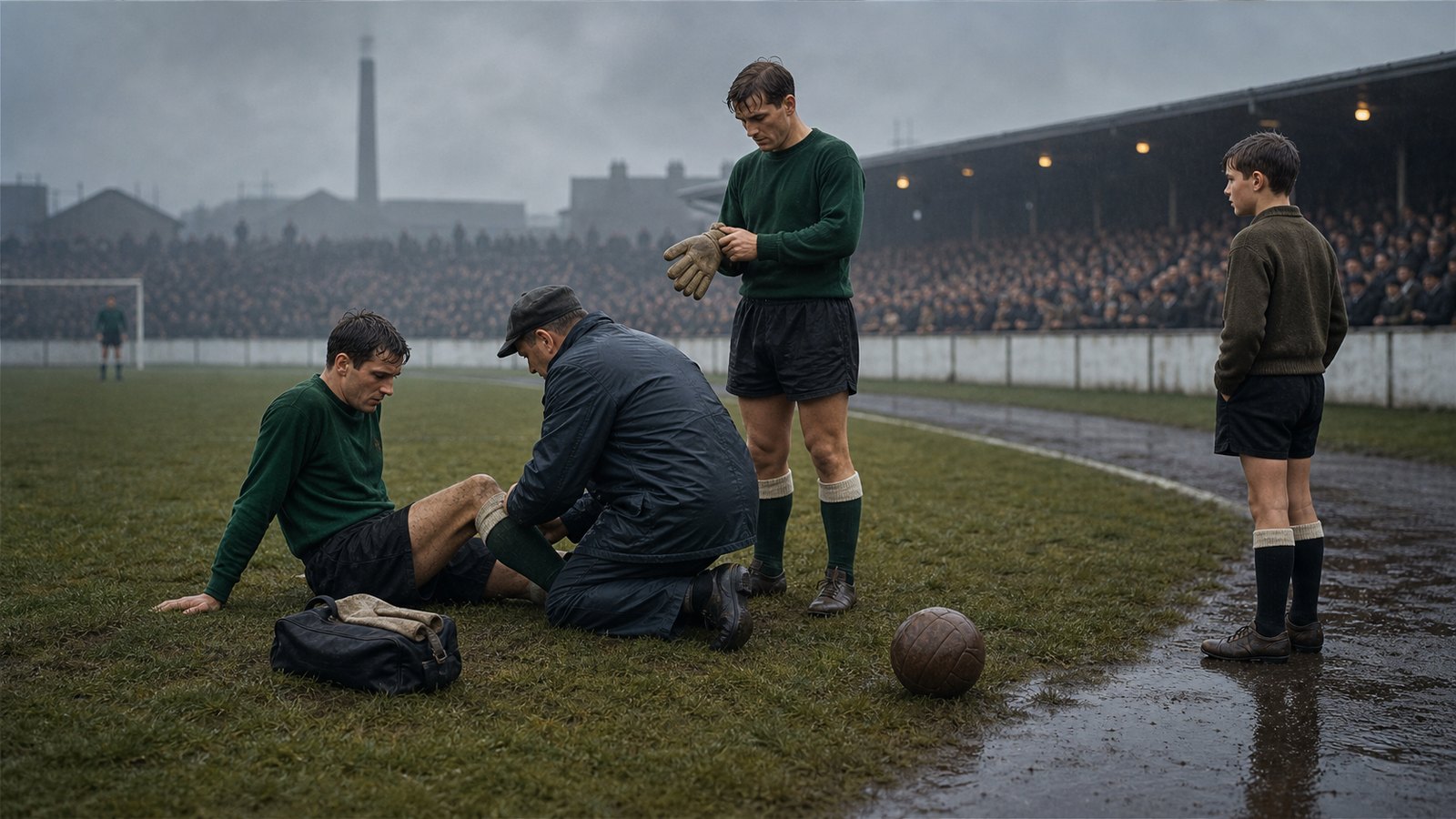
Peacock later recalled that he had assumed an appearance was unlikely. Players were expected to continue through pain, and the new rule applied to injuries alone. In his description, it could take a broken leg or a deep head wound before departure felt acceptable. The reserve’s fully buttoned kit was less a promise than a reminder that somebody else’s afternoon had to go badly first.
Eleven minutes at Burnden Park
The setting was Burnden Park, Bolton’s old ground, on the first day of the league season. Stokoe had informed Peacock shortly before the match. Then Rose’s injury compressed the rulebook experiment into its first quarter of an hour. Peacock crossed the touchline, Hewie went in goal, and the match continued with Charlton restored to eleven players.
The result did not give the moment a heroic finish. Bolton won 4–2. Peacock said he did not understand the wider significance until he saw a small report in a Manchester football results paper that evening. There was no ceremony waiting by the tunnel and no sense that every future tactical substitution could trace part of its ancestry to this practical response to an injured goalkeeper.
Thirteen substitutes were used across the Football League’s opening day under the new rule. Peacock was simply the first through timing. Another landmark arrived that afternoon when Barrow’s Bobby Knox came on against Wrexham and became the first substitute to score in a league match. Four months later, Knox replaced goalkeeper Ken Mulholland at Doncaster and saved a penalty. The supposedly narrow injury provision was immediately producing roles nobody could have planned neatly.
A rule created for damaged teams
The Football League’s decision followed years of pressure. A sequence of FA Cup finals had made the cost of injury impossible to ignore: a player could be hurt, a spectacle could tilt, and the rules offered no repair. Allowing one reserve addressed that unfairness without yet granting managers a free tactical hand.
Substitution itself was older than the 1965 rule. Nineteenth-century match reports contained stand-ins, often for players who had not arrived on time. Modern-style replacements had appeared in qualifying for the 1954 World Cup, where Richard Gottinger replaced Horst Eckel for West Germany against Saarland. Yet World Cup finals did not permit substitutes until 1970. Football’s competitions adopted the idea unevenly rather than through one universal announcement.
The first English version remained intentionally restrictive. The substitute could replace an injured player, not rescue a poor plan. That distinction was meant to preserve the moral character of the starting selection. A coach could insure his team against physical loss, but he could not openly acknowledge after half an hour that he had chosen the wrong winger or needed a second striker.
Usage was consequently sparse. The Guardian’s history of the rule notes that West Bromwich Albion made a first substitution on 10 September 1965, waited until 27 November for the next, and used a replacement in only seven of 42 league matches that season. A substitute was visible, but he had not yet become part of a manager’s normal match rhythm.
When injury became an alibi
The restriction created its own enforcement problem. If tactical changes were forbidden but injury changes were legal, the referee had to distinguish pain from convenience. Suspicion grew that players were feigning injuries so their managers could alter a match. The rule that was supposed to be medically tidy depended on judgments that were anything but tidy.
In 1967 the Football League accepted the practical answer and allowed substitutions for any reason. The effect was immediate. West Brom used a substitute in half of its league matches in 1967–68, a sharp rise from seven appearances two seasons earlier. The bench could now respond to shape, fatigue, scoreline and individual performance without requiring a theatrical limp.
This was the deeper change hidden behind Peacock’s eleven-minute entrance. The 1965 rule protected teams from losing a body. The 1967 relaxation gave the manager a new decision. Once that decision was legitimate, football acquired a second selection point inside the match itself. The starting lineup no longer contained the whole tactical plan.
From reserve to match intervention
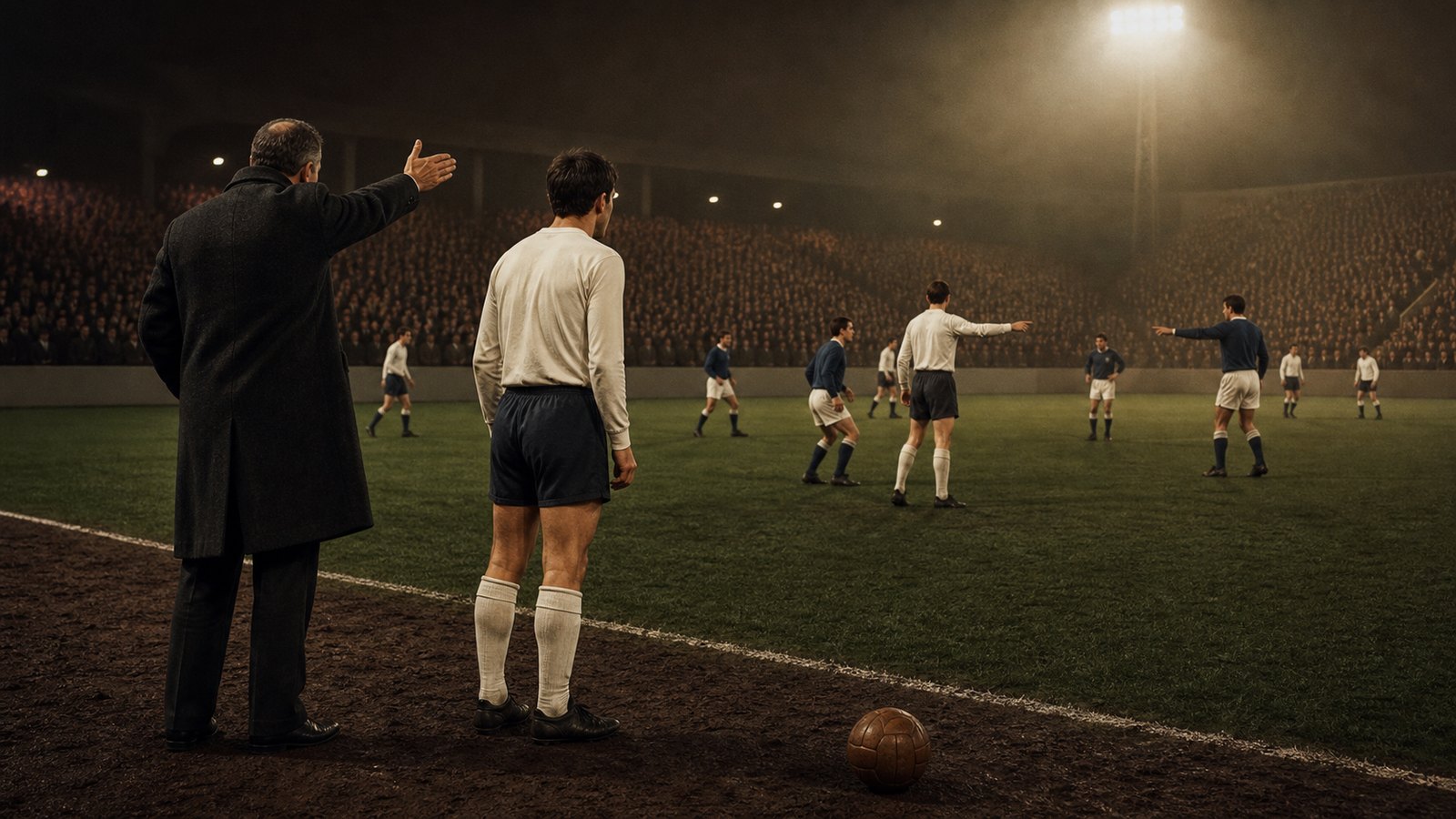
Modern viewers read the touchline differently because substitutions became expressive. A defender warming up can signal that a lead will be protected. Two forwards at once can advertise urgency. A replacement goalkeeper may be prepared for a shootout. None of those meanings belonged to Peacock’s first walk onto the field. He entered because Rose was hurt and because Charlton finally had permission to restore its headcount.
The transformation also altered how squads were built. A single injury reserve demanded versatility, as Charlton’s rearrangement showed. Larger benches later let clubs hold specialists for different match states. The substitute moved from emergency cover to tactical resource, then to a carefully managed part of workload, pressing intensity and tournament planning.
That evolution belongs beside other rule changes that made football’s familiar visual language. Ken Aston’s traffic-light idea gave referees a way to communicate cautions and dismissals across languages; the story of how cards entered the game shows another practical problem becoming a worldwide ritual. Substitutes followed a similar path. A narrow solution eventually became so normal that its absence is now difficult to imagine.
Peacock’s own career was much larger than one footnote. He made more than 500 Football League appearances for Charlton between 1962 and 1979. Yet his first remains uniquely useful because it captures the change before football understood its scale: one disappointed 20-year-old, one injured goalkeeper, one hurried reshuffle and a 4–2 defeat.
The small notice that announced a new game
Peacock found the milestone in a results paper after the match. That modest discovery fits the event better than a grand unveiling would have done. The first substitute did not enter to score a winner, reverse a final or reveal a tactical masterstroke. He entered because the new rule had encountered exactly the kind of accident it was written to solve.
What followed came in stages. The Football League allowed one injured-player replacement in 1965. The FA Cup and Scottish football followed with their own firsts. Tactical use became legal in 1967. The World Cup finals accepted substitutes in 1970. Each step moved the bench farther from passive insurance and closer to the active command centre familiar today.
At Burnden Park, however, the future still looked like a young midfielder waiting beside the pitch in full kit, expecting not to play. Eleven minutes later, the boundary of the match had expanded. A team sheet was no longer a closed document, and the people outside the white line had acquired a lawful way to enter the story.
Sources
News Shopper; The Guardian / When Saturday Comes; English Football League; Soccer History.