
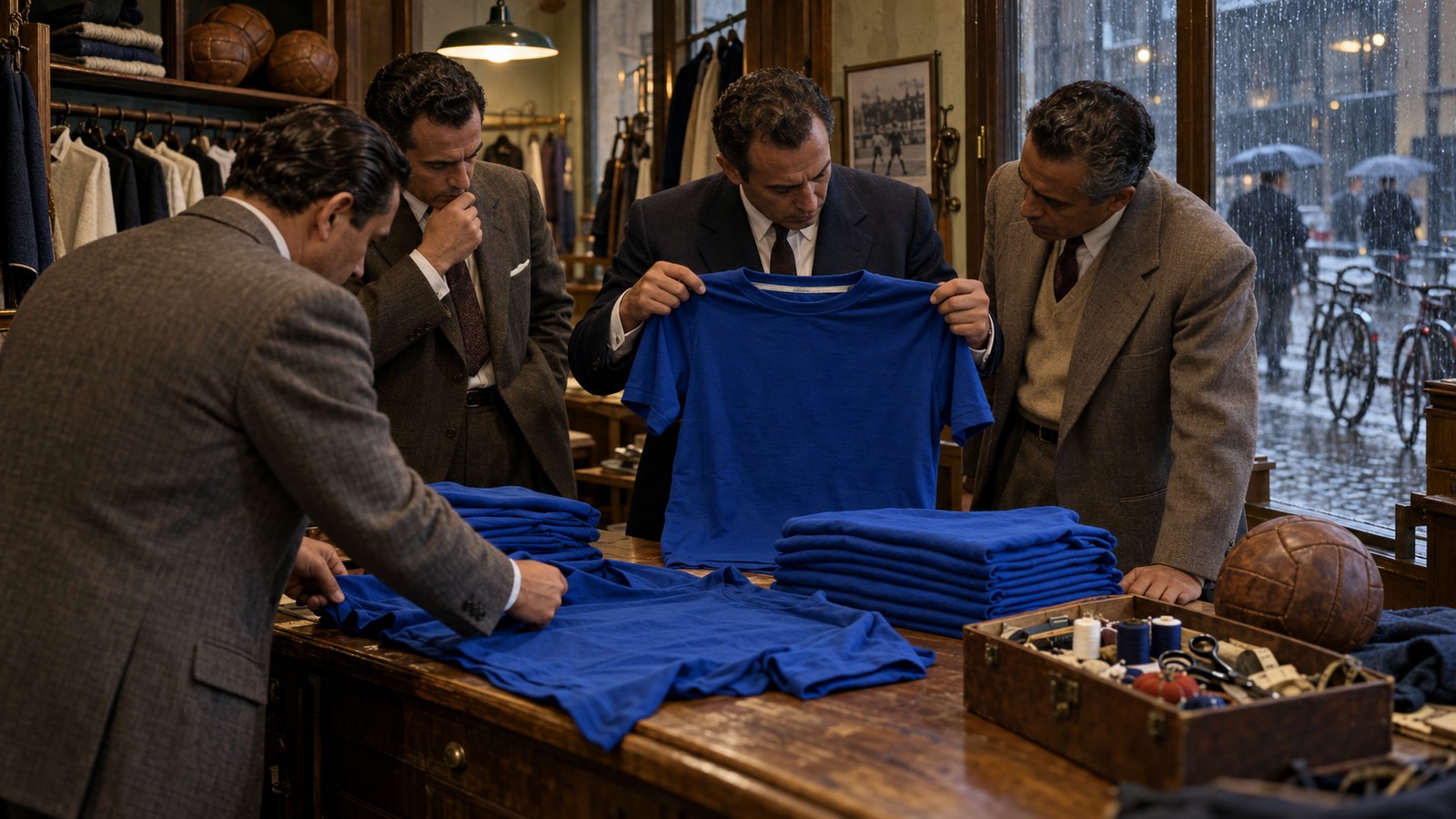
Somewhere in Stockholm, 22 ordinary blue shirts had to become Brazil shirts. The national team had reached the 1958 World Cup final, but Sweden also wore yellow and had won the right to keep its first-choice strip. Brazil had no prepared change kit. The solution was not waiting in a federation trunk or a designer’s studio. Blue shirts were bought in the host city, then given the emblems that made them usable on football’s largest stage.
That hurried alteration did more than solve a colour clash. It placed Brazil’s first World Cup victory inside a longer argument about what the national shirt meant. Eight years earlier, white had been associated with defeat. Five years earlier, a newspaper competition had produced the yellow design that became the country’s visual signature. Now, for the match that would fix that signature in global memory, Brazil could not wear it.
The blue shirts therefore carried two histories onto the grass at Råsunda: a deliberately rebuilt national image and a practical improvisation made necessary by the final itself.
White Carried the Memory of 1950
Brazil’s familiar yellow shirt was not timeless. Before it existed, the national side played in white shirts with blue collars, white shorts and white socks. Those colours were in use when Brazil hosted the 1950 World Cup and entered the decisive match against Uruguay at the Maracanã needing only a draw to finish first in the final group.
Uruguay won 2–1. The defeat was immediately larger than a scoreline because the tournament had been staged as a national showcase and the decisive match had unfolded before an enormous home crowd. The white strip became part of the reckoning. It was criticised as insufficiently patriotic and as a poor reflection of a flag built from green, yellow, blue and white.
That reaction matters to the 1958 final. When a clash with Sweden raised the possibility of returning to white, the colour did not feel neutral. It carried the memory of the Maracanã. A change strip could not be treated as a purely technical choice when one available colour had become attached to the country’s most painful football afternoon.
A Newspaper Competition Rebuilt the Palette
In 1953, the newspaper Correio da Manhã opened a competition for a new national kit. The instruction was unusually strict: the design had to use all four colours of the Brazilian flag. The winning strip was intended for the 1954 World Cup in Switzerland, giving the contest a deadline as well as a symbolic purpose.
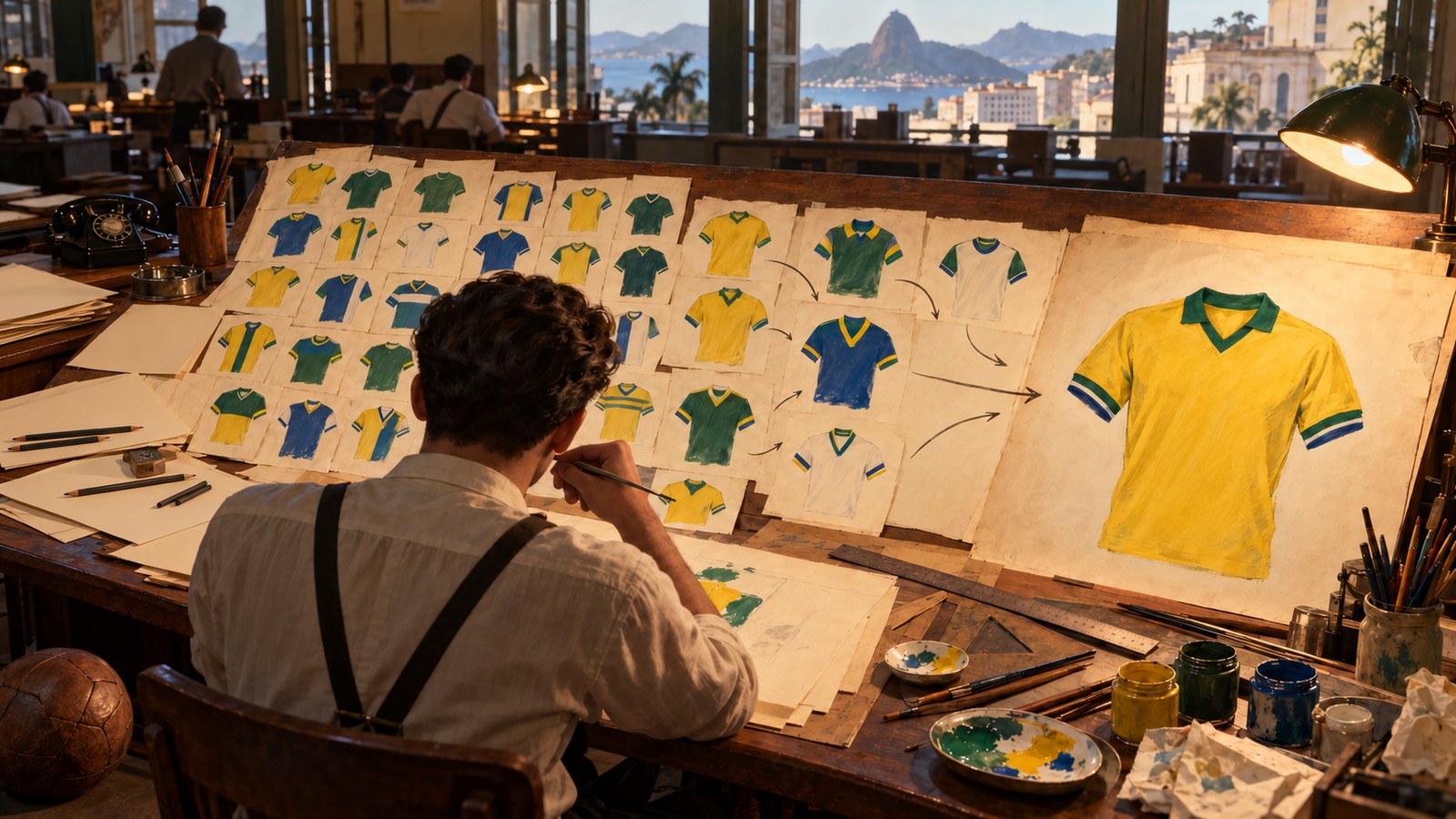
Aldyr Garcia Schlee, a young illustrator from Pelotas near the Uruguayan border, worked through roughly 100 combinations. Hoops, stripes and chevrons all offered ways to satisfy the brief, but adding four colours without producing visual noise was difficult. Schlee’s eventual answer made yellow dominant, placed green around the collar, used blue for the shorts and kept the socks white.
The judges chose that arrangement from 401 entries. Its achievement was one of hierarchy rather than mere inclusion. Every required colour appeared, yet the shirt could still be recognised instantly from the stands. Brazil first wore the new colours in March 1954, beating Chile 1–0 at the Maracanã. By 1958, yellow was established as the primary shirt, even though it had not yet accompanied a World Cup triumph.
The redesign explains why the later refusal to use white was not simple superstition. The yellow kit had been selected through a public attempt to make the team visibly national after 1950. Going back would have reversed that project on the day when Brazil hoped to complete it.
Sweden Owned the Colour Brazil Expected to Wear
The 1958 final paired Brazil with the host nation at Råsunda Stadium in Solna, near Stockholm, on 29 June. Both sides normally wore yellow. A draw was arranged to decide which team could retain its first-choice strip, and Sweden emerged with the right to do so after Brazil declined to take part in the draw.
That left Brazil responsible for finding a contrasting colour. White was considered and rejected. The delegation also lacked a ready-made alternative in its equipment. According to Carlos Alberto, the solution was to buy 22 blue T-shirts in Stockholm and add Brazilian emblems to them.
The number makes the scene concrete. This was not a polished launch of a second uniform with months of manufacturing behind it. It was enough shirts for a match squad, acquired because the final demanded a visible distinction between two teams. Blue was already present in Brazil’s flag and in the shorts of Schlee’s winning design, so the improvised strip remained inside the palette chosen in 1953 even while changing the team’s most prominent colour.
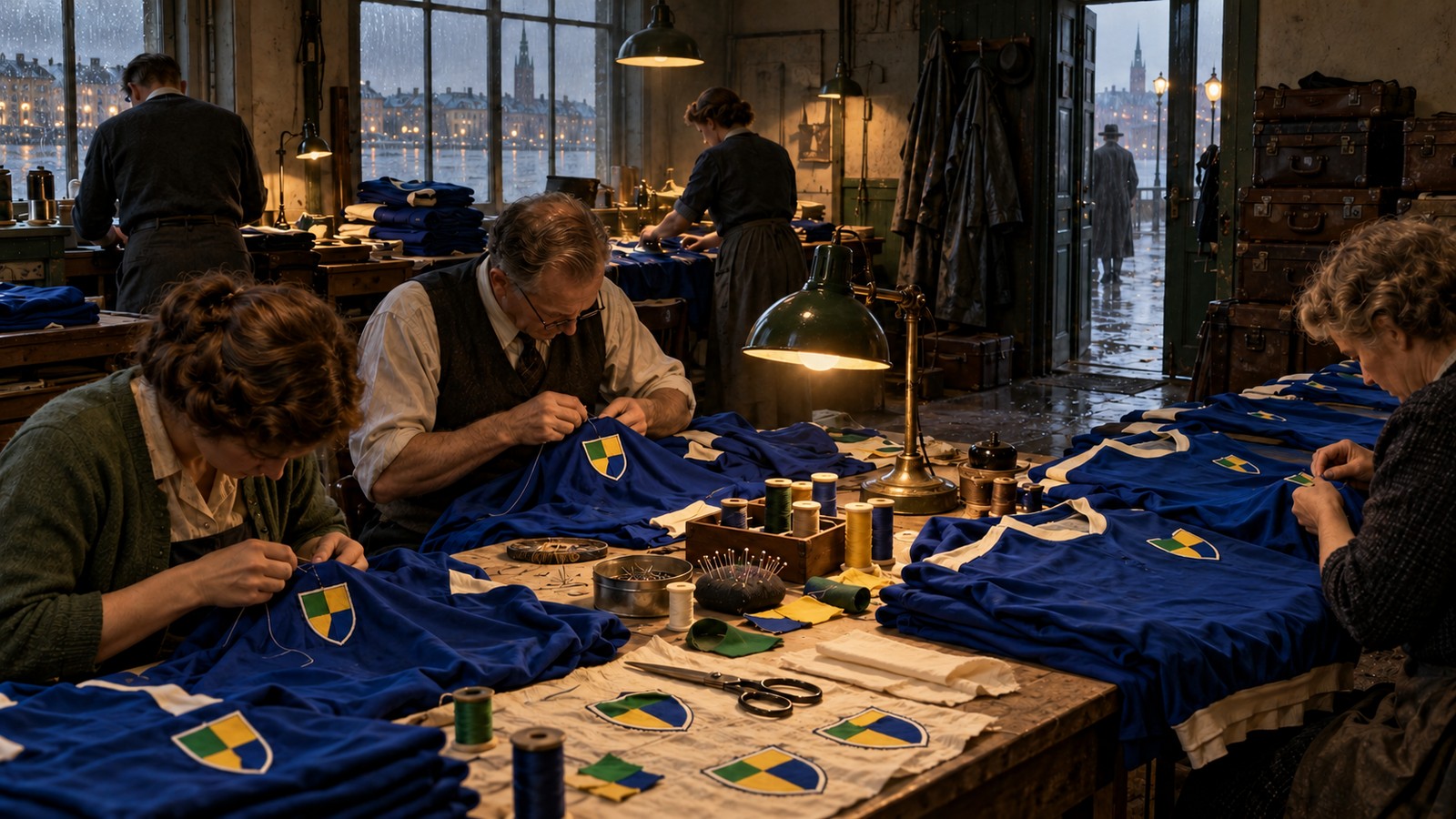
The emblem did essential work. Without it, the shirts were retail garments. With it, they could represent the national side. The transformation was small in materials but enormous in setting: stitching and cloth had to bridge the gap between a shop purchase and a World Cup final.
Seven Goals Made the Emergency Shirt Historic
The final did not wait long to become difficult. Sweden captain Nils Liedholm scored after four minutes, placing the hosts ahead while Brazil were still settling into their unfamiliar blue. Five minutes later, Vavá equalised. He scored again in the 32nd minute, and Brazil went into half-time leading 2–1.
Pelé extended the lead ten minutes after the interval with the goal that became the match’s most durable piece of action: control inside the area, a lift over a defender and a finish beyond goalkeeper Kalle Svensson. Mário Zagallo made it 4–1 midway through the half. Agne Simonsson reduced the deficit with ten minutes left, before Pelé headed Brazil’s fifth in stoppage time.
The 5–2 result delivered Brazil’s first World Cup. It also made the final the highest-scoring in the competition’s history. Pelé, 17 years and 249 days old, became the youngest scorer in a World Cup final; Liedholm, at 35 years and 263 days, became the oldest. The match joined a new visual object to those records: Brazil’s first championship had been won in blue rather than in the yellow created for the national team.
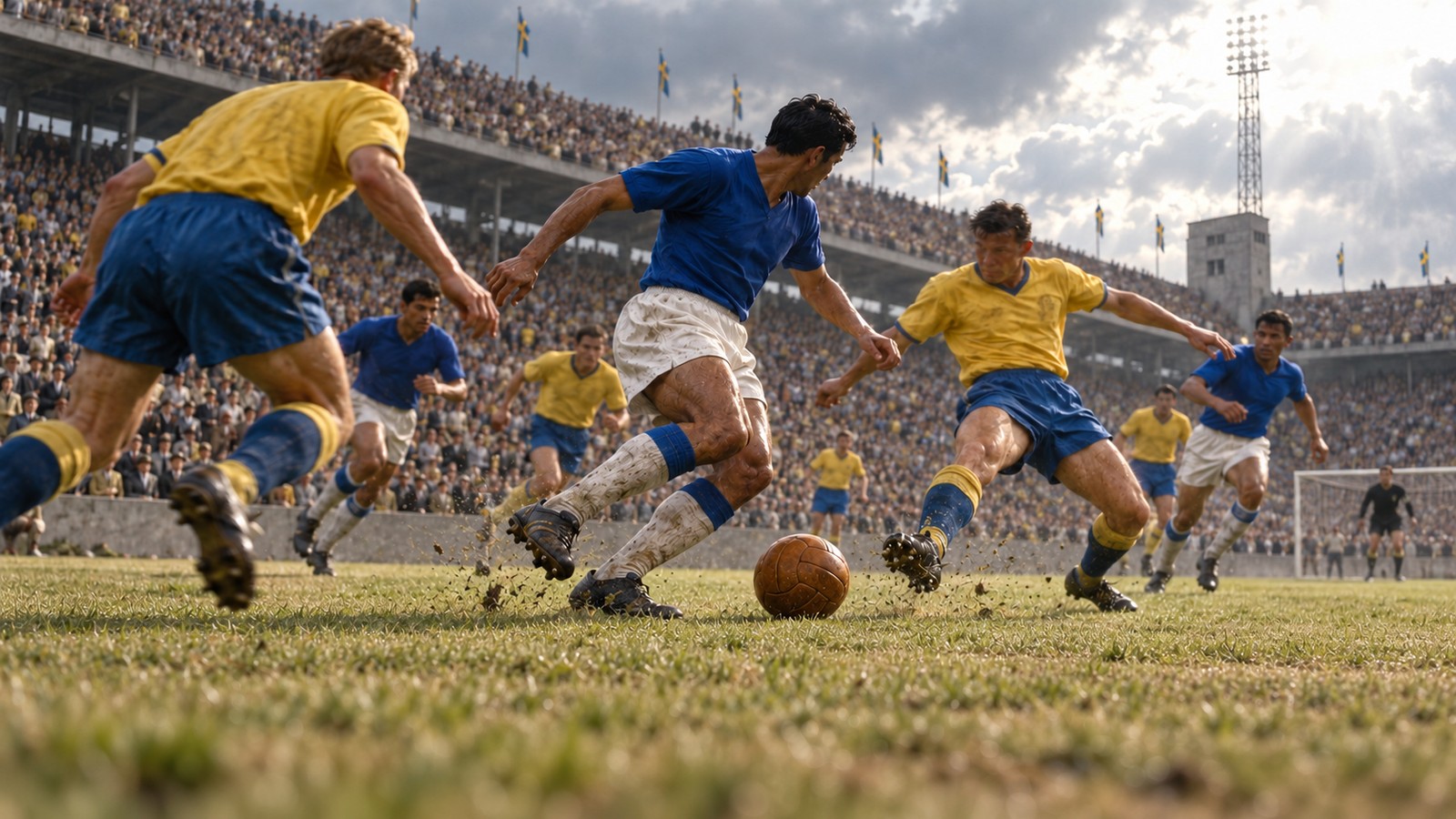
That irony did not weaken the yellow shirt. It strengthened the story around it. Brazil had reached the final through the identity built after 1950, then protected that identity by refusing the old white and improvising within the flag’s colours. The substitute strip became evidence that the new image could bend without being abandoned.
The Exception Helped Define the Icon
Much of the international coverage of the 1958 tournament remained black and white, limiting how many viewers could immediately appreciate the colour change. Brazil’s yellow became even more globally visible at the 1970 World Cup in Mexico, the first tournament widely encountered through colour television. By then, the shirt was connected not only with victory but with a style of play represented by Pelé, Jairzinho, Tostão, Rivelino and the sweeping team move finished by Carlos Alberto in the final.
Yet the blue shirts of Stockholm reveal how icons are often built through interruption. The yellow jersey had emerged from a national competition, but it was absent from the exact match that gave Brazil its first star. Its meaning survived because the team’s colours had been designed as a family: yellow, green, blue and white, arranged with one dominant element but never reduced to it.
The episode also separates branding from certainty. Today, an international team arrives with several manufactured kits, documented colour approvals and commercial release plans. Brazil arrived at its defining 1958 match without a usable second shirt. The federation’s visual identity was strong enough to make white unacceptable, yet its logistics were loose enough to require a local purchase.
Those two facts belong together. The 22 blue shirts were not a rejection of the yellow jersey. They were the improvised protection of everything the new colours had come to represent since 1953. When Brazil lifted the trophy in blue, the exception completed the icon rather than replacing it.
Sources
BBC Sport, “The story of Brazil’s ‘sacred’ yellow and green jersey”; FIFA match record, Brazil v Sweden, 1958 World Cup final; 1958 FIFA World Cup final historical record.