
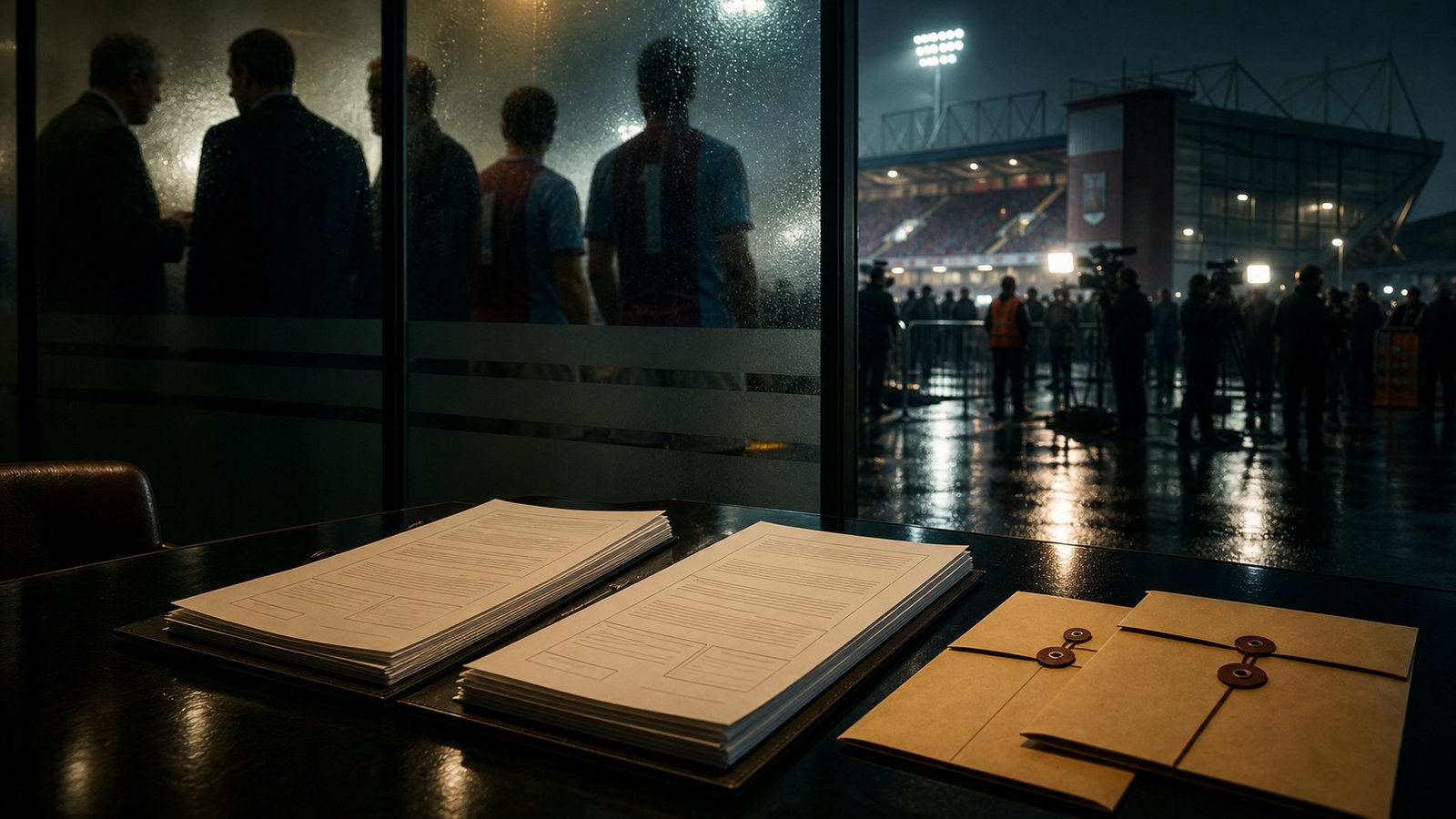
The most important action in West Ham’s 2006–07 season did not begin with a whistle. It began with an independent commission reading private agreements line by line. On 27 April 2007, with the club fighting relegation, the panel published a judgment about the registrations of Carlos Tevez and Javier Mascherano. The famous number was £5.5 million, then a record Premier League fine. The more revealing details were smaller: £2 million, £150,000 and even £100,000. Each figure sat inside a clause that helped answer a basic question. Who actually controlled what happened to the players?
The case is remembered as an argument about punishment. West Ham escaped a points deduction, Tevez helped them stay up, and Sheffield United went down. The commission’s reasoning came first: it reconstructed a frantic deadline, separated registration from economic power, and treated hidden paperwork as a breach of trust. Survival made the verdict explosive; the contracts made it possible.
Deadline week linked two players to a takeover conversation
The last week of August 2006 was crowded even by transfer-window standards. West Ham were discussing a possible takeover led by Kia Joorabchian while also trying to acquire two Argentina internationals from Corinthians. The commission found that the conversations were linked. Carlos Tevez’s private agreement with MSI Group and Just Sports was dated 30 August. Javier Mascherano’s deed with Global Soccer Agencies and Mystere Services followed on 31 August, the day both players signed their Premier League employment contracts.
That timing mattered because the summer window closed at midnight on 31 August. Club officials were working against the registration deadline while the Premier League’s company secretary, Jane Purdon, was responsible for the formal process. The later judgment examined disputed telephone calls involving Purdon and West Ham’s legal and commercial director Scott Duxbury. Its larger finding was unambiguous: the private agreements should have been disclosed, and they were not.

Rule U18 was concerned with power rather than labels
West Ham admitted breaches of two Premier League rules. Rule B13 required clubs to act toward the league and one another with the utmost good faith. Rule U18 prohibited a club from entering a contract that gave another party the ability to influence its policies or the performance of its team. The second rule did not require proof that an outsider had ordered a substitution, selected a lineup or deliberately changed a result. The prohibited thing was the contractual ability to exert material influence.
The commission listed the dangers it saw in third-party economic rights. An outside company could seek to decide when and where a player moved, block a transfer the club wanted, prevent termination of a contract or weaken the club’s disciplinary control. Those interests might conflict with the player’s wishes and the sporting needs of the team employing him.
The panel explicitly said there was no evidence that the third parties had tried to influence West Ham’s performance. The clauses nevertheless gave them leverage over future decisions. A club could field a player while holding less practical authority over his next move than the registration suggested.
A £100,000 option showed where control could move
The Tevez agreement made that leverage concrete. MSI and Just Sports were described as owning his economic rights. They held a unilateral right to terminate his West Ham contract during the January 2007 transfer window by serving notice and paying the club £2 million. In a later UK transfer window, the corresponding payment could be only £100,000. The agreement said the club and player had no right to object.
Other clauses required West Ham and Tevez to inform the companies about circumstances that might lead to a transfer. Transactions involving his rights were to follow their written instructions, and the club could not change or terminate the employment agreement without prior consent. Tevez wore West Ham’s shirt; decisive parts of his exit route belonged elsewhere.
Mascherano’s deed used different figures but raised the same concern. West Ham held his federative rights while two companies held the economic rights. If those companies served notice during a transfer window, they could direct a move and pay West Ham £150,000, subject to conditions about the destination league and the player’s terms. The two deals were not identical. They converged on the point Rule U18 was designed to test: an unaccountable third party had contractual tools capable of shaping a club’s squad policy.

The undisclosed documents became a breach of trust
The case was not confined to complex ownership arrangements. Its harshest language concerned disclosure. The commission concluded that West Ham officials knew the league was unlikely to approve the private contracts and decided to keep them from the competition. On 1 September, when press speculation prompted questions, the league sought confirmation about any third-party arrangements. The panel accepted Purdon’s account over Duxbury’s where their recollections differed.
It also found that chief executive Paul Aldridge later gave Premier League chief executive Richard Scudamore a direct assurance that there was no undisclosed documentation. The judgment described three parts of the good-faith breach: failure to disclose the contracts, misleading Purdon and misleading Scudamore. For a competition organised as a joint venture of member clubs, hidden terms were not just an administrative omission. They deprived the league and rival clubs of the information needed to apply rules everyone had accepted.
The documents surfaced on 24 January 2007, when finance director Nick Igoe forwarded them after learning that the league was preparing a report on third-party ownership. That cooperation counted in West Ham’s favour, but the disciplinary process now reached its climax when a points sanction would have immediate consequences.
The panel chose a record fine instead of certain relegation
The commission said the breaches could have justified a points deduction and described them as serious enough to involve dishonesty and deceit. It nevertheless decided that removing points in late April would be disproportionate. West Ham had pleaded guilty, the club was under new ownership, and the delay meant a deduction at that moment would almost certainly send the team down. The panel also considered the players and supporters, who had spent months fighting relegation under the threat of punishment.
There was another uncomfortable factor. Tevez had played more matches after the contracts were disclosed than before. The league had possessed the power to terminate his registration but had not done so immediately. The judgment reasoned that compliant arrangements might have been created earlier, as happened when Mascherano moved to Liverpool under a different approved structure.
The financial calculation was designed to punish and deter. The panel noted that West Ham had obtained two international players without paying transfer fees, that Premier League survival carried large financial benefits, and that even relegation would bring an £11.5 million parachute payment. It said a contested case proved against the club might have produced a fine near £8 million. Credit for the guilty plea reduced the total to £5.5 million: £2.5 million for the third-party influence breach and £3 million for the failure of good faith.

Survival made the contract case impossible to contain
West Ham’s season kept the judgment alive. Tevez remained available after the club changed its position over the offending agreement. His late goals helped carry West Ham out of the bottom three, and he scored in the final-day victory at Manchester United that confirmed survival. Sheffield United went down. A dispute over contractual influence had become inseparable from league position and the value of staying up.
The panel did not find that an outside owner had instructed Tevez how to play. It found that West Ham accepted documents giving outside companies prohibited powers, then failed to disclose them. The sporting effect was debated for years; the mechanism was recorded in clauses, dates and payment options.
The smallest figures in the judgment therefore matter as much as the record fine. A £100,000 option could reveal more about control than the badge on an employment contract. A £150,000 payment could open a path for a company to direct a transfer. The £5.5 million sanction was the public consequence of those private rights—and of a league member deciding that its rivals did not need to see them before the players took the field.
Sources
- Premier League independent commission judgment, reproduced by The Guardian
- The Guardian — “Guilty West Ham hit with record Premier League fine”
- West Ham United 2006–07 season record